
Of sack truck and ashes
21st March 2021
Have you filled in your census form yet?
Hullo again. Regular readers will know by now that Andrew is an avid auction-watcher. Not just e-bay, but F'book Marketplace and traditional auction houses both on line and off. Steph too used to keep a close eye on the likes of Ellis Willis & Beckett but sadly they closed down. Early in the week Andrew had acquired a couple of lots from an auctioneers that was new to us, just outside Barnsley. His plan had been to take Wednesday afternoon off, borrow the van and head up to collect them, followed by dropping in on a friend (to collect something - social distancing as required). But I had a phone call first thing on Wednesday to say that the profiles I'd been waiting for were ready, so I shot off PDQ to collect them and some other bits, return to Darley Dale and unload so as to be back in time for him to take the van back north again. But as we ate lunch it became apparent that certain things going on with Andrew's work meant that he couldn't take the time off, and the friend wasn't there anyway, so I agreed to retrace my steps and collect the 2 lots from the Barnsley auction house. All I knew about them was that one was a sack truck with pneumatic tyres, and the other a lifting beam. Now, we have 3 sack trucks in the shed. One is a green one, a 'light duty' contraption that came from my father's and is gradually falling to pieces as it is not up to the loads we place on it. Then there's a red one that came through an Ellis, Willis (etc) auction from a bankrupt firm in Chesterfield. It too is showing some signs of being under-specified, and squeeks with any sort of weight on it. Then there's the blue one, which takes anything we care to put on it but is the heaviest of the three.
So I found this place on an industrial estate north east of Barnsley, and looked around as I figuered where to park the van. 'You look lost' said a man with a dog. I admitted that I'd never been here before. 'Follow me then' he said and the three of us went round to the office, where he took my details and stamped my sheet as a release note. 'One lot's in the lower yard, the other's in the upper yard. Louise will show you where they are' he said and passed me to this girl in her early twenties. Louise looked at the first lot number and took me on a guided tour of every sack truck in the place. As we stood by a blue one she said 'do you know what colour yours is?' 'No' I answered, 'but it has got pneumatic tyres' I added as I looked at the solid rubber tyres on this one, with a big chunk out of one of them. She got on her radio. I didn't catch all that was spoken but after several exchanges she said 'wait here a minute' and disappeared back to the office. I wandered around admiring the generators, compressors, cement mixers, vibrating thingies and all the other small plant they had. Louise returned with another lady. 'We're terribly sorry -' one began 'but we think someone's taken yours, will one of the others do?'. The others had all been solid tyred. They're ok on the concrete floor of the shed, but our access outside is on ballast and may account for the shortened lives of 2 or our 3 resident sack trucks, not to mention their tendency to eject their loads when they've a mind to.
The man and his dog turned out to be the boss - 'this has never happened before' he assured me. I told him that it has happened to me, not just with the trip I'd had to take out to the east coast last year but going back as far as the auction at RFS Engineering back in the 1990s, when I won a very good 'executive' office chair only for it to disappear before we came to collect it and I was palmed off with a chair little better than a dining room one. 'Have you come far?' asked the boss. 'Matlock, Derbyshire' I replied: in truth it was only 50 miles but it probably sounded farther away. I'd heard mutterings about giving me a refund but hadn't accepted that. I was about to when the boss turned to the two females: 'give him one of the new ones, it'll come out of your bonus'. Near where we were standing was an interior store room with a flat roof, and on top I could now spy 2 or 3 yellow contraptions in plastic bags. The older girl went off and got a step ladder, climbed up on to the roof and passed one bag down to Louise. The bag was covered in dust, but I could see the yellow frame, the seperate silver axle strapped to an upright and the pneumatic tyred wheel.
'Excuse me,' I said as the second girl started to descend the ladder 'I hate to be pedantic but shouldn't it have two wheels?' They looked. 'Oh yes' said Louise in embarassment, and her colleague went back up the ladder and returned with the second wheel. After that Louise pointed me to a ramp leading to the upper yard and said someone would see to me up there. I drove up and looked around at the deserted upper yard, but eventually a man appeared and Andrew's new lifting beam was located and slung in the back. I retreated from Barnsley with relief.
I was in the shed most of Thursday and could not resist assembling the profiles loosely. To recap, my first set of profiles which we assembled early last month - well, let's just say that the brackets that fit to the engine were correct (after all, I've fitted them to other R-R engines - most recently to RS8 - so they should be) but the ones that attach to the loco frame were not my finest creations. I had already noted that the ballast block on the 0-4-0 Fowler did not appear to be drilled quite the same as the 0-6-0. It now appears that in fact, Fowler drilled them the same, but that I just can't measure them properly. I'd also had a complete blind-spot in that I had tried to put a frame stretcher in to locate on a bit of side frame that wasn't even there, so the 'Mk 1s' been put on one side and maybe will be used somewhere else.
I'm not too familiar with Fowlers productions, but it was common practice on many locos to incorporate cast-iron ballast blocks as a cheap means of adding weight. Sentinel diesels are full of them, but you have to be careful putting loads on to fixing points as you can pull the threads out of cast iron far more readily than steel. When we came to repower Sentinel 0-6-0s to Cummins, we created a sub-frame to sit on the old R-R C8 mountings rather than cantilever across to the shorter 6-cylinder Cummins, but others just dropped in a Perkins 2006 and hung the engine to one side and seemed to get away with it. The trouble with a cast-iron block is that it is quite a pattern in order to produce one, and with the investment that represents, you don't want to be producing a different one for each version of loco you manufacture. When we came to strip out the damaged Leyland engine from 4240015, I was surprised to find that the ballast block included 4 clusters of mounting pads, but that the engine was bracketted by arrangements that cantilevered both fore and aft. Clearly, this ballast block was not designed to suit the Leyland engine (I suspect it may have originated for a 4-cylinder McLaren, that used to be Fowler's go-to engine firm) but rather than produce a new pattern/block, they just bracketted as best they could. Hence the 0-4-0 Fowler looks to have exactly the same ballast block, and the scheme I've got for the 0-6-0 should be directly repeatable on it.
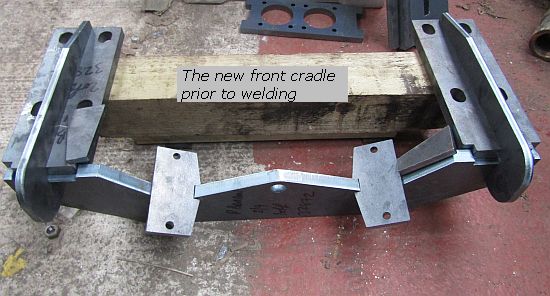
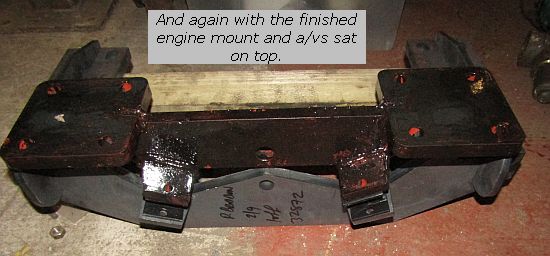
So the Mk2 frame mountings had been drawn up (after measuring the ballast block mounting clusters several times over to make sure I had it exactly right this time!) and if the rear mounts looked very similar (in fact, they had become left and right handed) the front mount was entirely new, and formed a cradle from the front mountings of the ballast block. As usual, my mountings use tab and slots to locate prior to tacking up, minimising the chance of errors in assembly and time in positioning parts together with magnets and so on before they are welded. The front cradle was particularly awkward as there was no room to gusset the important front piece underneath, so two ribs were added over the top. I decided to dry-assemble this on the shed floor, using timber to represent the flat pads of the ballast block. This became quite solid and so I tried standing the complete engine side of the assembly with the a/v mounts between. But that was Thursday, and I moved on to other jobs including the wrapping up of Claire which is very close to being ready.
Friday had me on other things, but first thing Saturday morning both Andrew and I were down at the shed as Adam was bringing the trailer back in for some mods and general TLC. They rolled up at about 08.55, and by quarter past nine the tractor unit was winging its way back, and as the weather was quite pleasant I made a start on the trailer neck. The Lister engine that powers the winch has a control panel that mounts on the end above the pump, so you have to climb up on the neck to start or stop it. The panel (in fact a box) has vibrated itself loose and the throttle control is about goosed, so after some thought I decided to relocate it under the neck next to one of the other boxes that contain the trailer hydraulics. Two brackets were recovered from some bits that were once on 14901, the old box was disconnected and a connector box mounted with an armoured cable down to where the old control box will be re-mounted. A new box back plate was cut and drilled and left out for painting.
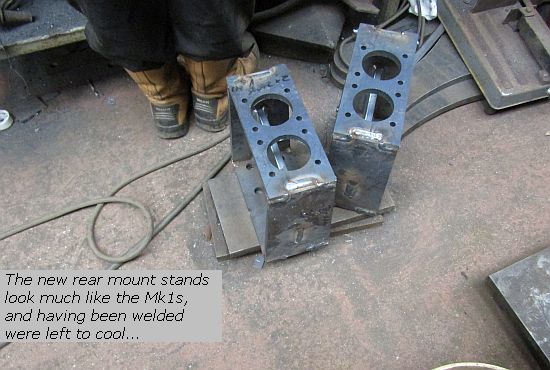
Andrew had therefore started welding up the new mounts for the Fowler, starting with the rears (that had been left ready on the fab' bench) and moving on to the front cradle. I carried the dry-assembled cradle and it stayed in one piece all the way to the bench. Meanwhile I had adjourned to the Fowler and remove each of the 16 bolts for the frame mounts, cleaned out the tapped holes in the ballast blocks (3/4 Whit) and run a die nut down each of the secscrews (well, 14 setscrews and 2 bolts).
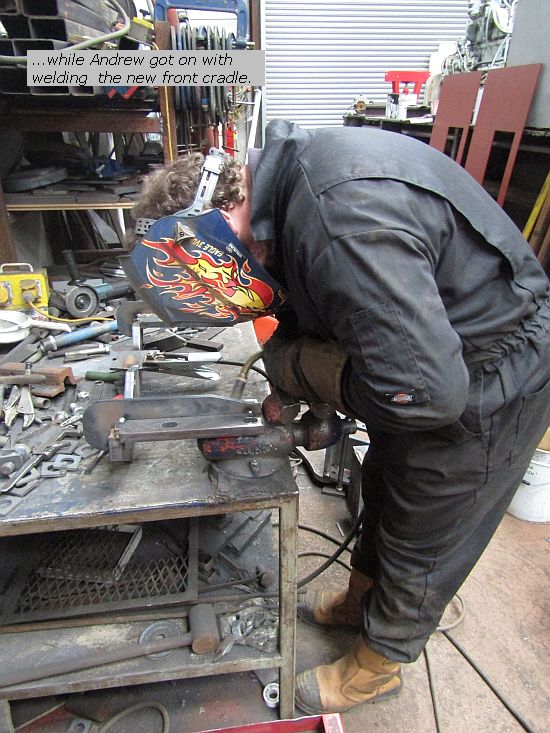
Andrew finished off by priming everything, confident that the brackets, still warm from welding, would aid the drying process.
Sunday, and the target was to get the C6T in and the gearbox out of the Fowler, as a group are collecting a lot of bits next week. Not as early a start as Saturday, but Charlie was fired up and brought the Fowler down to the shed. The first crunch test - would the brackets fit the mounting pads this time?
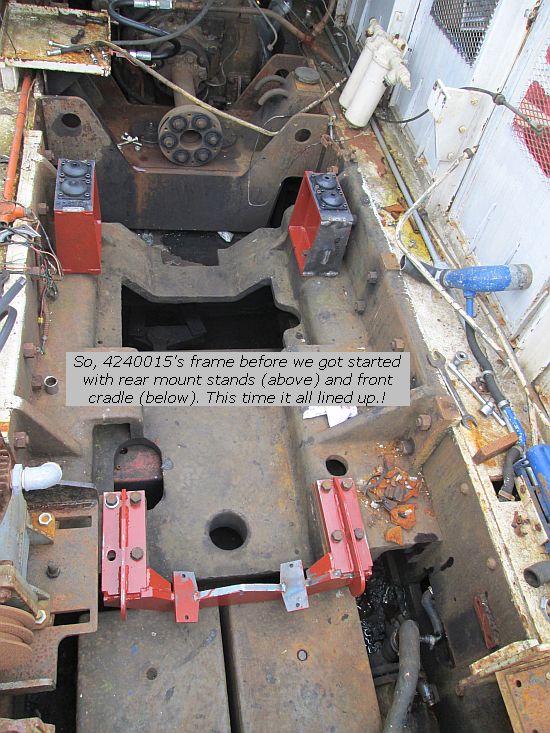
Yes they did - though the primer was still tacky and bits wlll need priming in situ. The engine has been sat waiting for a couple of weeks since we recovered it from the German flat wagon. We detached it from the bed frame and lifted it clear with the fork lift, before fitting the engine brackets in mid air. The rear mounts needed a bit of grinding - as did RS8's as I recalled - I must mod the profile a touch next time.
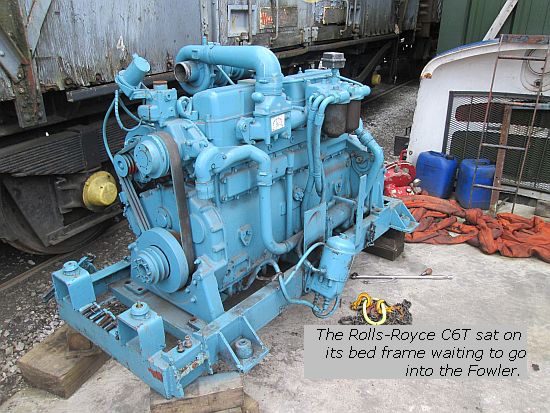
The engine was delicately lifted in. Everything looked good until- with an inch or two to go, we realised that the front of the R-R sump was fouling the ballast block at both sides. My mistake - well not exactly, I've no proper drawing of this sump on a C6 and no proper drawing of the ballast block, so it just hadn't shown up on my installation scheme..
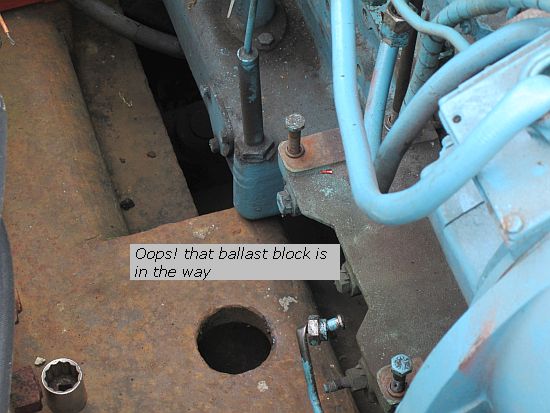
Nothing for it but to lift the engine out again and cut away the offending bits, which were fortunately only about an inch or so thick at that point, starting with the 12inch grinder. With a bit of cleaning up the engine was put back into position and the front mounts bolted down.
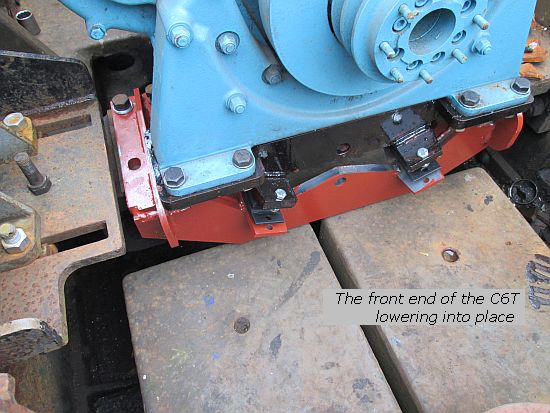
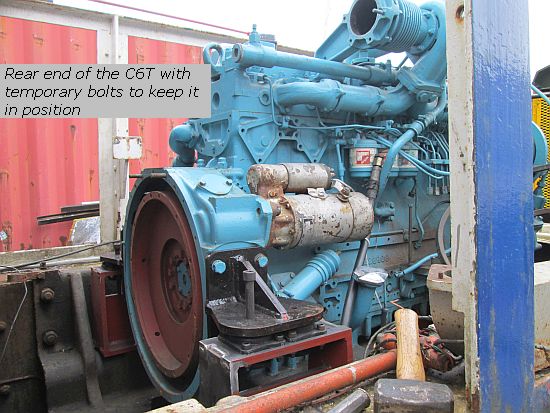
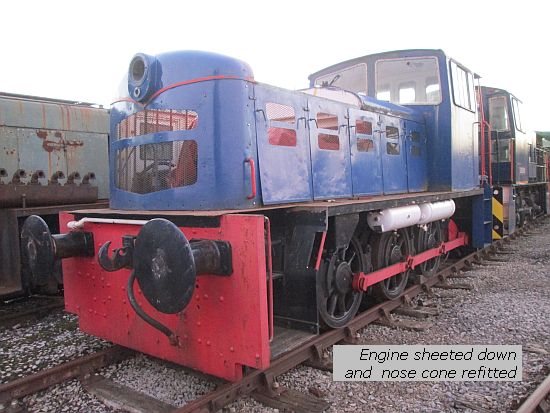
Some overly-long M16s for now locate the back end - until the converter is fitted these cannot be set up. The delay in cutting the ballast block mean that we had run out of time for lifting out the gearbox, but Andrew insisted on re-fitting the front nose cone as it was taking up space and would help keep weather off the engine, which we sheeted down anyway. So for now the Fowler 0-6-0 has a complete engine back in, we know what to do with the 0-4-0 which has a similar C6 earmarked for it, and I can move on with both projects as time or customers permit.
We did both agree though that installing the engine would have been much simpler had the Hatramm been available - we have 6ft forks on the forklift specifically so that we can reach the centre line of the locos but you know about it with an engine dangling on the hook. The Hatramm - wth a bigger hydraulic crane - would be more flexible.
And that's about it for this week. Plenty to be getting on with, Claire to finish, a traction motor for a Janus due to return, and the trailer to get ready for a number of forthcoming jobs. Care to come back next week? See ya then.