
Of King of the hacksaw
28th March 2021
Looking back, it's been quite a productive week.
Usually, I start with a blank screen, write 'Of' and the date, then 'intro' and start writing the first real paragraph (this bit). And when I've got to the end, I search for a title and something to compose as that intro - the snippet you see that I hope encourages you to click on 'Read More'. Last week was unusual. Not only did I have a title in advance, I had an intro, to whit the refrence to the census. It is not that I am on some mission (or comission) to aid the government, but it hadn't been getting the publicity it has in past periods, but maybe it had too much news to compete with. Anyway, it got an interesting reaction: a couple of my regulars subtly questioned what it had to do with a railway-themed blog, but another thanked me for the timely reminder as he'd forgotten all about it and it had become buried!
It has been a busy week here in our little part of Derbyshire. I won't report all of it, but hopefully the interesting bits. First thing Monday a traction motor returned: this is for a commercial job that is sitting in the workshops, and has occupied some time in past weeks. After that I was out collecting brake blocks from the foundry, and on Tuesday dropping them in to Rotherham for drilling ready for despatch.
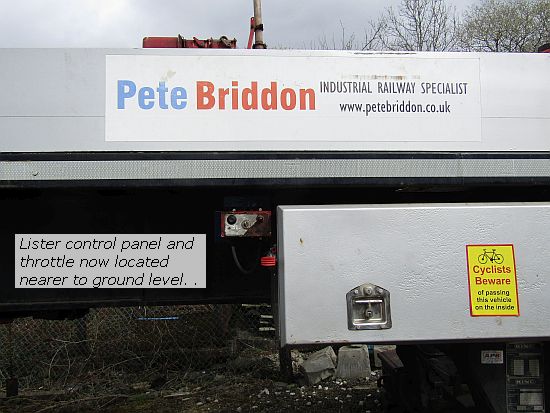
The trailer has of course been here with us all week and I had made a start last weekend making up the brackets ready to relocate the control box, but I didn't have a new throttle cable and my usual supplier for these things didn't have anything that appeared suitable and anyway their lead times would have probably meant that I would not have got anything in time. So I hunted around and found a supplier on-line with such things in stock to fixed lengths so ordered one with a 2metre cable that would be far too long but probably had the wrong end on anyway. It arrived the next day and on Friday I set up and drilled the trailer's hydraulic control box to accept the throttle lever and cabled up the Lister's control box now that I'd had wired it and painted the back. Although the original box had a big hole in the bottom thnrough which the cable entered (with such slop as to allow any rain water to get out), with the box now somewhere where it might see spray in transit I sealed the hole with a proper cable gland and added a nitrile rubber seal between box and back plate. That still leaves us to climb up on the neck to check the Lister over and shut it down afterwards (I simply haven't had time to consider how to set up a stop cable) but with an additional return spring fitted to the throttle lever it should be a whole lot more convenient to operate. I say should, and that's a worry: I've simply extended the wires between engine and control box and while I am pretty sure everything is cabled up correctly, I can't run the Lister with the pump attached and haven't had time to disconnect the pump, so the revised set-up remains untested.
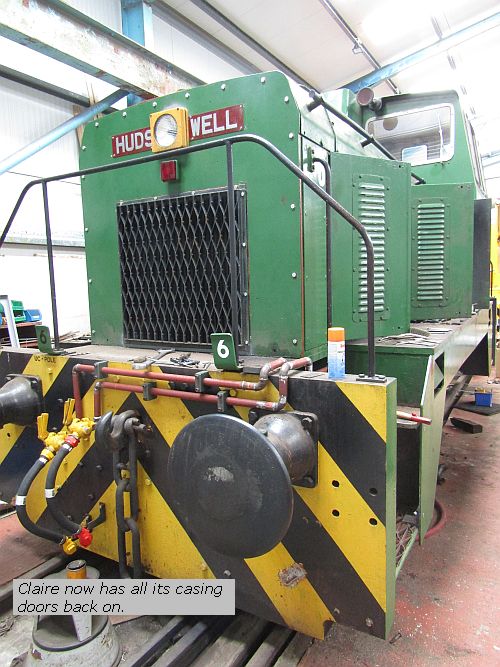
Anyway, during the week Andrew ordered up some timber for the floor of the cement van, and I some steel from Twiggs. Both were due to arrive on Friday, and last time it worked out that Twiggs loaded their vehicle last thing the previous day, and the driver started at 07.30 in the morning and we were his first drop, Sure enough at 07.45 I had a call from the driver and had to high-tail it down to assist unloading. Friday was a busy day indeed: I set off with the 12mm bar that had come from Twiggs and started cutting replacement hinge pins (on the hacksaw) for Claire, whose casing doors were due to be refitted. Hudswells in their wisdom used a headed pin made in ordinary steel through a thick walled tube also in ordinary steel. Surprise surprise the water gets in and corrodes, and sometimes the pins sheer when you come to open up. When we first worked on Claire we had a few new stainless steel pins manufactured, and even a couple of these stuck as the rust between outer tube and pin wedged them. When we came to Grace we had a better idea: short lengths of 12mm bar dropped in to the bottom half of the hinge (the fixed bit) and secured by drilling a hole through and fitting a mills spin. The casing door just drops on, and although water can get in, with plenty of grease applied it will take a long while to seize, but is easier, for reasions I won't try to explain, than the headed pins. Indeed, a worthhwhile suggestion has been made to cap the top of the tubes with a silicon sealant and stop moisture getting in altogether. We'll try that.
Meanwhile Jagger was on site and in between working on what we know as Jack, helped unload all 35 boards bought for the cement van floor and then cut them down into 2.37m lengths to slot into the slots to be found at the bottoms of the internal sides of said van. Sadly only some 8 of these got fitted - we must move the contents stored therein in order to remove more of the original floor.
The 0-6-0 Fowler was brought down to the shed and after various bits had been disconnected, the fuel tank was forked off and the change speed gearbox was lifted out. Of course, this was never as simple as it sounds. Two mounting bolts refused to be drifted out even after their heads had been gassed and ground off. Eventually we unbolted the bracket from the cross-stretcher and lifted that out too.
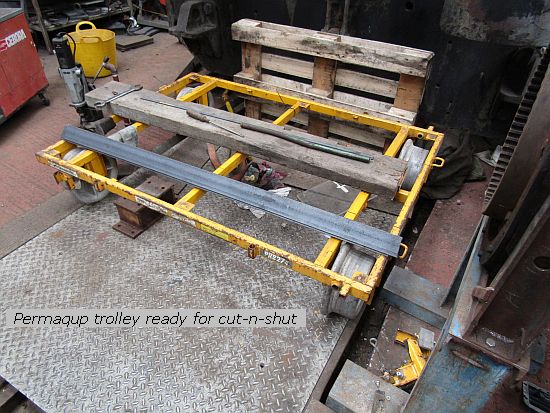
Saturday was similarly busy. I decided to try my hand at the 12inch grinder, and cut two lengths of 75 x 75 angle for the permaquip trolley. I don't think this has got a mention before so a brief introduction. Andrew has planned a short wheelbase trolley for purposes such as supporting a traction motor when detached from under a loco. However the present Janus sat in the shop arrived before he was ready, and we really didn't have time to start manufacturing a bespoke example. Equally we have several trolleys kicking around but all really too big and their owners would not thank us for 'adapting' them. Then Andrew saw a couple of Permaquip trolleys advertised at less than the cost of new wheels, so I dutifully went and bought one.
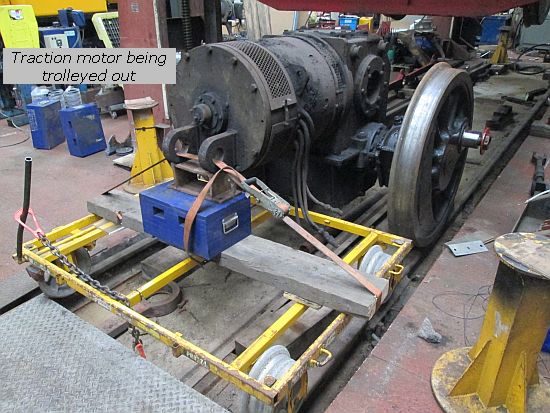
It got us our traction motor out, but is really too long (and seems a little flimsy) so will be reduced in a cut-n-shut exercise using these two substantial angles as the abutting faces. Here it is with the angles trimmed and waiting for drilling before surgery begins.
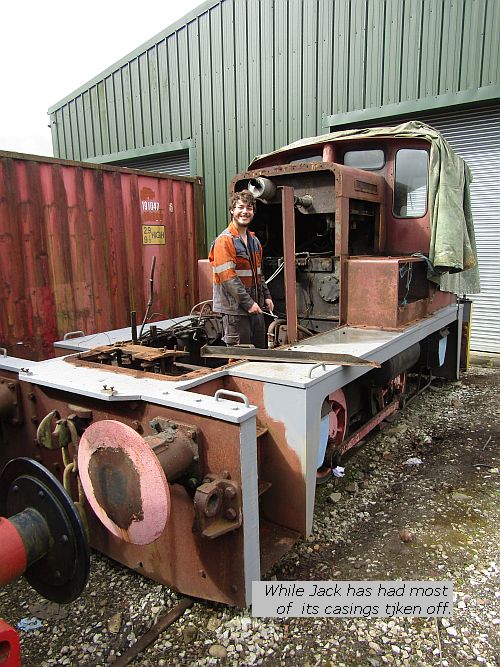
And so to Saturday. We got started fairly early as we were expecting a couple of guys from Tanfield who were to collect various parts from the 0-6-0 Fowler to help maintain theirs for the future. They weren't due until lunchtime, giving us a little while to get ready, for the radiator was safely in store in the PCV which meant drawing a couple of locos clear to get the forklift up to it, and the rest of road 1 back so that their vehicle and forklift could meet up. Charlie was struggling to pull the line on track 1 last week and I had decided to check the transmission oil level, and sure enough it was out of sight in the bottom of the level gauge. I might look at proper 'low level' warning switches in future. Anyway, topped up, the train was pulled back and we were not far from ready when a brand new king-sized Enterprise rental van arrived and we filled it full with engine parts, gearbox, converter, radiator and such that should help keep their 4240010 functional. One thing they had been promised was the silencer, but this was still in the casing top and the casing top still above the container, so things had be moved aside so that the forklift could bring it down and seperate it. We left the casing top on the ground, planning to fit it back on our 4240015 on Sunday and so afford more protection to the newly-installed Rolls'. (And hopefully confuse UKLocos who currently record it as 'uneconomic to repair'). After the van had departed, (and I was so busy that I took not one single photo of the proceedings) we lifted the casing sections off Jack (as was) ready to go for shotblasting.
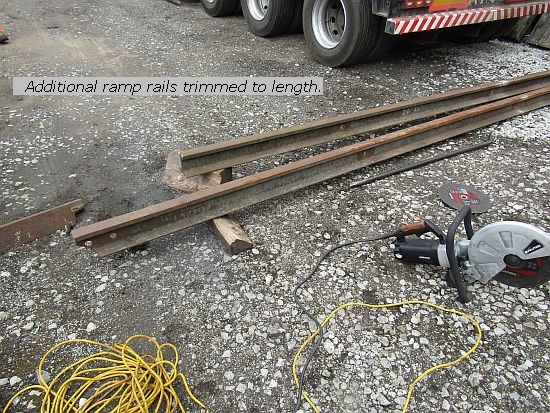
Andrew was angling to call it a day, but I reminded him that we needed to get on with the trailer works as putting it off until tomorrow was reliant on the weather. Consequently we adjourned to the trailer, dragging out two long rails from by the grey container that once were the deck rails before we bolted down the (squatter) crane rails, etc. These were to be cut square and to a common length. Then we used the forklift to recover the old winch bracket from the neck. This bracket you have seen in these pages long ago: we mounted the original winch to it holding it in the vertical rather than the horizontal, after Andrew calculated that the 4 M12 bolts which were expected to secure it to a flat surface had insufficient safety margin if the winch achieved anything near its maximum pull. In fact this winch performed only 11 operations before seizing up, and even this was accompanied by loud mechanical noises that did not inspire confidence, and 'tinging' as individual rope strands snapped. In the end, the drum end welds disintegrated, yet I'd had a pressure gauge on the hydraulics and knew that loading a loco required barely half the pressure it was supposedly rated at for a full 'pull'. We went out and bought a new winch, physically twice the size yet the same nominal pull, with better quality wire rope and secured with 4 M20 bolts. This howver, in the light of experience, was placed at the back of the trailer and the bracket for the old winch remained, acting as little more than a handrail when climbing on and off to get at the Lister.
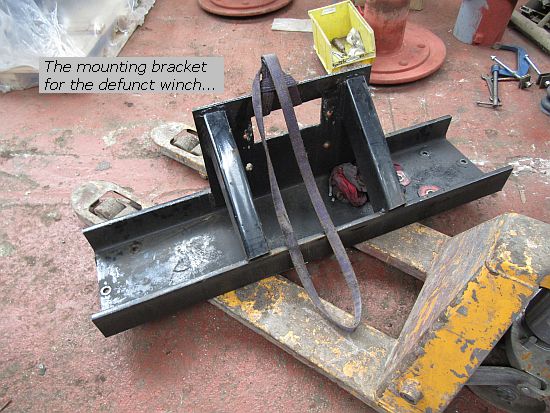
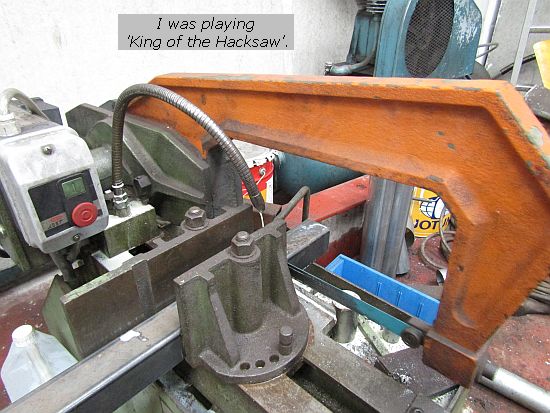
Up to now, the spare wheels have been strapped to the back of the trailer, but with upcoming loads requiring to use nearly the entire trailer length, they might be in the way and Andrew wanted to convert the winch bracket into a spare wheel holder. It was a late start on Sunday (academic as it was raining when we first arose), and I soon found myself in charge of the hacksaw, cutting box section for new tie bars and angle for the spare wheel carrier.
Charlie again drew track 1 clear so that forklift and gas bottles could get around the front, and Andrew cut the two rails to length and finding the holes no longer lined up, reluctantly cut new ones with gas ready for new tie bars.
He also cut a length of 30 x 50 (the last bit of our Twiggs order) in 2 to make 'rails ' that will go over the back axles. Then he came inside and working to a plan in his head built up the spare wheel carrier bracket. To save time (it was by now after half five) we refitted the bracket to the trailer neck, lifted the two wheels up and checked that they fitted, then blocked them temporarily clear so that I could squeeze in and prime the new steel.
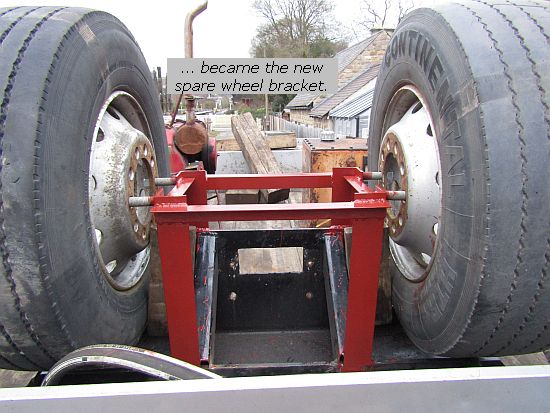
Meanwhile Andrew loaded the two long rails to the trailer and had 'rationalised' some of the timber that lives aboard as being unsuitable for further use. At this point it started to rain again: I dug a sheet out to try and keep the worst off the wet primer, then trudged up to Charlie and pushed the train back. Adam comes in to collect the trailer tomorrow: we didn't get some of the jobs we intended to do done, but all being well we can stay on top of things as work for the trailer is steadily rising.
I have tried to refrain from Peak Rail stories of late, but recent events, as reported in the Matlock Mercury, will have a bearing on Peak Rail's aspirations indirectly. For another group - MEMRAP (the Manchester East Midlands Rail Action Partnbership) who want the line through Bakewell re-opened as a passenger line back to Manchester - had their proposals unanimously rejected at a full meeting of the Derbyshire Dales District Council. One councillor claimed that reinstatement would cost billions (somewhat of an exaggeration,) that there was no commercial justification such that it would end up as 'just another tourist railway'. Moreover, it was stated that the public roundly prefer the trackbed as a walking/cycling/horse-riding amenity. Now, apart from the established fact that a tourist railway brings in a lot of revenue to the area it traverses, and the re-instatement cost would probably be only around £250-300m (based on 2004 estimates of £80-120m, with inflation and additional requirements today) you are up against a conserted campaign to prevent the re-instatement of the line which should not be under-estimated. And for this campaign we have to thank as much as anything the ill-judged public meeting held in Buxton a couple of years ago, at the height of Peak Rail's fantasy 'Quarry Consortium' which was going to re-instate the line for stone traffic. Unrealistic claims were made at that meeting which triggered the opposition we see now. MEMRAP may have copped for the council's ire but Peak Rail would be unlikely to fare better. At a previous (public) Peak Rail plc AGM a Director made a long (tediously long) speech outlining all the ways in which the railway had tried and failed to get the extension north started and how the Quarry Consortium was the 'last throw of the dice'. Without it, he said, the railway would NEVER get back to Buxton. In the last published accounts mention of the Quarry Consortium was conspicuous by its absence and in a reply to a question raised by a shareholder, the Board asserted there were no plans to extend north as it was not viable. In a normal environment the Peak Rail Board would now face reality and abandon plans to go any further, or stand down and let fresh blood take up the challenge. We will wait and see what it chooses to do. In my experience some Directors, like politicians, seem able to forget conveniently what they said before.
And on that pessimistic opinion I will wish you all a happy lockdown-easing week and hope you will be fit and healthy next time. See ya then.