
Of Buffer Towers
28th February 2021
March beckons. Can summer be far away?
The question I raised about reduced mpg in colder weather brought forth a couple of interesting responses. One put the issue down to lubricants, and their relative stiffness/viscosity at lower temperaures. Now there is certainly something in this, anyone who has had the pleasure of handling that dear old Motak (other brands are available) will be familiar with its characteristics and that at low temperatures it becomes remarkably stiff. (For those who are unfamiliar, Motak is a 'grease' that is used in traction motor gears. Even the word grease is misleading, one of my fitters once slapped a lump of it on to an inspection pit wall. We plotted its progress over the next 3 months, the time it took to slide to the bottom of the pit, leaving a long black trail behind it. P/way men may speak disparagingly about fishplate grease, that is nasty, sticky, highly transferable stuff, but Motak, in my opinion, trumps it.) Anyway, the problem with that argument is that after the first few miles, there ought to be enough heat in the engine and drive line to have warmed the oils/greases, and although I grant you the wind-chill factor will probably mean an operating temperature lower than on a hot summer's day, I can't see it being sufficient to cause the drop in mpg I consistently see. (It doesn't apply to all lubricants in your car, but your main sump oil is almost certainly a 'multigrade' oil to maintain lubrication and minimise 'drag' at all normal temperatures.)
Anyway, we had a job planned this week where the plan had been to crane the loco on. The customer had asked whether I had any advice on craneage and my reply was 'don't'. I had a list of reasons not to, including the first one of cost and going on through damage to loco superstructures, handrails, running plates, even bent side rods. Crane operatives tend to think that buffers make good lifting points if they can't see any proper lifting brackets - the buffer manufacturers probably wouldn't agree. One reason I must remember to add when I update that list is 'weather'. Suspended loads are susceptible to swaying in moving air, and high winds make the job unsafe. And so it was this week, when high winds got up just before the lift was due to take place and had the crane company saying 'no way'. It was a wasted day all round
Elsewhere snagging has continued on Claire. Many years ago (the drawing file says it was created in December 2005) I changed the piston on the clutch cylinder. The air system on this Hudswell Clarke is simple and for the most part, reliable. The clutch cylinder though is unique. Instead of buying a commercial, industrial air cylinder, Hudswell made their own, with a cast body and machined piston. But the piston rod is far, far thicker than you'd have on the equivalent industrial cylinder and in that is the principle on which it operates. The clutch 'out' direction is connected directly to the air system, and is on the piston rod side of the piston. The clutch 'in' side only receives air when the appropriate desk valves operates. When it does, of course, it only has the same air pressure as does the clutch 'out' side, but the 'in' side has the full diameter of the piston to act on, but the 'out' side has less area by subtracting the diameter of the piston rod, which is about 70% of the piston diameter. Thus when air comes on to the 'in' side of ther piston, it easily overcomes the same air pressure holding the clutch out and has sufficient force left over to put the clutch in as well. But remove clutch 'in' air and the clutch comes straight out without anything else to prevent it. (This principle of differential forces would apply to any industrial cylinder too, but there the piston rod is so small that the difference in forces would be minimal. If you want another example of this though, see how a vac brake cylinder works.) Now, so far I am impressed but then Hudswell have to spoil it all for me by mounting the cylinder horizontally. At the cylinder exit for the piston rod is a seal, but with the piston rod horizontal the weight of the piston rod is resting continuously on the bottom of the aperture and thus one part of the seal. And being thick, it isn't lightweight.
When we first acquired Claire and got it running, that seal leaked - badly - and I re-designed the piston rod to get around it and another problem. How I selected the seal to use I don't now recall, I suspect it was what was in there originally. Wind forwards to 2021 and the seal is leaking again, so we stripped down the cylinder and went to source a fresh seal. But now we have the internet, (well OK, we had it in 2005 but it wasn't half as diverse in content) so instead of blandly going down to a supplier with a seal, we type the number into the search engines and hey presto, lots of information, including that this seal is fitted to several items of Cat equipment. But one site I click on quotes the dimensions, and I am bemused to note that the inside diameter is quoted at 40.4mm. I wouldn't have been able to obtain this info in 2005, and my drawing of the new piston rod, compiled perhaps from vernier'ing the old worn shaft, quotes 40.2mm. On the face of it there was a 0.2mm clearance (subject to manufacturing tolerances) when the shaft was new, could that be why it leaked so quickly? So instead of just replacing the seal, I 've ordered up a couple of new ones with an I.D. of 40.0mm - they're specials, so they aren't in yet, but we'll see whether that makes a difference
I mentioned last week that I had to pluck up courage and investigate the relays which are not very accessible. Well the relays themselves are, but the connections at the back aren't and I dreaded having to release the base and tease the assembly out so as to see the back, let alone sort any wires. In practice through it was easier than I feared and soon I found that there was no wire in the relay connection that should power the clutch 'in' light in the desk. I threaded a new wire through from the relay to the tag on the board and put the relay assemblies back into position, praying I haven't dislodged anything else in the process. So up on the tag there were 3 wires, my new one would make 4. But according to my diagram, one would go to the clutch 'in' light, a second went to a valve that activated a lubricator and the third would be the one from the relay, so where did it really go? I detached all 3 and one was suspiciously loose. I pulled and it came straight out - yes, it had been disconnected from the relay. I tightened in my new one and everything now appears to work.
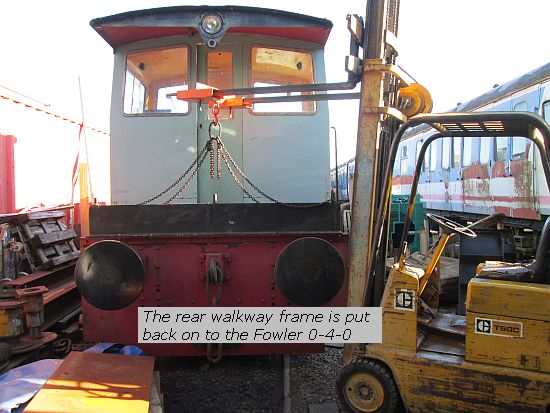
This weekend has been like a breath of spring, with clear blue skies and lots of sunshine, though frosts to scrape off the 'screens each morning. After a couple of quick tasks in the shed (but with a roller shutter door open to let the warm air in) Andrew wanted to do a bit of tidying up outside and so I tackled a plumbing issue inside the shed and he burnt through the bolts holding the steps and rear access floor frame for the 0-4-0 Fowler. This is the bit, you may recall, that travelled loose on the back of the low loader and had to be unloaded by gravity and fancy footwork. The step assemblies themselves want a bit of TLC but the floor section would be better back on the loco, until we are ready to fit the new running plate sections which are not yet to hand. So Ludwig was fired up and brought the Fowler across, after which the forklift lifted the section back into place. For now it is just held in with a few M12s.
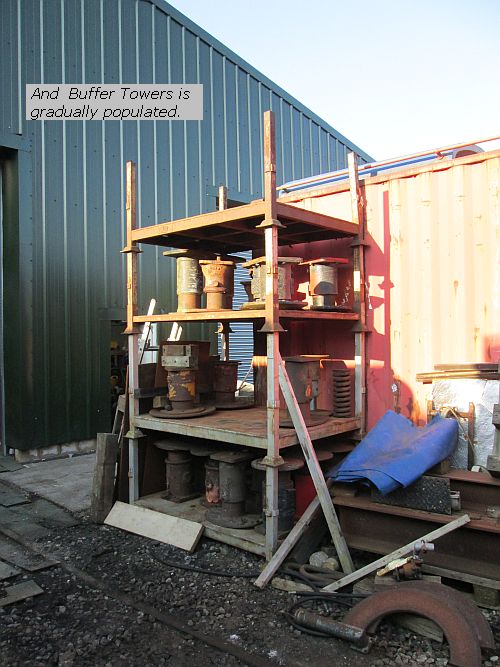
The assemblies had been sat on some 4 poster stillages which Andrew had bought some months ago on auction and with those now accessible he decided to put them to use as a repository for buffers. So let me introduce you to the new 'Buffer Towers'.
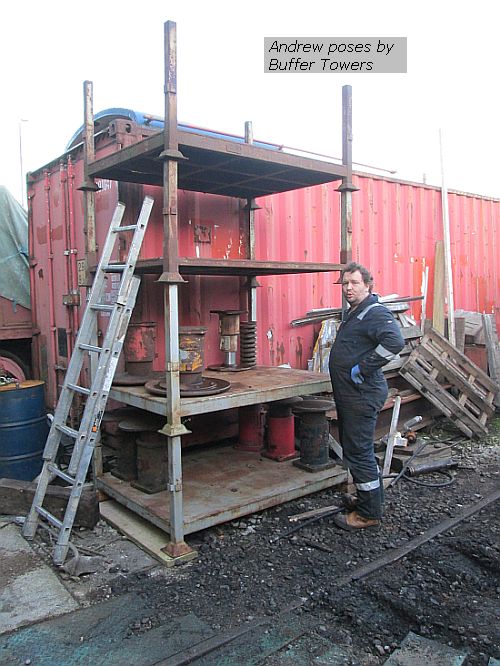
Getting all this assembled and buffers placed in took most of Saturday and a large part of today, given that the buffers were mostly in stillages or on wagons farther up the yard and had to be fetched or the wagon brught down and unloaded. In the course of Saturday we also lifted off the Rolls-Roce C6T due to go into the 0-6-0 Fowler and used the space thus freed to rehouse a Cummins 855 removed from a loco I had through last year for Ford.
Sunday had the additional interruption as we had a purchaser over to collect the old Hatz power unit which we no longer require. Indeed, I was tempted to call this week's edition 'Goodbye to all (t)Hatz' but didn't to appear too highbrow.Thus it was we had left the gate open and during an afternoon tea-break heard steps outside and found an enthusiast at the doorway. He started by asking if we knew when Peak Rail would be starting to run again and we had to admit that all we hear is rumour; indeed I think it is now over 12 months since the Association sent out a magazine and I suspect that renewals may be a touch disappointing this year. Anyway we ended up chatting and I gave the usual (socially distanced) site tour before returning to work.
Which brings me to an observation of this last weekend. Open topped cars, cars with canoes on the roof - you aren't going to tell me that this is 'essential' traffic or just short distances to places of exercise, the 'semi-lockdown' we've had of late has only worked because many people are afraid of the virus and the attitude abroad now seems to be that it's all over bar the shouting, with 20million having had a first jab. The Police are going to have more and more problems (and become even more disliked) trying to enforce the regulations - Mr and Mrs Joe Public have had enough of it.
So, traditionally we have always had the last weekend of the month as the one where everything goes wrong, yet we seem to have achieved quite a lot, and while the engine mounts planned for the 0-6-0 Fowler didn't pan out as intended and must be altered, for the most part it was a succesful weekend with bits of shed floor and ground outside de-cluttered. We'll have to see what March brings. So come back next week and I'll see ya then.