
Of a tale of two Fowlers
31st January 2021
Right, well that's January over with.
If things had gone to plan, on Monday, or maybe b****y early Tuesday I would have been heading South for a commercial loco move and having finished it, we would have trundled across to Chasewater to collect a loco for refurb. But the first part of the plan fell apart (maybe for the best, there was rather a lot of rain) and instead I met up with my low loader and the 'team' on Wednesday morning. The object of this was a former Royal Ordnance Factory Fowler, serial 4220015, one of the 1950s Fowler designs that featured Albion engines and a range of hydraulic as well as mechanical transmissions. When my boss at Thomas Hills John Capes, was in a reminiscing mood, he used to tell me that if Fowlers wanted the job, then they would take it (by under-cutting everyone else), but that by then the bulk of their production was not rail so they only went after rail work when they had capacity to fill. And to be fair they had some good features - visibilty for the driver was quite good, and there was what you would call a shunter's recess at the front corners. But, oh dear, the access to the front side running plates is bad from those recesses and the step access up to the cab - well, put it this way - the rear sandboxes are filled from the cab and climbing up those steps with a bag of sand is not a welcome occupation.
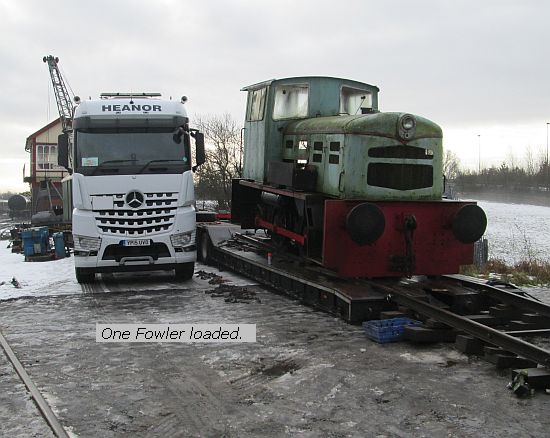
Anyway, 4220015 was built for the ROF at Radway Green, near Crewe, so had some 'flameproof' features such as an external battery box. (There is 'flameproof and there is 'flameproof'- lets shorten that to FLP - an FLP loco for a gaseous mine is not the same thing as an FLP Loco for a refinery which is not the same thing as an FLP Loco for use in an explosives environment.) When it left Radway, it had gone to Chasewater, where it had operated for some time until it suffered an engine failure. Some work was begun to repower it (they tell me they had in mind a 10 litre Cummins) but then bits disappeared, presumed scrapped, and the work stalled. But for Andrew getting involved, it too would have been made into razor blades. Anyway, what was left was paid for by yours truly though this was the first time I'd clapped eyes on it, as it waited, coupled to a Thomas Hill 4w'er, to be propelled up to the trailer and winched aboard.
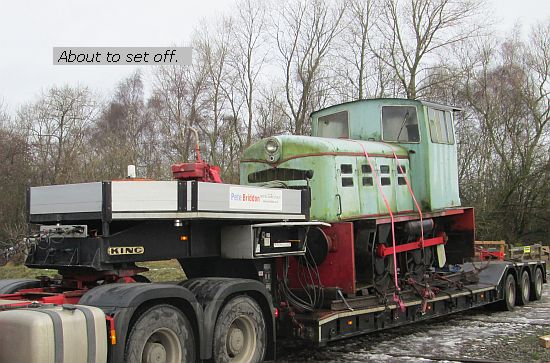
Compared to picking up 08s and such, it was easy, and though Chasewater staff reckoned it was (once) a 36ton loco, according to the published literature and the fact that it is only a 5ft 6in wheelbase, it should only have been a 33tonner, and such FLP gear as it had wouldn't have added much to that. The rear steps and walkway sub-frame had been detached and so were put on the back of the trailer, and we set off, Adam having set the cruise control at about 55 on the A38 as the big Merc would not have found the little Fowler much of an impediment. The Chasewater staff did warn me that the 'handbrake was seized' so they'd backed off the brake rigging, but then many hauliers ask you to leave the brakes off anyway.
We rolled in to Rowsley and had a slight bit of bother unloading: thanks to those bloomin' lifeguards. The front ones are off but the rears had ground over the tip rails on the trailer as the winch pulled it on - but going down they dropped over the tips and wedged themselves. Anyway, Ludwig was on hand to give it an encouraging tug and we were soon on the rails. I left Adam and Ian - and my van - at Rowsley and took the Fowler down to Darley Dale, pausing at Church Lane to check bearings.
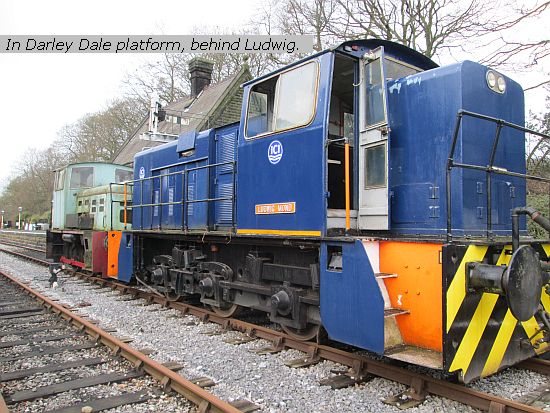
Adam meanwhile brought the trailer down to stand by the gates, the theory being that I would draw the train forward, get the forklift out and lift the step assembly off, but I had left my shed keys in the van at Rowsley, so Ian and I tested the structural strength of the assembly by dragging it to the point of balance and then heaving it and getting out the way! The forklift recovered it later.
I have made a lot of refrence to the Fowler by its works number - 4220015 - and with good reason. Sat in the yard is a Fowler 0-6-0, which just happens to be 4240015 (422s were diesel hydraulic 0-4-0s, 424's where six wheel versions) and of course, it too had put a leg out of its old Leyland engine. When I came to look the 422 over a bit more on Saturday, I checked the handbrake linkage and behold, it was working OK, the problem in fact was that the brake weighshaft is stuck and the handbrake couldn't overcome it.
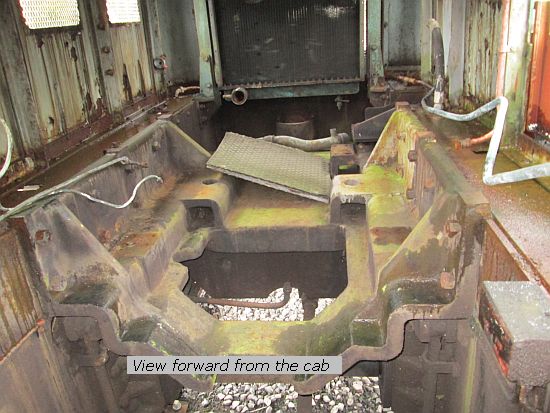
And guess what, the weighshaft on the 424 is seized too, but in its case, the lads at Whitrope were unaware and it gave us a hec of a problem to load it, in winchless-Andover-trailer days. Fowler's standardisation is such that the ballast block that sits underneath the engine is the same on 422 and 424, but a quick dimensional,check showed that the block is drilled slightly differently, so the rear mounts that you saw last week and planned for the 424, will not fit the 422.
So as I say, on Saturday we had a good look over it before getting on with work. It will require some welding around the cab lower which has been cut away because of corrosion, and various components are missing, not just the engine and converter and propshaft but the compressor, sundry valves, etc., but nothing fundamentally a game-stopper and it should make somebody somewhere a good little loco one day.
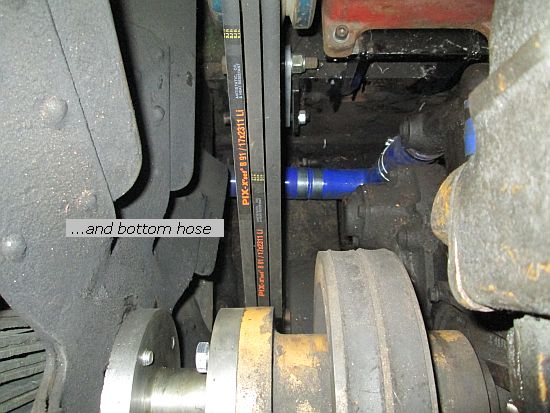
Back inside the shed much of Saturday was taken up with getting some parts ready for an export job of mine, but by mid-afternoon we had moved on to Claire. I had amassed a quantity of silicon hose, bends and clips for the top and bottom rad-engine connections, and for once tried the manufacturers coupling pieces to join tube to bend. But I prefer wherever possible to use T-clamps to Jubilees - they provide better all-round clamping force - but had bought the shortest couplings which proved too short to work with the wider T-bolts and I'd ordered longer ones which proved eminently superior.
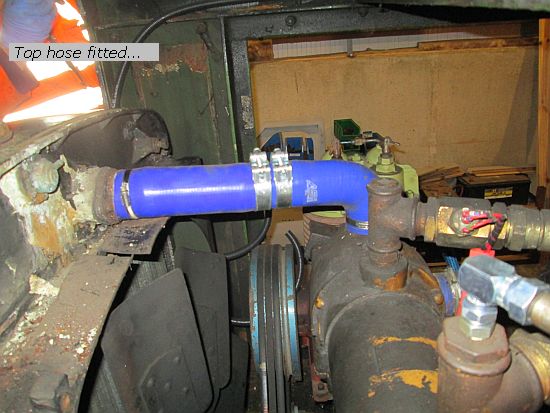
So top and bottom hose connections went in, (the latter requiring me to crawl underneath and access up through a hole in a cross-stretcher) were duly fitted and apart from a new water filter assembly, the cooling system should now be complete.
Andrew carried on making up the packing pieces that will hold the casing front slightly further forward and a test assembly of the new door lock. Some proper (i.e laser cut) packing pieces are though, required. I switched back on to some of the last bits of engine wiring that I had left unfinished.
A slightly later start today, but the two of us were needed to fit lagging to the exhaust pipe. In Hudswell's design, this pipe came unpleasantly close to the back of the instrument panel, but in my re-arrangement I had more wires in this area than HC had and nylon pipework instead of copper (although I had moved the electrical gauges, etc away from right behind the tail pipe and my new exhaust system had the tail pipe further forward than before) nevertheless a heat shield might be preferable and so I've tried this stuff, which I can assure you is not asbestos in any way!
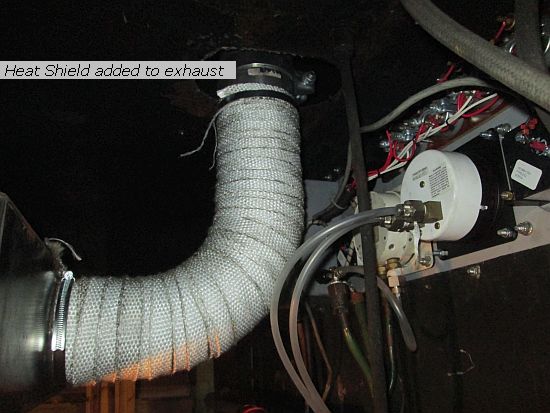
With the exhaust cowl (above it) refitted, the engine bay wiring complete (aside from some minor tidy-ups and cables to the front head and marker lights, which aren't presently there) and pneumatics 95% complete Claire is getting ready for static air and electrical testing - and not before time!
Anyway, that's about it for this week. I've a silly o'clock start in the morning to go move somebody's loco and they're forecasting snow - maybe it'll make a picture for a Christmas card, who knows. All being well, I'll be back same time, same website. See ya then.