
Of a flock of Fowlers
7th March 2021
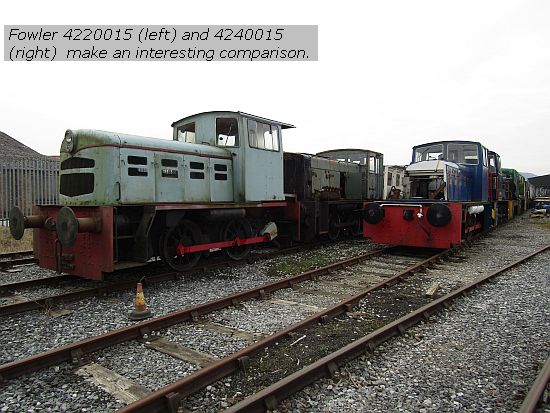
I said last week that a transport move was put off by weather, but it was rescheduled for 1 week later and this time it went ahead. I didn't go down to see it loaded - would have liked to but could hardly justify the mileage especially as the loading would not have involved me at all. Instead I waited for an ETA from Adam and wandered down to the destination in good time to assist in unloading and take a look around. That destination was Hunsbury Hill, Northampton, home of the Northamptonshire Ironstone Railway Trust. And if this week's instalment has something of a Fowler theme running through it, here's where it started.
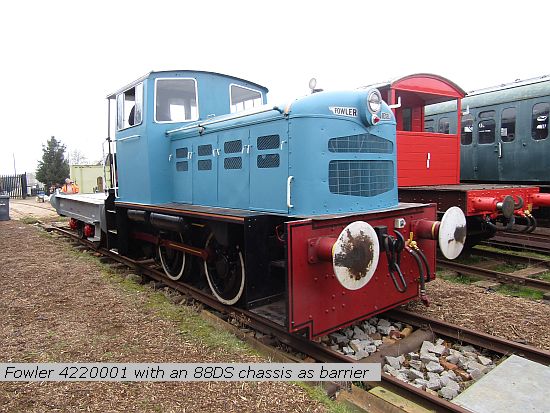
Not having been to Hunsbury Hill before, I was curious as to the set-up, though being based in a country park it has vague similarities to Long Eaton where I was involved in an n.g. railway in the 1970s. On arrival I found a Fowler 0-4-0DH - 4220001 - in action getting ready to receive the newcomer, and I was relieved to see, with a barrier wagon in the shape of a modified chassis from an 88DS Ruston. I say relieved because the actual place to unload put the trailer part way through a gateway, and I don't think the hoses would have reached to operate the winch. Extension hoses might be an idea to put in hand.
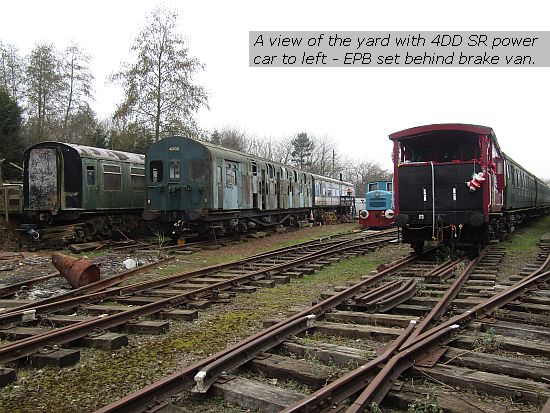
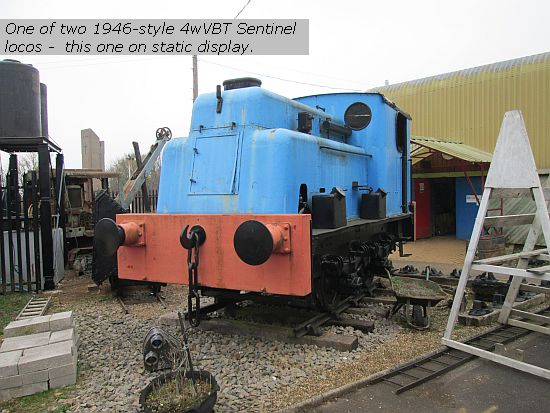
I continued a tour round, noting the two post-war Sentinel steamers with that peculiar casing design ex Thos E Grays of Burton Latimer, or the selection of Southern Region suburban sets, including the Double Deck example, which had suffered from vandalism.
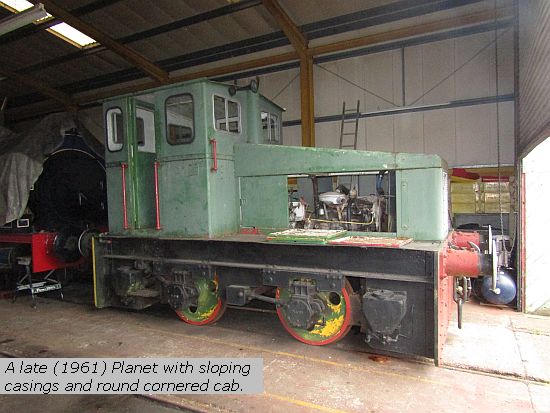
In the shed was a Planet - now as you may know I have a soft-spot for Planets, Andrew often says he only bought Pluto because he knew I liked it - and here was a late (c 1961) 18tonner with a sloping casing and a cab which instead of being 4 sheets bolted at the corners to angle irons, had radiused corners out of one sheet. Sadly it is the lightest loco there, they say, and its adhesive weight limits its usefulness.
Anyway, about twenty-five past four I had a call from Adam just to clarify where he was coming to, and five minutes later the second Fowler of the week - 4220016 Flying Falcon - was gracefully crossing the car park. Now, Flying Falcon looks a little different to your average 0-4-0 Fowler, because it was built for a quarry with a low bridge and featured in some articles on Fowler at the time.
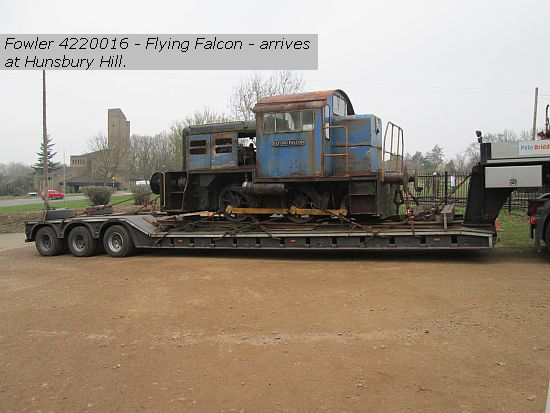
Other than that, it probably was mechanically much the same as the example at Darley Dale but before I first heard about it, it had been transfered to Croft quarry and received a Cummins engine from a piece of plant. In my early days at Thomas Hill, I avidly read all the reports from the sales and service personnel so knew that this loco, plus a 28ton Ruston, were operating Croft, and from about 1983 I was giving the Quarry Engineer budget prices for new or rebuilt 0-6-0s as he made his annual application for capital plant he'd like to buy. The two locos were coping with the wagon traffic they had (though breakdowns were said to becoming more frequent) and they needed bigger, but each year the powers-that-be turned the request down. Meanwhile they went ahead with a planned investment of new big capacity hopper wagons and a new stone loading silo to up the rail traffic output. The new stock and plant came on stream in summer 1986, and almost immediately the two little locos demonstrated that they were neither big enough, nor healthy enough, for the work they were being called on to perform. We got summoned to a meeting with the Quarry Engineer and he called in his boss - maybe the very man who had turned down the Engineer's requests to buy an 0-6-0 - who after a discussion on the matter, gave the poor Engineer a b*****ing for 'not having got it sorted sooner' (knowing what I knew I felt very sorry for him) turned to us and said 'what can you hire us now to get us going and what can you supply as a long term answer?' And with little further formality we had an order to put in a Sentinel 0-6-0 on hire while another example was rebuilt, fitted with train air and Hydrovane compressor and named Kathryn. It's still there now, though with Croft closed I understand it is about to depart. Anyway, Flying Falcon was transferred down to Meldon quarry, but as the Dartmoor Railway project developed it appears to have been parked up. I recall walking past it on my one-and-only visit (a party of prospective General Managers being given a guided tour) and other than noting it had my brake blocks on it, that it appeared to be parked up then.
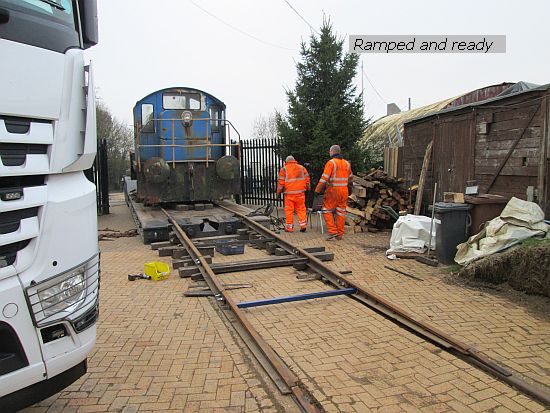
So anyway, back to this week. With the ramp built up, the Ruston barrier wagon became the filling of a Fowler sandwich and 4220001 drew 4220016 off my trailer and parked it over in the shed. By 17.30 Adam was on his way home, and after formalities I followed.
First thing Friday morning I was down at the shed to get a Traction motor loaded and away for TLC, which meant drawing the train back to free up Track One and get the pick-up nearer to the forklift. This task was alotted to Ludwig Mond, so I duly started it up as normal but after a minute or so I heard a loud banging come from the engine and shut it down without delay. No time to investigate, I started Charlie up instead but that wasn't the end of my problems. As Ludwig hadn't run long enough, there was next to no air pressure and not enough to release the parking brake even though I had only applied it at about 20psi on the cylinders.
A slight diversion here: many drivers are in the habit of applying the loco air brake fully, say 60-65psi, winding the handbrake on and then letting the air off. That is bad practice. The handbrake linkages are designed on the assumption that the maximum force applied is that of a man on the handbrake wheel - putting the handbrake up 'behind' the full air brake and then releasing the air subjects the linkages to several times more force than they were designed for, and if, when you return to the loco next day, it won't start, you haven't a feline-in-fire's chance of unwinding the handbrake. Never put the air on at more than 20psi before winding up the brake, that will park the loco quite adequately. I drum that into any driver I am required to do training with, but here I was with only 20 psi before application and I still couldn't unwind the handwheel.
Fortunately Ludwig was just in range of our combined air hoses, and we had a train air hose with a quick release coupling, so the shop compressor was hooked up to Ludwig's Reservoir Train pipe line and sufficient pressure raised to release the handbrake and let Charlie push it out of the way. So when Andrew and I got down Saturday the first order of the day was to investigate the noise - was it engine, generator, traction motor blower? On a loco like this with auxiliaries directly driven it could be any or all, and from the cab it is hard to differentiate, but in my gut I was sure it was the engine. After a brief crank to confirm what I had heard, it was definitely engine, so we tried barring it over by hand and found one place where you felt like you'd hit something solid and could go no further, and going backwards hit the same obstruction about 350 degrees later. Taking covers off the crankcase showed no obvious problems at the big ends, and my money is on something having broken off in one of the cylinder heads and being hammered into head and piston. Ludwig has a Dorman 8QT, not, I am sorry to say, an engine with a good reputation. The Q series suffered from flame ring problems and I have heard several instances of those engines suffering terminal failures, usually quite dramatic ones. Maybe if I hadn't shut it down so quickly that might have been the fate of ours, but for now it renders Ludwig unservicable and the question now is what to do with it for the future. A repower is on the cards - perhaps the CV12 we had planned to put in a 14, or possibly a Cummins KT19. Conversations today wandered around fitting a PLC system and seperately exciting the traction motors, taking some of the auxiliaries off the direct mechanical drives and instead running fans, blowers and compressor/exhausters through hydrostatics.
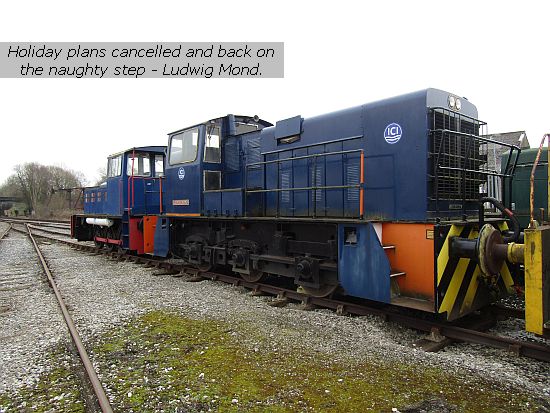
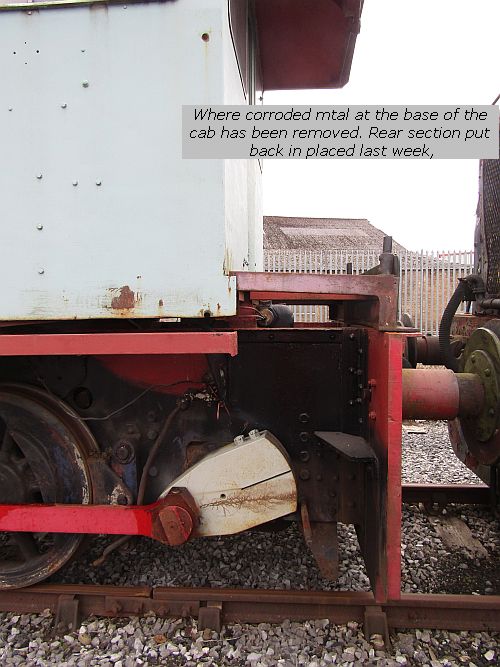
But all this is for the future, and for now Ludwig has been shunted on to Track 2 to await time and money. Last week we put the rear walkways back on the 0-4-0 Fowler 4220015 and during the week I collected from the profilers the new running boards for the sides.
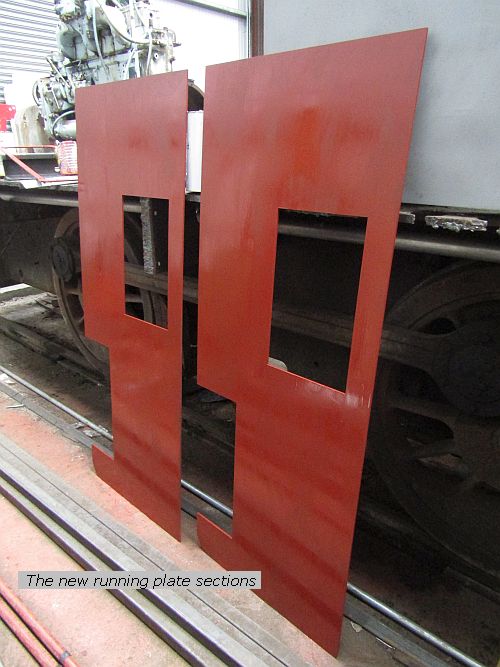
These will go under the cab and walkway, and have a recess where the steps go and a cut-out where the rear sandbox mounts. Comparison of 0-4-0 and 0-6-0 showed commonality of sizes and components. For now they are propped up on Adolf and have been primed - I hope to get them fitted shortly if only to save on shed space.
Work has progressed on Claire but is held up by the clutch cylinder seal, which despite being quoted as 3-4 day delivery will be 2 weeks tomorrow and no news yet. Meanwhile the train cocks have been reconditioned and tested, door locks packed out to suit the new door seals, and the troublesome wiper motor found to be nothing more than that the inlet air connection was blocked solid with muck! I had a problem with a gauge in the cab - originally it was the Train Pipe pressure so was only 0-100psi, but as part of installing a twin pipe system to Claire we've put a duplex gauge for that in the instrument panel. Thus I'd re-allocated this gauge to be an Emergency Reservoir gauge, which to me is a rather dubious benefit (in that if you are properly trained you will have seen the brake cylinder pressure rising on start-up and will know that it comes via the emergency reservoir, but Inspectors back in TH days insisted that the driver must 'know' that the pressure is there) but as the system pressure will be taken to over 100psi (safety settings are about 125) this would have over-travelled the gauge. Fortunately I found a 0-160 gauge amongst our past acquisitions and this is now in place.
All in all Claire is nearly finished, which is fortunate seeing that the customer was on to me again about it this week! As part of the general re-organisatiion, Andrew decided to re-locate our lifting equipment racks as the section of wall they occupy is earmarked as new homes for polstores, tool cabinets and a re-positioned pillar drill. With revised mounting brackets for the 424 Fowler drawn up finally during the week, and mutterings about using the engine installation I drew up for the Ford Hudswell on one or other of the remaining HC 0-4-0DHs, together with repeating the exhaust system as on Claire, it has been a fairly positive weekend despite the bad news on Ludwig.
If you recall 'Of Snow and Gronk' you might remember that I had to forego a Covid jab that Saturday as I was in Great Yarmouth. It was organised through our GP surgery and for the following 2 weeks I had waited hoping that they would phone up to re-book me, but all I got was texts reminding me NOT to ring the surgery for jab bookings. So on Wednesday I got around to doing so on-line through the general NHS service. It took up an hour or more of my time. For starters you have to book both jabs together to ensure your second is at 12 weeks. I opted for the centre at Pinxton about 10 miles away, and as I went through all the screens it came up with a message that one of my appointments I'd just selected wasn't available. So I backed up and went through it again, but it gave me the same appointments, and confirmed my booking by e-mail. Four minutes later it sent me another e-mail telling me my second appointment was not available and please re-book. I went back on, and although it was only one of the two appointments it wouldn't let me cancel that one, I had to cancel both and start all over again. Yet again I had to go through the whole proceedure twice before it appeared to be OK, and I sat watching the screen for 10 minutes waiting for another e-mail to tell me that this too was in some way defective, but it didn't and I breathed a sigh of relief. On Thursday my local surgery texted me to book an appointment for a jab (are they not part of the NHS?) so I tried them and got a slot for Wednesday this week, earlier than the earliest appointment offered through the NHS site which was for next Saturday, so I went back and cancelled all my hard work getting those! Meanwhile research has revealed that asthmatics are statistically 'under-represented' in Covid cases and research in India has suggested that full-time glasses wearers are up to 3 times less likely to catch Covid than normally sighted people. At last I can feel proud to be a short-sighted asthmatic, but will take the jabs nonetheless.
And with that I'll call it a night for this edition. Provided the side effects aren't too severe, I'll be back next Sunday. See ya then.