
Of taking a brake
23rd May 2021
No, no, not that sort of break, I'm talking cylinders.
After the upset of last weekend, when Andrew was very much under the weather, things this week have calmed down. He and I got to spend two or three evenings in the shed: the rack got painted, planking got cut to form the shelves and with a slight repositioning of the train it proved possible to get the assembled rack into the 12ton box van and two stillages of parts relating to a Yorksire 0-4-0DE were laid out on them. On Monday though I had my second Covid jab - Andrew gets his first this week - and I was back in the shed on Wednesday morning as visitors were expected to view the PCV. They came and as I gathered they were knowledgeable I ended up doing the full guided tour as well. Other than that I haven't been far from home, just the usual tour of suppliers picking up bits for various jobs in progress. One such may form the theme this week, as a defective brake cylinder arrived from a customer. Initially all they had seen was that a bit on the outer end, where the piston rod emerges from the body, had broken off. During the week I got that apart and here is a view of the inside.
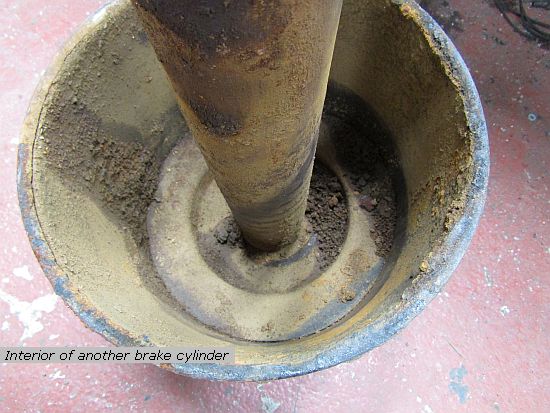
You are looking into the barrel of the cylinder and what you see at the bottom is the back of the piston. Air is admitted at the far end and acts over the piston surface - this is a nominal 12 inch diameter brake cylinder if that gives you a sense of scale.
Brake cylinders are things that all too often operators forget all about. I've been on a loco where one brake cylinder failed - or to be exact its seal failed, allowing the air to escape rather than slow us down. In that case it was down at the Channel Tunnel in construction days - sorry not IN the tunnel, rather the yard at Cheriton outside - and we had a train air fitted loco and train, so stopping wasn't an issue, but I wouldn't like to be on a loco running loco brake only downhill with a train. Then you're entirely reliant on the handbrake, which is not a service brake but a parking brake, and simply not intended to put that much force on to the brake blocks. And although many manufacturers put two brake cylinders on a loco (Hill's did, the Drawing Office Manager telling me that it cost more but ensured that the brake force was evenly applied onto the weighshaft) if one cylinder seal failed, the other cylinder became ineffective. And they can go suddenly: it rather depends how they were mounted and how they have been looked after by their operators.
This is one theme I come back to, because the biggest danger to loco air systems is water - condensate in the posh venacular - yet loco operators seldom bother to drain it out of air receivers where it collects. In BR days, Spirax Sarco developed an automatic drain valve - officially called a BRair trap but more frequently a f**t valve, which by means of a disc with a slight groove across it automatically expelled small quantities of air at regular intervals and hopefully evicted any condensate with it. If you go back in this blog you'll find refrence to Pluto's air brake cylinder. Westinghouse - unlike other manufacturers - put two air ports on their cylinders and if you mounted it so that air was admitted at the upper one, they suggested taking a pipe to an exterior drain valve from the other, to enable moisture to be extracted. Now, if you mounted it so that the cylinder ports were at north and south, that ought to work, but Mr Hibberd, bless him, mounted Pluto's east and west and although a drain line was installed, it had to fill half the cylinder before you could guarantee to push any out. In my Channel Tunnel example, the brake cylinder was a D&M, and on a Hunslet loco mounted with the cylinder facing downwards at about 40 degrees, so any water that got in simply sat on top of the piston, going up and down, and in my case, my colleague's verdict was that it had hydraulic'd.
That same colleague, the late Derrick Hobson, was conducting a training course for me at Stanton, and became suspicious that the locos built up their main air pressure too quickly to be true. He investigated and found that the air receiver drains had been replaced with plugs. He insisted the plugs be removed and over half the volume of the air receivers turned out to be water. It is by no means unique: more than once I've found BRair traps on industrials blanked with half inch plugs, rendering them ineffective. Why? Probably because the operator got annoyed by the noise from the valve as it functioned every 30 seconds or so - they didn't get their nickname for nothing.
For all that they are critically important to brake function, brake cylinders do not therefore get the attention they deserve. And being such large diameter, with the resultant contact area between seal and barrel, they can leak a considerable amount of air and not be audible. If you're operating a loco, and when you leave it parked with the engine off the air pressure falls, try doing it with the loco brake applied and repeat with it released - if it takes longer to drop with no brake pressure in the cylinder, then the brake cylinder itself is probably a/the leak. Anyway, let's return to my customer's cylinder. You can see a dark area where the piston was once moving up and down but a large amount of debris has accumulated across it. When I got it this far I could not move the piston at all, and it was obvious that 60 psi of brake air hadn't moved it for some time either. To complete the story, last thing this afternoon, Andrew suggested using one of the test pumps we acquired by auction a year or more ago, so we found a couple of fittings, pumped away and suddenly there was a clunk and the piston rod toppled sideways, and water emerged. Thus disturbed, out came the piston and here is the state of its cylinder seal.
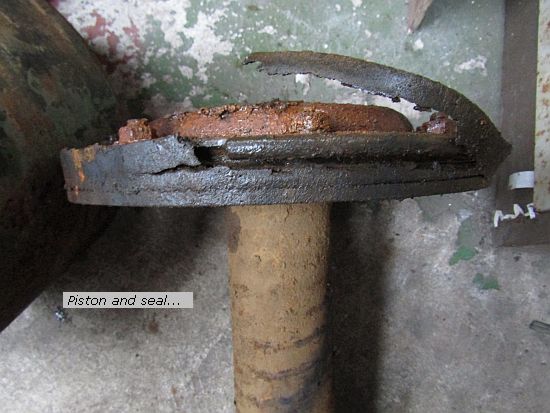
This particular locomotive is normally the customer's back-up, is train fitted and the site is predominantly level - quite how long it's been like this I don't know.
Anyway, back to the weekend, and after having told you all last week that only works trains have been operating on Peak Rail, this weekend we have been graced with crew-refresher turns, with Eustace Forth and D8. The weather has been mixed, and being busy I only took a couple of shots, on a run when Eustace Forth was heading the train up from Matlock, whereas usually it has been leading down.

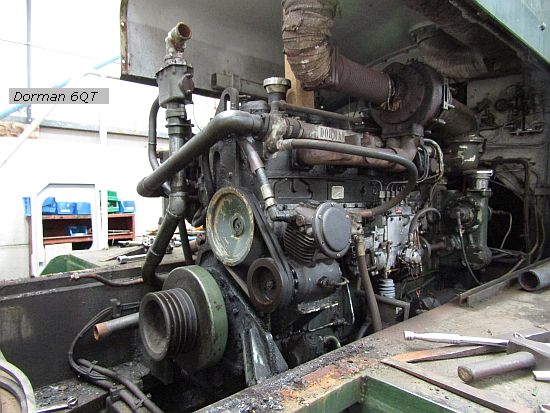
Saturday and Andrew had proposed making a start on another commercial job, the scope of which neccessitated taking the 'nose' of the casings off as the engine has a serious oil leak in the front which could not be accessed any other way. But before that we started Charlie up and drew the train back, as a cross-cut saw that Andrew had been toting around had been inspected last weekend by two gentlemen who had paid for it, and said they'd be back this Saturday with a bigger van. So we lifted it out of its place, positioned it on a pallet, and took the combo down to the north end of the shed ready for their arrival. By mid-afternoon when they hadn't showed, Andrew phoned them and no, they weren't coming this Saturday - nice of them to keep us informed. Anyway, we switched back to the other task and lifted the nose section off with the forklift, so let me introduce you to the front end of a Dorman 6QT.
Over a mug of tea and a slice of Steph's teabread, Andrew started muttering about how little time we seem to get to progress 'our' projects of late (don't I know it, I have more commercial work on the go than I really want) and so Sunday was declared to be an 'our day' day. Tom was the principal recipient. In the course of a shuffle-around yesterday it was brought across from 3B and 3A, so we fitted the plastic window I had cut last week. It is not a perfect fit, but will do for now and Andrew has declared he'll get a proper one manufactured soon. After a stock-take on suitable batteries, it was decided to re-fit RS8's batteries to Charlie, and take Charlie's (which are actually ex 14901) to go on to Tom. These are actually big silver alloys made by the firm of Moura, which my battery supplier tells me were such good ones that the firm went bust. We added some 50 litres of gas oil to the tank (it wasn't completely dry, just low) and after topping up coolant, refitting the compressor belts (which had turned over), checking oils, etc, we attempted to start it. The starter refused to engage, just ratchetted against the ring gear.
This is an 'old' Rolls C8 supercharged, and the starter motor is strap-mounted. I know some people who swear by them, we tend to swear at them as one of their habits is to slide within their straps and so not engage. But this hadn't happened which meant that either the motor wasn't properly extending or not managing to get in to engagement when it did, and the latter might mean a bit of wear or damage to the ring gear which barring the engine over might solve. But barring an engine like this is another matter. On a Cummins 855 you can put a socket on to the retaining nut for the auxiliary PTO, and on later Rolls they made a special 'barring device' which bolts into the spare port cast on to the flywheel housing which enables a starter motor to be put left or right side to preference. But on this engine that cover plate lay right next to the oil filter bowls, with insufficient clearance even to take out one bolt. Andrew eventually succeeded in barring the engine around a bit but it made no difference other than at least confirming that the engine wasn't seized.
Why didn't we just extract the starter motor and bar it there? Well the transmission cooler - known colloquially as the 'torpedo' sits right over making inserting and removing the starter even more of a grunt and finger-trapping exercise than it ought to be so we had hoped to leave it alone, but after this Andrew reluctantly pulled it out and sure enough the pinion teeth were burred. So he set too and cleaned them up with an angle grinder, hoping to get sufficient 'lead' to get them to go in properly. Back went the starter but sad to say, it was no better. We could not get the engine to crank and more drastic action may be called for.
To complete our brake cylinder theme for the day, we returned to RS8, which Andrew would like to see operational with an eye to at least one railway for it to visit. It has three issues preventing its operation. A leak around the bottom radiator connection, a failure to get full rpm on the throttle cable, and an issue with its brake cylinder. So he headed underneath and between us we got the brake cylinder off and out. In contrast here's a view of RS8's cylinder barrel - yes that's light rusting that has taken place and needs polishing off: clearly it wasn't greased sufficiently when we did it up before and the last 16 months of waiting for attention hasn't helped much.
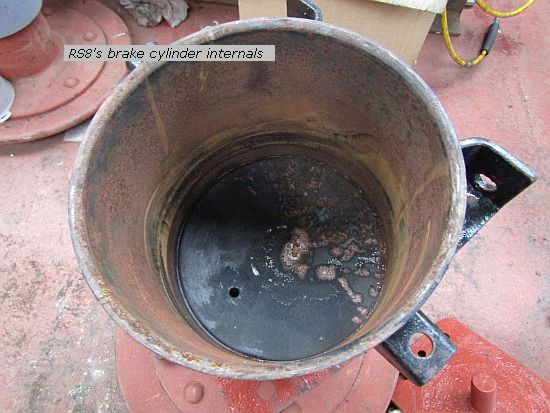
Ah well, we'll fettle that up again and get it back in shortly, and maybe RS8 will take a turn outside.
I've listened to the government announcement on the plan to form 'Great British Railways' this week. Apart from automatically associating anything that starts 'Great British Railway...' with a certain Mr Portillo in a coat of many contrasting colours, I was struck by the feeling that wasn't this what the Strategic Rail Authority' was supposed to do? But for now that's it for the week. I've got loco moves in prospect, the PCV is departing, and loads of other things to get on with, so I won't be bored. All being well, you can read about them here next week. See ya then.