
Of rack, jack and relay
16th May 2021
If you've arrived here by following the plug in Mark Hambly's 'Another Railway Ramble' - congratulations! you've made it!
It has been an expensive week here at the Briddon Country Pile, looking back at it. I was trying to get some paperwork (invoicing, ordering, drawings) done on Monday when mid-morning the phone rang and a voice at the other end told me that their wagon was sat oustide our workshops but there didn't seem to be anybody there. Well there wouldn't, cos I wasn't, and Andrew was at Kettering or Bedford or somewhere monitoring his Class 360s which had come into use rather earlier than anticipated. I had said to the electric motor company that the Janus Traction Motor would be out and ready to go, just I hadn't agreed a time. So, quick wash and shave and down to the shed, fire up Charlie, draw train back, fire up forklift, bring outside and plonk on to back of wagon, put forklift back, wave wagon goodbye. push train back down... As I was about to take Charlie back down the yard I saw that D8 was out with the works train and had stopped in Red House cutting, just south of us. If passenger trains are passing our Safety Systems say that we stop and wait: it makes sure there's no chance of collision and anyway it gives us a chance to wave at surprised-looking passengers, but in this case D8 was stationary and wasn't hauling carriages, so I carried on and put the loco away. It is a sobering thought that it is now 14 months since Peak Rail ran a revenue-earning train and the website continues to show services suspended with no hint of a resumption.
Andrew had acquired a lot off e-bay on Sunday and had asked me if I could pick it up, so Monday afternoon I found myself travelling to Thurgoland, not some weird African country but a village on the Huddersfield road out of Sheffield. At a road haulage depot our acquisition was awaiting me. We have, from time-to-time, picked up bits of Enerpac equipment, which for the uninitiated is a brand, like High Force, which produce manual hydraulic pumps and all sorts of little jacks, which enable you to get into small spaces and exert large forces. When we recently tried to extract the three inch diameter pin that holds up the back end of a Janus traction motor, it was an Enerpac that we used to put force between the immobile pin and the side frame of the loco. Result? The pin stayed still and the loco's frame bowed out. We had to cut that b*****r out: but you get the idea.
Andrew and I had ammassed 3 or 4 pumps (one of which leaks every time you use it and the oil attacks the floor paint) and half-a-dozen jacking heads from one about 10 inches tall down to one barely 1 and a half. I came away from Thurgoland (no passport required) with a selection that not only increases our number but also our range of sizes, plus an electric pump which takes away all the hassle of hand-pumping and would have cost new several times what was paid in total. For now, it is unloaded in the shed awaiting time to clean, test and put it all away properly. Then there was the HATRAMM.
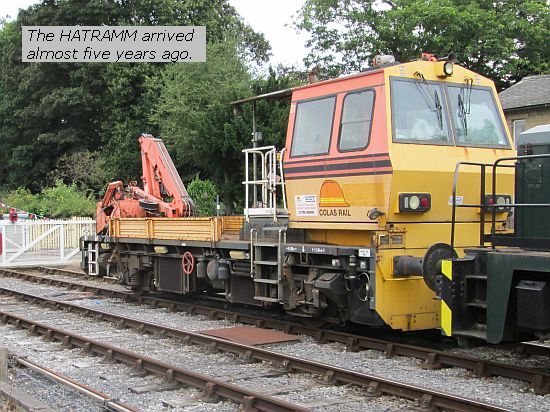
For years now it has been on Andrew's website, but although a price had been agreed with Colas for its purchase, the paperwork hadn't materialised. It was fortunate that Andrew's offer to Peak Rail's p/way department to make it available had been completely ignored as without title to it we did not feel we could carry out the neccessary work to make it runnable. But earlier this year Andrew nudged them again and this time it brought forth, not a simple one page invoivce 'To supply of one redundant TRAMM vehicle as seen and approved by you £XXXX' but a 14 page contract that probably cost Colas more to produce than they earned from the sale! Anyway, the monies have changed hands and though an 'Acceptance Certificate' has still to be completed, we can say it is ours now and although Andrew is unwilling to commit time immediately, it brings it up the priority ranking to get it going.
The transport side has been kept low-key this week to give Adam more time to sort out the delinquent Merc tractor, but we had a couple of gronks to shift, so Tuesday lunchtime I met up with him and the trailer. No Ian this week, instead he had brought Phil G, and if that name is familiar he has been at Darley Dale many times but is now driving for HFS.
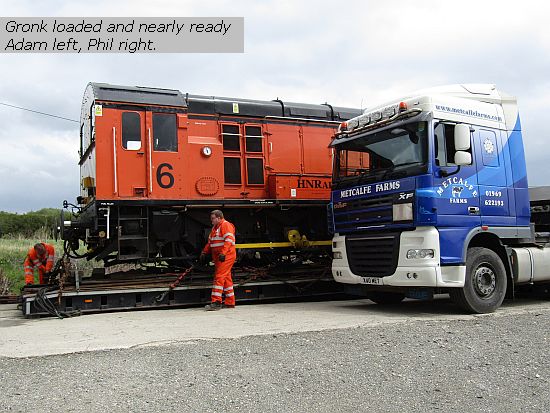
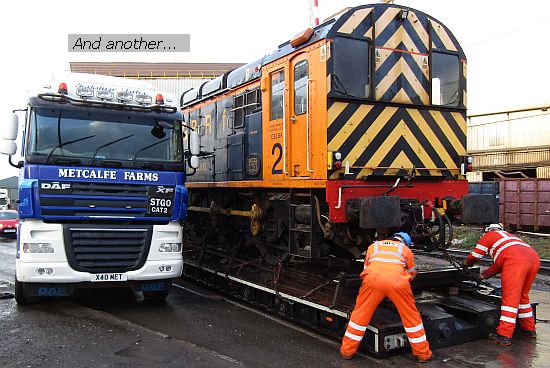
The tractor unit too was a stand-in, not as salubrious as last week's being an X reg DAF but it got the task done. Here they are getting on with the job. The loco was taken down south, offloaded and another brought back the next day. (I was assisting, just not all the time).
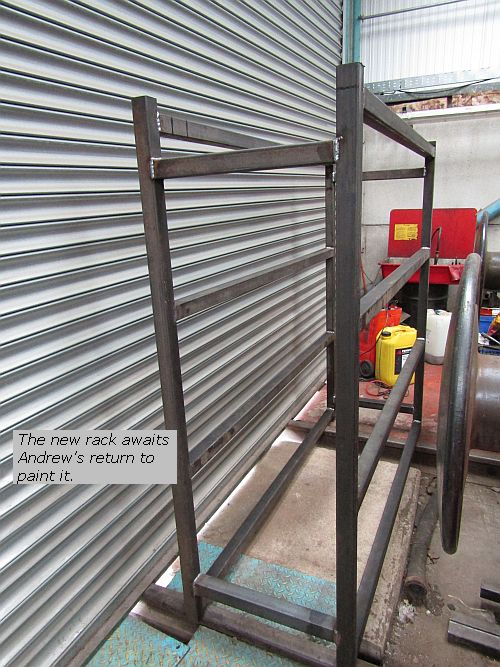
Andrew's stress levels rose as the week went on and by Friday he had developed a cough and was beginning to lose his voice. Nevertheless we had got one evening in the shed, (to get away from 'work' he said, as he was still fielding phone calls well into the evenings) cutting 50mm box section to length and making up a new rack to go into the box van, whereby the one in there he built specially for engine parts can go into the cement van, at least, I think that was it.
Friday evening this week was the Peak Railway Association AGM and although it had been left as late as pssible, was a 'closed' meeting to be attended by (socially-distanced?) Directors only. Unlike the Peak Rail plc AGM last year, where questions were taken from shareholders but were apparently only answered to those shareholders alone, the PRA Directors undertook to answer any questions by publishing them and their answers on the PRA website. The meeting was due to begin at 18.30, and with only about 6 Directors actively involved (Director Statham having resigned on April 9th, and Director Tomlinson stepping down and not seeking re-election) and all proxies due in 48 hours before (curiously the proxy forms called for the name and address of your nominated proxy: given that it was a closed meeting, it surely would have been sufficient to ask you to name the Director of choice) the formalities of an AGM could be zipped through in fifteen minutes. Yet a passer by reported the cars still there after 2 hours - could they have got bogged down with drafting replies to numerous questions, or merely gone on to a high level Board meeting?
And while we are on the subject of leaving formalities late, I see from the Charities website that The Waterman Railway Heritage Trust has yet to file its March 2020 accounts and is 105 days overdue. I can't wait to see its results - in 2019 it had declared total income of £6,600 and expenditure of £156,000, and this was not that dissimilar to earlier years.
On Saturday we headed down to the shed, but Andrew was suffering with severe coughing and general lethargy, and having then slept on his chair in the mess area for an hour took himself home again. As a precaution Steph popped in to Matlock for a Covid testing kit: but it proved negative which, as Andrew had none of the other symptoms e.g loss of taste or smell, was what we expected. Clearly he had a bug, just a lesser one. Anyway that left me on my own and I spent my time firstly on the HATRAMM, assessing where to begin. As Andrew had observed, it had had OTMR and TPWS as well as GSM-R and bits of this equipment remain, particularly the OTMR which apart from several large cabinets must have a kilometre or two of wire hooked in to various parts of the machine to record its every action. Removing most of this will clear a lot of space and hopefully make the remainder seem a bit less daunting, and maybe even free up some floor.
For those readers who have not forgotten, or those who have come on-board since, some years ago, when Terry Day was still with us, we got as far as getting the Deutz engine running, but clearly the control system didn't want us to and we had to hold the fuel rack manually to stop it shutting down. Andrew recalls that on a later attempt (I was elsewhere) they got as far as the transmission seemingly taking power, but didn't dare trying to see if it would move. It is an immensely complicated machine, having a torque-converter plus powershift transmission for normal transitting but with a hydrostatic drive for slow-speed steady crawling, say for rolling out a cable. Thus the two transmissions, both starting from the one engine and endng up at the same wheels, have various detection systems to prevent both being engaged together. Thinking back, I had seen the same thing on Geismar units that Thomas Hills built for them, and niavely assumed that the engine drove the hydraulic pump and motor and thence into the powershift combo! Still sat in the cab was another copy of the manual for it: we have one copy at the Briddon Country Pile, but I was loathe to deface the wiring diagrams, which amount to 9 fold-out sheets. But here was a second copy in well-thumbed condition, having been sat several years in the cab without heating - I decided this copy could be utilised for investigation and brought it away with me.
Back on track 3B stands Tom, the Sentinel 0-6-0 that has not seen action for several years, not in fact since it came back from Scunthorpe especially since, allegedly, all its fuel had been drained out as a reaction to its imminent departure. Then when we had the first round of child-invasion, rocks were used to smash one of the drivers sliding windows. Toughened glass shatters into thousands of pieces that proceed to take up far more volume than they ever did as a sheet. These windows cost several hundred pounds each and we don't have any spares, so the cab was sheeted down for protection against the elements and the loco left.
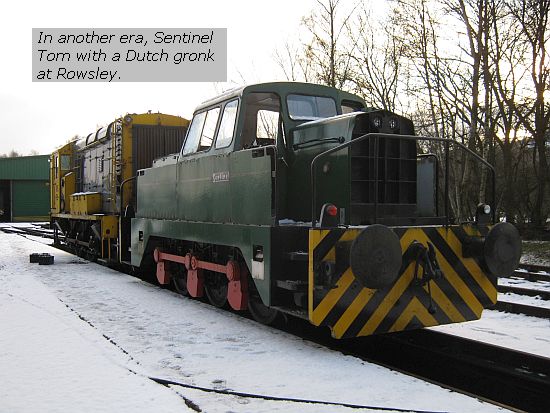
But over the last few weeks, and especially since Ludwig developed that engine problem, the fate of Tom changed and the decision was taken to get it back operational. So after leaving the HATRAMM, I dug out some Makrolon (other tough transparent plastics are available) and set about making up a replacement pane that will serve for now. The side sliders are of course made with an aluminium frame, and the original glass bedded in some sort of mastic. So when the window smashed, it left pieces of glass at the edges, fractured like the others but held in the mastic and sticking out like a row of jagged teeth. First task was therefore to prize these out and remove as much of the mastic as well as would easily let go of the aluminium. Having checked that my Makrolon would sit into the slot in the extruded aluminium frame it was then a case of measuring, determining the corner radii and then finding something of near enough the same radius to draw the shape onto the Makrolon to follow with the jigsaw.
By late in the afternoon I had got it cut, but the need to remove the tarp, and trial fit it first from the outside (where it was parked wouldn't have been very safe to try) put me off going further and instead I started doing some tidying up of the broken glass within the cab, to make it reasonably tidy once again. Andrew has agreed we'll shunt it across to another track when he's feeling better and can get it done. Thus Saturday night, with nothing much on TV and Andrew out for the count, I cleared a bit of desk space and extracted the first sheet of the HATRAMM drawings, using the key list to write on what each unit actually was and try to make sense of it. The conventional wisdom is to go on adding interlocking relays to everything. Our record back at Hills, if I recall, was a loco with 45 relays. The trouble is, without anything visual, you have no means of diagnosing when a fault manifests itself. That's what I like about PLCs (programmable logic controllers). Every input is provided with an indicator light to show its state, on or off. Interlocking doesn't mean more and more relays with all the attendant wires, rather you write it into software and if you've got any nounce, you write some form of feedback whereby when something you are trying to do is a no-no, the system tells the operator why it won't co-operate.
The HATRAMM is crying out for a PLC but it won't get one yet-awhile, so instead I became engrossed as I gradually got to figure out what the relays (there's about 50, plus timers and limit switches, two or three frequency switches, rotary switches and so on) all purport to do. From our point of view, simplification will be to extract those relays whose function is to switch things on the machine we do have, to control from the other half which we don't. It also shows different approaches to problems, which is quite interesting in itself.
When I joined Hills, the technical specs on locos referred to 'anti-plugging' which turned out to be an arrangement whereby once the engine has started, you cannot accidentally re-engage the starter motor ('cos it doesn't do the starter any good at all!). At Hills we did it by using the oil pressure switch - oil pressure equals engine running equals disable the starter motor, though it could give the occasional problem with an engine so reluctant to start that it built up oil pressure before firing. The gallic approach called it a 'Starting Anti-Repetition relay', but all it seemed at first to be was that pressing the start button energised relay 1 and that in turn energised relay 2 that powered the starter provided relay 1's contacts gave it a supply. But relay 1's return from its coil disappeared across the page and when I traced it through, it was connected to a terminal on one of the two alternators. (Yes it has two 24V alternators, there are a lot of power-hungry 24V DC devices on this machine, and I'm not just talking about all those relays.) Actually, I realised it was connected to the terminal that links to the alternator (charge) warning light on the desk. You'll have one on your car - it goes out as the engine starts showing that the alternator is charging your battery after it did its job starting the engine for you. What actually happens is that the bulb is connected to the battery at one side, and when the engine is stopped (or the alternator fails), the terminal on the alternator has no voltage so current flows through the bulb giving you the warning light. As the engine runs, that terminal rises suddenly from no volts to a bit over your battery voltage (on a loco that's 27.5 typically for a '24V ' system) and your bulb with virtually the same voltage both sides, goes out. Now return to our relays. At start up, relay 1 has 24V on one side, and like the warning light, sees no volts at the alternator so energises. But as the engine starts, that terminal rises to 24V too and long before that, the current through the relay coil drops away and the relay opens, and won't close again until the engine has stopped. Given that it not only powers relay 2's coil, but its contacts also gives the 24V to relay 2 to send to the starter motor, this doubly ensures that the starter goes off and stays off.
And round about half-midnight, when I had been at it for three hours or so and was up to page 5, I suddenly found an innocuous-looking relay at the bottom of the page whose coil was connected to earth on one side and a cable to the 'other half', and thus could only be energised when that other half was coupled up. Its contacts however, would 'make' the throttle control (subject to some other conditions) and appears to be what we lacked those years ago when we got it to run before. As I went to bed I had a long set of notes and several relays slated for removal in due course.
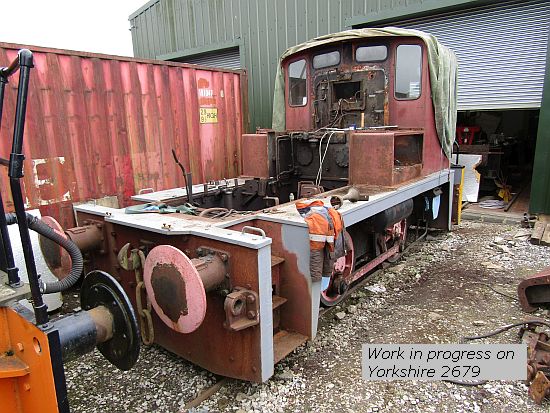
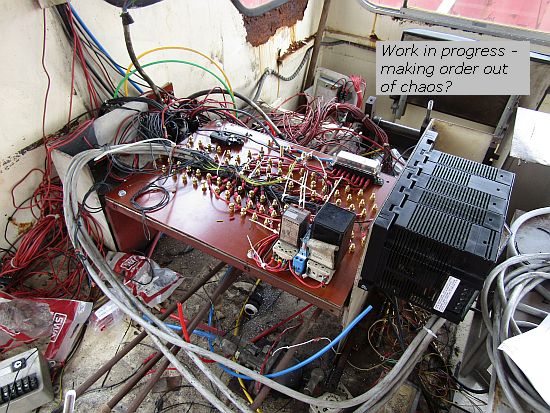
Jagger was across today, working on the loco we have always known as Jack, which he is stripping down for a thorough overhaul, reversing the damage that began after a group 'down south' borrowed it, took all the paint off and left it (mostly) in primer. Primer is not waterproof so the rust comes through. Tempting though it was to return to the HATRAMM, I thought I really ought to get back to Alstom's loco and resume the task of re-connecting all the wires that will enable its new PLC to do its stuff. It's a steady task, with 5 multicore looms planned to go from PLC into the 'connection' area (3 finished now) plus the multitude of wires that go to the control panels at the sides which I have yet to deal with. It is slow, satisfying work but hard on the back and backs of the legs, leaning over the desk base to access the various positions. I have invested in several hundred tie-wraps to keep things tidy!
So that's about it for tonight. Next week is looking a bit vague - I have the van to get MoT'd tomorrow and myself the second jab, so Tuesday's held open and Wednesday I've got visitors booked. I'll tell you all about it next week, see ya then.