
Of nostalgia and dynamometers
6th June 2021
Is a new normal on the horizon?
I've racked up another 700 miles or so this week but with little to show for it. I had to go down to the southwest on Tuesday - lovely day, the sea looked awfully inviting - but I had to be in Brum on Wednesday so it was straight down and almost straight back, though I did go on a little detour to a place I had spent several days in during my early years with 'Hills, doing dynanometer tests to ascertain what size shunting loco they would require to replace their aging 'fleet'. Now, to most enthusiasts talk of a dynamometer throws up pictures of a specially modified bogie carriage and white-coated engineers crowding over a machine churning out a mile of paper roll with pens recording all sorts. But our equipment was rather more prosaic and went in the boot of a car (or once or twice, even my old land Rover).
What it was was a hydraulic cylinder with a pressure gauge attached, but the pressure gauge was calibrated in lbs of force that was being applied through the hydraulics.It was rated as a maximum of 50,000lbs and manufactured by a firm in Feltham, just oustide London. Originally Sentinel had one and Hills had a second, but after Rolls ended rail production at Shrewsbury theirs ended up with us. At each end of the cylinder was a lug and through that a shackle, and the result was like a 3-link couling with the big heavy cylinder as the middle link. And that was how we used it, with an extended hose to come up from the 'coupling' to somewhere you could read the gauge, plus a clipboard, paper and a pen.
You then carried out the duty envisaged, with either the current train (if new rolling stock was expected) or with a suitable load if increased tonnage was on the cards, recording time, loco speed, drawbar pull (as per the dyno needle) converter/engine temperatures and rather importantly, where you were at that moment on a track plan of the site. In my first year or two at Hills, the test was carried out by one of the sales team and the figures came back to me in the office to be 'written up'. Provided the track plan was to scale and had gradients logged (sometimes the sales personnel had to find this out for themselves - I once spent most of the day 'surveying' the Flixborough branch with a metre long spirit level and a calibrated hardwood wedge) I could have a happy time laying the train out on the plan, calculating all the gardient, curve on rolling resistances of loco and train, 'proving' my results against the actual drawbar pull that the dynamometer hydraulics indicated and then extrapolating to what was required.
Having done physics and chemistry at school, I was quite familiar with the procedure for writing up experiments - methods, results, conclusions - and produced a quite presentable document that would show what their loco was doing, why it required that force in that location, and by the extrapolation, the locomotive required for whatever it was we had been called in for. Was it scientific and objective? No. For one thing, just as at school how you learned to fudge the results of your experiment to get the answer that the teacher expected/required, so I could build in factors when neccessary to steer the result to the locomotive we wanted to sell them. But it looked convincing and after all the effort we had gone to (for free) it went a long way to winning the order.
But not always. I did a long report for a certain cement company north of London which recommended a 48ton 0-6-0 of 370bhp and couldn't understand why we lost the order to another whose loco was only 45tons and 305bhp, and diesel mechanical at that. Years later I found out that our Sales Manager had fallen out with the customer's engineer, who had passed my report to the competitor with the message, 'get as near as you can to this and the job's yours'.
Anyway, I still have memories of this place I returned to on Tuesday: I think it was one of the first where I had been let out to do the tests as well as the write-up. But it must be 40 years ago and I recognised almost nothing (we didn't get the loco order either, but then nobody did, they went over to a beetle). I think I must be getting nostalgic in my old age.
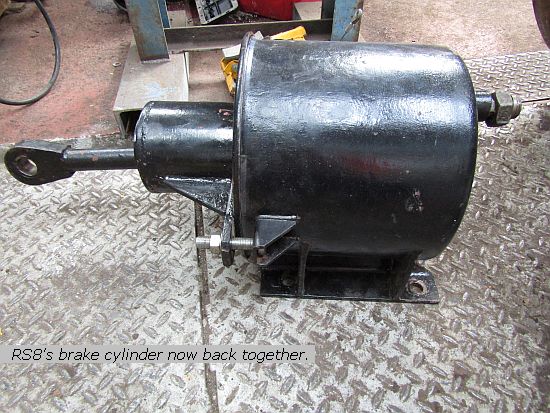
Andrew and I got back into the shed on Wednesday night and finished reassembling RS8's brake cylinder and testing it. It judders a bit but will probably bed itself in especially when it works at higher pressures, the return spring in the cylinder had a much lower static force than other brake cylinders I've worked on. Grandson has been up for half term so Andrew's time in the workshop otherwise has been minimal: for myself I spent all of Friday and most of the weekend, though Andrew was taking grandson back today so only joined me late on. I've been plodding steadily on with Alstom's re-wire, the chaos you saw in past pictures is now looking much more organised though as usual I am thinking that I should have allowed more space where the cables all come on to the board and maybe another dozen or more connection points...? Ah well, I'm over half way getting all the wires on so it can't get too much worse.
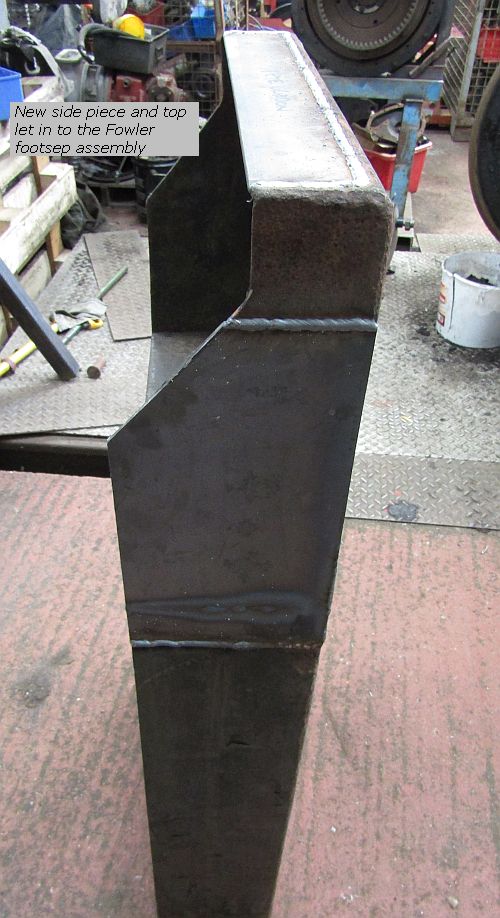
Andrew on Saturday made a start on the step assemblies for the 0-4-0 Fowler. One in particular as rotten and jack-rusted at the top so he has let a new piece of steel in (still to be drilled for mounting holes) plus a piece at the side which had corroded right through. The bits still need dressing off but should be a lot more substantial.
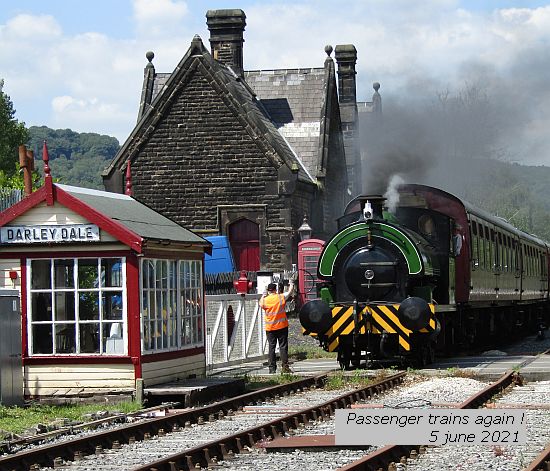
And outside this weekend we've had the return of Peak Rail passenger trains. Passenger numbers (from what I've seen) weren't breaking any records but at least it will be a modest income back into the coffers.
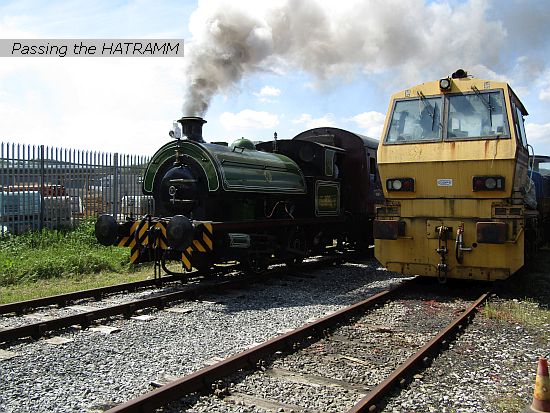
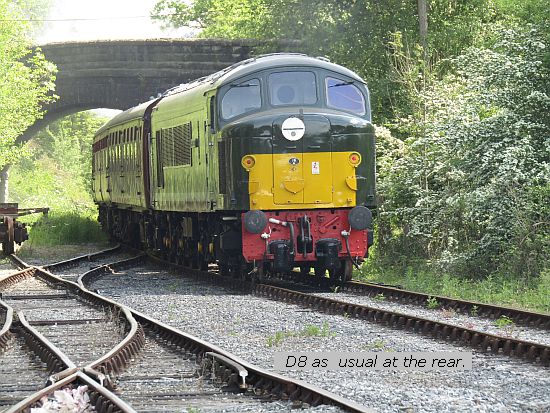
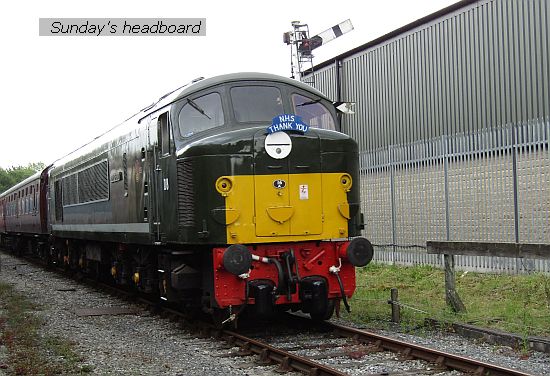
You'll notice that they're working wrong line through Darley Dale southbound - the up platform is out of action for p/way work - but of course the trains are get on at Rowsley, get off at Rowsley anyway. A nice touch was the NHS headboard carried by D8 today
So that's about it for this week.Oh, nearly forgot. The Tits are back. After two years of Great Tits nesting inside a buffer on the Bakewell end of the Ferry van, I heard tweeting from the other buffer and sure enough, there are young hungry tiits in the that buffer this year. Presumably they decided that the first buffer is too insanitary for use this year.
Several interesting developments are in propsect, more transport work is booked. I'm off first thing in the morning so it's time I got to bed. I'll be back with something new next week. See ya then.