
Of cameras and holes
13th June 2021
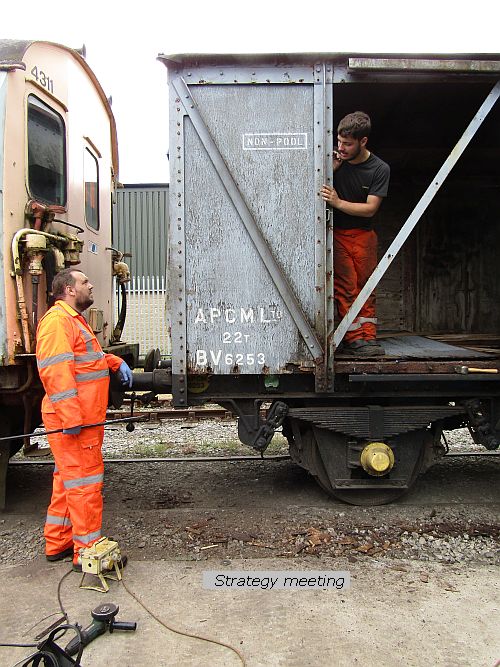
What can I say about this week that is fit to say? Rhetorical question, I know. Not as many miles drven as some weeks, but the transport side is ramping up again so I can enjoy the lull while I can. Which ought to mean that I have been able to get on with all manner of other jobs but with the usual interruptions it hasn't really worked that way.
On Tuesday I collected Tom's repaired starter motor and that evening Andrew and I popped down to get it fitted. Then with some tredpidation we cranked it over and it fired almost immediately before dieing off almost as quickly (no surprise). On a second attempt it started and ran. For a loco that has been stood for two or three years and that we remembered as labouring to start, this was gratifying, but not without its issues. Andrew noted an oil leak from under the supercharger, I initially saw torque converter base pressure show but when next I looked it had dropped away, and the charge rate on the ammeter appeared to steady at about 20amps, which was a bit high and merits further investigation. But despite all these good and bad points the loco eventually built up air pressure (a few leaks under the desk) and condescended to move itself, briefly.
The loss of base pressure may be nothing more than low converter oil (it's a candidate for a level switch as the sight gauge is in an impossible position to see properly) so it will be getting some TLC over the next few weeks.
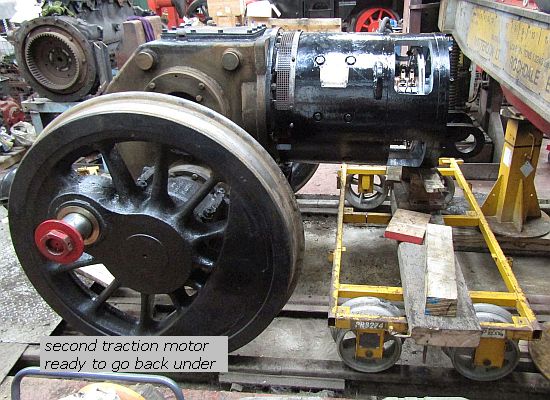
On Friday the second traction motor for the Janus returned, followed by two guys and a pick up from Scunthorpe collecting a couple of carriage drawhooks. I did the usual tour round the site (they apparently didn't realise how much we had and what facilities) before sending them on their way. Then the traction motor was re-united with its gearbox, and made mobile with the trolley ready to go back under. Which happened on Saturday, though it was a hot, tiring day getting the motor and wheelset back under, the traction motor suspension pin back in, the stretcher swung back in under, and the hornchecks re-fitted. With some of the brake rigging parts replaced while the loco was on the ground, it will next be raised so as to complete the electrical installations and once we're satisfied, its middle axle will be brought back and put under.
So (I think) in line with a new policy that I proposed, today was to be on 'our' stuff, not any commercial work of mine, and apart from a quick lift of a piece of brake rigging while Jagger was around to make it easier, we have today been on other projects. First on Andrew's list was a look at Ludwig Mond, for which he had bought a boroscope electronic camera thing that interfaces with his iPhone. To use it we planned to take out two injectors from the Dorman 8QT and peer down into the cylinder without the long task of draining coolant, removing inlet and outlet maniolds, etc. So the injector from the first suspect cylinder was duly detached from its feed and spill return pipes and the two nuts removed from the studs that held it in place. But it wasn't the only thing holding it in place and no amount of trying to lever it had any promise of extracting it. In times like this you need a slide hammer, and we have one somewhere. Basically it screws onto the outside end of your injector (by removing its cap) and attached to it is a long length of bar or threaded studding wth a stop on the far end and a substantial lump in the middle. Give substantial lump a good pull up and when it hits the end stop the momentum, in dead straight line with the axis of the injector, causes the latter to jump up. We have one yes, but could we find it? No.
After two of us had spent half-an-hour looking Andrew decided it was time to make another. A large lump of solid bar (probably a core taken out of a loco buffer beam when drilling for a train pipe) was located, an injector top cap recovered from RS8's old engine (fortunately the caps were the same in size and thread as the QTs) , a length of M10 studding and we were good to go. Andrew tapped out the injector cap to M10 while I drilled out the block to about 11mm on the vertical drill. (A 3-jaw lathe chuck would have been easier but we don't possess one).
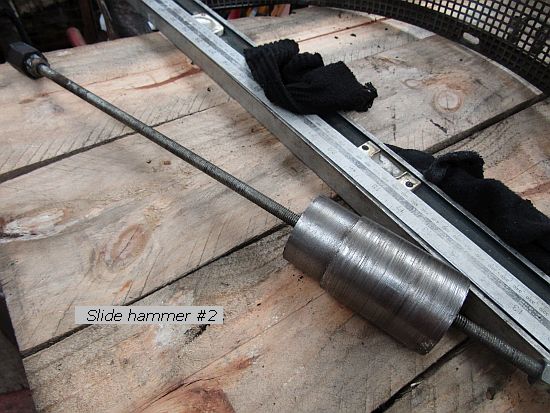
By now it was lunch time but after Andrew welded the thread firmly into the injector cap and still too hot to touch, I screwed it on the the QT's injector and out it came with a few thumps. It was now time to test his new toy and while he stood there staring at his phone I attempted to slide the camera down the injector hole into the cylinder. This is perfectly possible on a Rolls, we did it (with another boroscope) on RS8's engine. But Dorman's injector pocket includes a narrowing at the bottom at which the last few mm in to the cylinder is too small for the camera, so we were none the wiser. We barred the engine over and Andrew was convinced any noises of mechanical distress were coming from the other block (B3 as opposed to our first candidate of A1 if you're interested) so we took that injector out too (it came without a fight) to no avail.
So we boxed it back up while a decision is taken what to do next. Andrew tends to favour converting the generator to twin bearing and mounting a better engine than a Dorman (apologies to any Dorman-fans out there) in its place. Wait and see what transpires. Jagger meanwhile had been making slow progress to get out the first two plywood panels on the cement van which are at the 'rotten end' and require renewal.
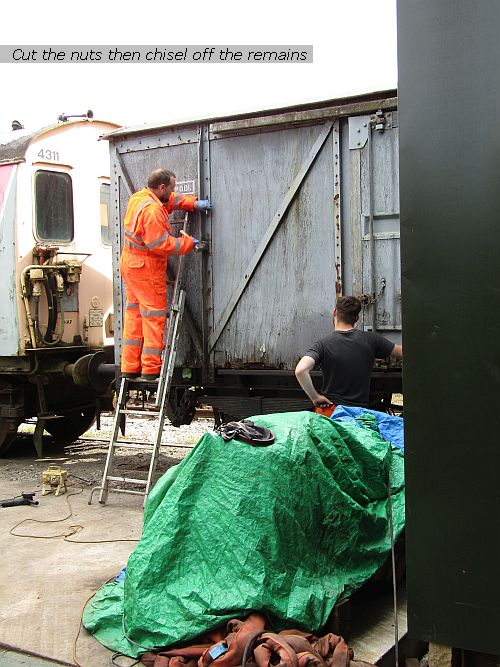
Andrew bought the plywod last week, and better that we make use of the weather while we can. It wasn't helped by Jagger's reluctance to work from the top of ladders (I feel the same but my alarm bells don't start until a few feet higher) so while Andrew was elsewhere I cut out lot of the bolts by slitting in to the end, through the nut, then knocking the two halves off with a hammer and chisel.
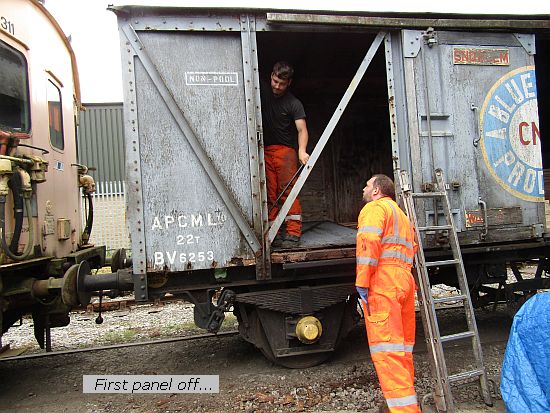
Andrew largely took over and he and Jagger then destoyed the side of the van (both inside and outside layers having to be removed together).
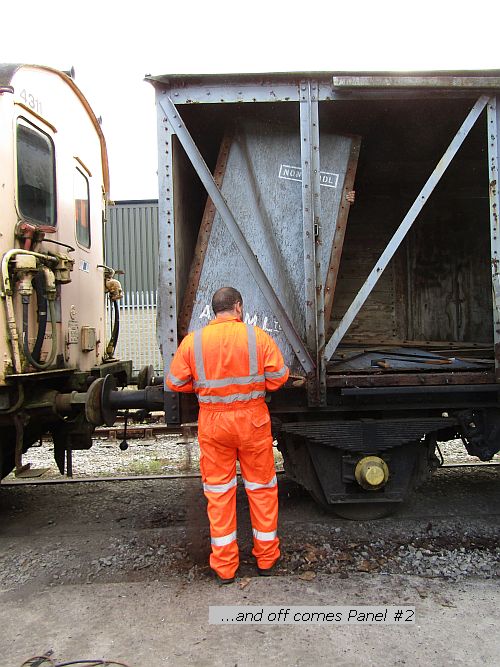
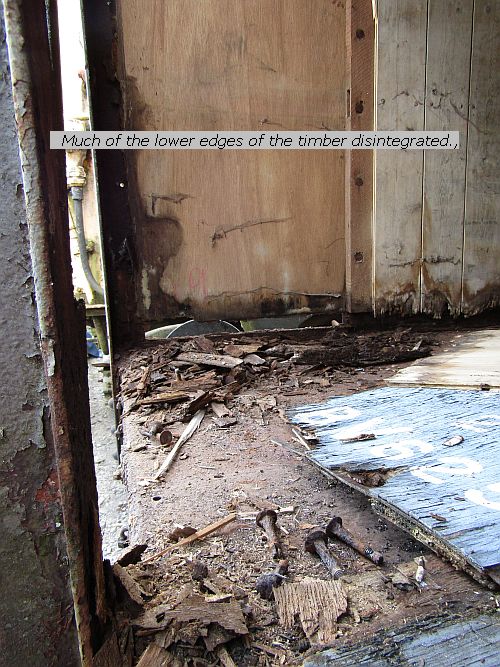
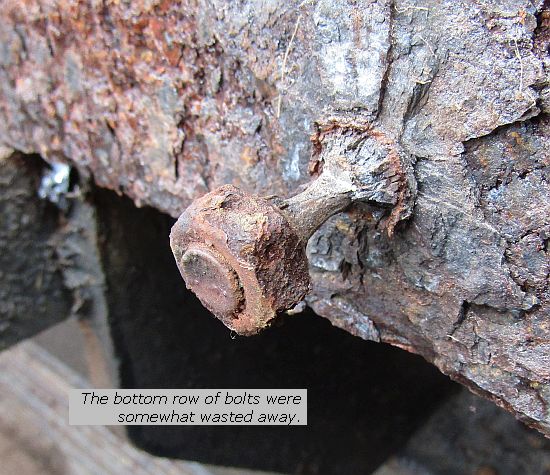
Some steel flooring needs renewal at this end where it has rusted and buckled, and the side angles need de-rusting and bolts that were left as they were holding nothing and were wasted away (sometimes called 'necked') must be extracted.
Having the actual sheets off enabled Andrew to check the dimensions he'd based his plywood requirements on and was relieved to find them close, so I guess it'll be cutting and drilling shortly.
And that's about it for this week. Tomorrow I'm off to collect a Lister engine/pump set from an auction that Andrew bid on, and later in the week there's locos and such to move. So I'll say cheerio for now, but be back next Sunday; see ya then.