
Of being on the wagon and mugs of tea
9th May 2021
The two are not neccessarily inter-dependent.
My plan for the week was all laid out, with loco moves starting on Tuesday and progressing through to Friday. But like a row of dominoes, when the first one fell down ('loco not ready') the next wouldn't happen and the last - well, the last I heard that wasn't ready yet either. So it was a workshop day on Tuesday, progressing on the Janus, getting it ready to lift out that second traction motor while an electrical engineer from a contractor looked over the generators and gave us his 'oh dear' face. But Wednesday had us out on the road. Do you remember Thelma and Louise? Not the film: they were two conflats that we bought in the nick of time from Bo'ness and refurb'd quickly to act as barrier wagons. After their contract was finished, they came back and later got sold to a member of the AFRPS, and were used to couple to some HST trailer cars they had acquired. But circumstances had changed and they were now to find a new home at Dereham on the Mid Norfolk, and I was contracted to take them there.
They had changed a bit since last I saw them. Our refurbishment had been to a deadline whereas work had started on a more thorough job, and Thelma had no floor and much of the tin-wormed side angles removed. Going on to BSC Scunthorpe neccesitated an Induction (my last expired in 2015 when it was Tata) and delayed things somewhat, so once loaded it was a steady drive south to Dereham. Arriving ahead of Adam, I thought I might have about 30 minutes to suss out where we were unloading (I knew that it was NOT going to be up near the level crossing!) but in reality I was barely 15 ahead of him and soon we were lining up and building a ramp to unload. I feel I know Dereham well, having had many a mug of tea at the Morrisons opposite in the course of collecting or returning grandson to his mothers in Dereham or more recently, a few miles outside. The station at Dereham though was a scene of significant activity, with many staff/volunteers to be seen, works trains being loaded, shunting of carriages and so forth in progress and contractors assembling formwork to cast a concrete floor in the shed through which we unloaded. Such was the rapid progress we made that I never got around to getting a photo, although Andrew had gone off with one of my cameras for work purposes.
On Thursday it was off again, and a very early start as Adam had decreed we should meet at Fawley Hill at 09.00. Exactly where we were going there was a bit of a mystery in itself. Thanks to good friends amongst the crowd that work at Fawley Hill, I had a description of where these two wagons were, but they were not part of the Fawley Hill railway and Andrew's version of Google Earth (on his i-pad) showed nothing, but when I scoured the same area using Google Earth on my PC, there they were.
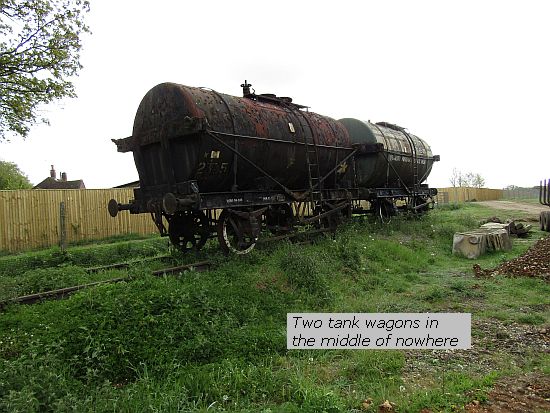
The only snag was that the rail height was over 2ft above ground level - not what I had expected and I thought meant a lot of ramp-building. When Adam arrived he took one look and proposed that we load over the back of the trailer, which was fine except the control valve for the winch was in the way, so I unbolted it and moved it to one side. There was also the winch itself, but the clearance was sufficient for the wagon to pass over and anyway Adam proposed to utilise two 'tips' back-to back to get from the track to the rails welded on the trailer and that would lift it a few inches more. Rather than winch, Fawley Hill estate's man-Friday (and every other day of the week) Roy used a telehandler.
With the effort saved from ramp building we allowed ourselves time for a mug of tea and Adam and Ian got lost in the late Bill McAlpine's museum. If you've never been to Fawley Hill (its openings are infrequent even in normal times) it is the most unlikely place to put a standard gauge railway, with a gradient of 1 in 13 near the top. A large amount of wildlife lives there too, from lamas and deer to peafowl, whose calls transported me back to quiet days back at Chessington Zoo (as it was called then) where I had been employed in my youth as a car park attendant.
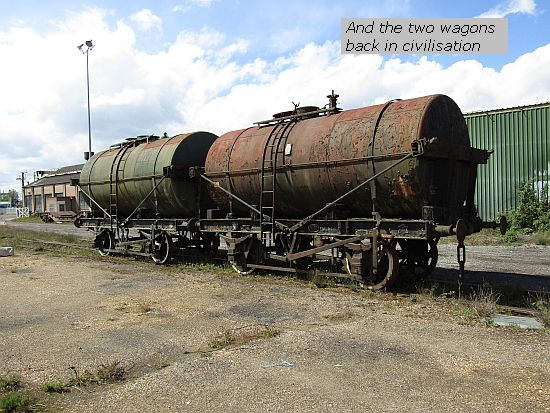
But back to today. Our destination this time was Southall. Adam confessed that his pulse rate rose whenever he had to drive 'inside the M25' and I know why: I notice a different standard of driving whenever I have to go into the outskirts of the metropolis and I am not in charge of a large 6x4 with an over-width low load trailer behind. Again I went ahead to suss out the route and advise Adam on which lane to grab where and by late afternoon the two tank wagons were in their new surroundings.
On Friday it was time for more paperwork but on Saturday Andrew and I went back and brought that second traction motor out from under the Janus. One of my regular readers was surprised to see that the traction motor was at 90 degrees to the axle, model railway-style, having expected a parallel armature. This is not unique to Yorkshire though because the gearbox was a BTH product along with the motor, so saved the loco manufacturer the hassle of designing one of their own. The downside was that it only came with one gear ratio. So when matching the power output of the engine and genny with the torque from motor to suit the adhesive weight of the proposed loco, the only variable remaining was the wheel diameter, so Yorkshire had a multiplicity of them across different designs, which Janus the largest at 3ft 8. The cut'n'shut trolley was put into action and the traction motor came out into the light of day. It will be away shortly for specialist attention, which I fear it needs.
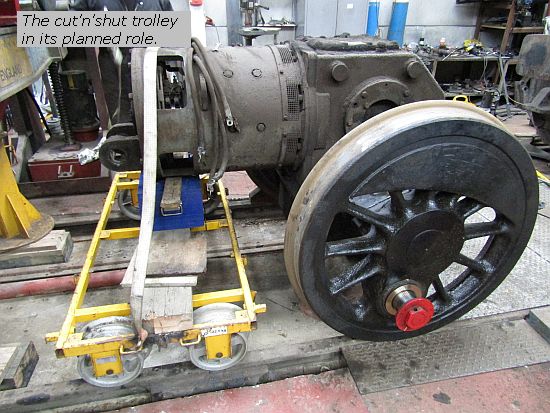
For all that most BR locos were DE, in a heritage environment DE locos require more attention than do DHs, and much of it involves getting under to inspect or rectify. We opted not to excavate a pit within our shed, because we are too close to the water table from the Derwent, but we can get underneath and can lift the loco if more prolonged access is required. Now, saying that we took the traction motor out and split it from the gearbox is a simple enough sentence but behind it was most of Saturday and that was after we had already detached everything and cleared the under-bits (brake rigging and such) earlier in the week, leaving only the motor suspension pin and horncheck ties to complete the job. We did spend some time beginning to reassemble the brake rigging at the other end (if only to tidy up the floorspace) but that was about it.
Today Jagger had joined us to work on the Yorkshire 0-4-0DH - Andrew gave him assistance cutting corroded brackets off at the front end and all three of us eventually lifted the rear casing section off after it had been detached from the cab front. I had hoped to get around to making the spring buckle for Charlie, components for which were profiled 3 years or so ago, but when we came to lay them out it was obvious that the flamecut buckle had a taper across its base (a side-effect of the flamecutting process) which needs milling square before welding together so that got put out for subcontract. I retired to the Alstom loco to continue cabling, returning mostly for periodic mugs of tea. Jagger has his with a considerable volume of sugar in: I have to remember to keep stocks high when he or Phil are over.
The Rail industry has been seeing some change of late. For those of you who are not up to date, Wabtec, having absorbed Brush (and which had earlier absorbed the old Barclay premises in Kilmarnock, latterly Hunslet-Barclay) closed Brush-Barclay rather suddenly. More recently we wondered just how long Brush at Loughborough would survive, Wabtec has recently announced its forthcoming closure. The interesting one is Hunslet. Although Hunslet Engine was bought by LH some years ago and transferred to Barton-under-Needwood, it too had come under Wabtec ownership, but here the decision was made to sell the business, and it became a two horse race. The winner was the firm of Ed Murray, known mostly for loco hires based in the North East. Companies House watchers spotted that a new firm 'Hunslet Ltd' has been registered to carry on the business, the old firm of Hunslet Engine Co being dissolved. (As an aside, I find it irritating that a number of enthusiasts insist on refering to Hunslet Engine as Hunslet Engineering as though the Engine is an abbreviation. I want to ask them if they've ever read 'Thomas the Tank Engineering'.)
And then of course there's the debacle that's unfolding with the Hitachi bi-modes (and to a less critical extent with their Scottish emus) where areas around lifting brackets have developed cracks. Hitachi are responsible for ongoing maintenance and there are penalty costs for trains being out of action. To have the whole fleet affected and probably a campaign repair/alteration to come, on top of the incident in Leeds a while ago where one ran into the back of another train at low speed and came out much the worse for it, will have management at Hitachi worried. It will be fascinating to see what stop-gaps appear on the network as the problem is tackled.
Well, I had expected last week's program to be retimed to this week but even that's gone for a burton so I've even less idea what's in store than usual. You'll just have to come back and find out. See ya then.