
Of Rules and convictions
1st November 2020
First day of a new month. Did you remember to say 'White Rabbits' first this morning or was it more of a 'Oh gawd another day in lockdown'?
Despite my confidence last week, my sister has reported that the Bailiwick of Guernsey was rocked by a 'small cluster of Covid cases' (nine) that were discovered about a fortnight ago, but an effective track and trace system identified patient zero as one who had returned from 'abroad'. Thus they are at level '5C' (and you think Teirs 1,2 and 3 were complicated enough).
Anyway, enough of all this, what has been afoot in the sunny climes of Darley Dale? Tuesday was a good day: somebody came to view the old mechanical hacksaw, which, despite e-bay listings hadn't attracted much interest and consequently was occupying about 10 sq feet of floorspace. Plugged in and shown working, the visitor confirmed an offer and arranged to return at 4pm to collect. That sounds simple but in order to achieve this it was necessary to pull locos away from the shed, then move across and drag the train up Track 1 so that his van could get around the back for the saw - once it had been released from the clutter that had grown up around it - to be forklifted out of the shed and into his van. Andrew estimted it weighed about 200-250kg. I thought it weighed way more than that but rather than appear too foolish suggested it was over 300kg. Andrew offered to take a bet, knowing that he was safe in that I make it a rule in life not to bet, and when put on the hook of the forklift through the load cell he bought recently, it tipped the scale at 510kg. So I could have earned myself a few extra quid if I'd stuck to my convictions but not my rules. Either way that evening we celebrated the release of 10 sq ft of workshop floor by sweeping it up and admiring it.
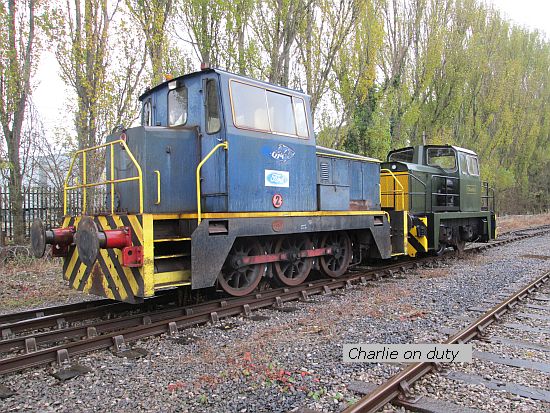
One of my other 'rules' has been not to discuss commercial work on this blog as it can be confidential but for once I'm going to stretch the boundary a bit as else I'd not have a great deal to say. On Thursday it was time to despatch a loco back to Ford at Dagenham, and for reasons I'll not go into it had to be propelled up by Charlie. Here they are about to set off from the yard.
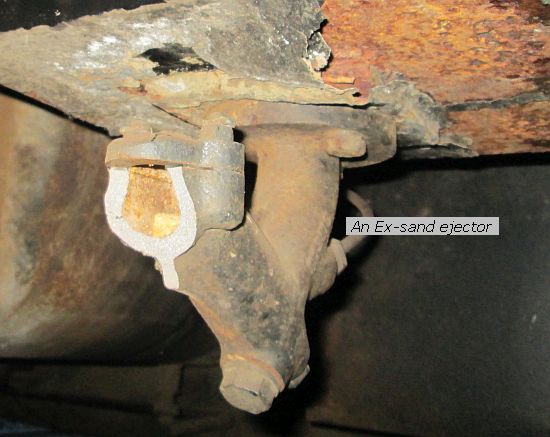
By the time we got to Rowsley the ramp had already been assembled so instead of setting it up to be hauled on by the winch, I went for it and pushed it up with Charlie. Once the loco had been secured, Charlie dropped back down the ramp and unfortunately a sandpipe was caught as the springs bounced. A year or so after Charlie was built, Hills made an alteration to the sandpipe design. Instead of being one solid pipe, it was split into two pieces,and joined by a few inches of hose and two clips. The lower section had a supporting strip added back to the chassis, and as a result if the pipe encountered something, it flexed on the hose and maybe bent the strip, but the sand ejector was unscathed. But Charlie pre-dates this and I was reminded what a simple worthwhile mod it had been - as in this case the end of the sand ejector has been smashed off. Aah well.
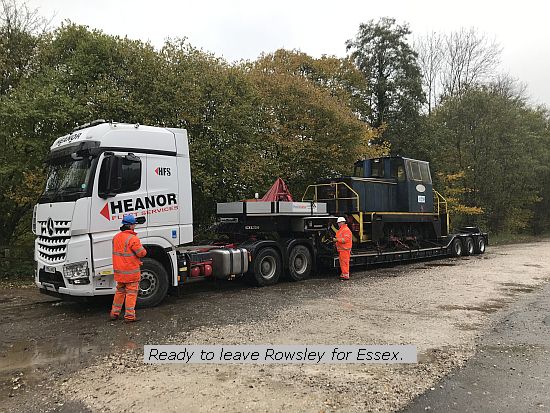
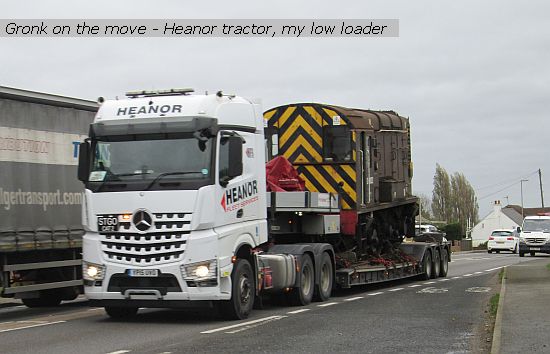
The loco is seen here just about to set off for Essex, and I chased after it (and apparently overtook it while they were in Newport Pagnell services on a break) and it was duly returned to its owners that evening. The following day we loaded a gronk. I won't go into this much, other than to remind readers of my previous expressed opinions of such locos ('State of the Art -1870s- chassis, State of the Art -1930s- traction package and a trawler engine') nor my incomprehension as to why every heritage railway seems to believe that it must have one, or two, or three: but for some reason it is as though until you have transported one of these old fossils you won't be taken seriously. So here I can prove we have.
Saturday and I was back on a loco in the workshop - to whit Claire which is getting nearer completion. So much of my weekend in fact has been spent on a former Land Rover seat cushion cabling up the control 'box' under the desk. It may look a bit untidy (it's not finished and a few tie-wraps will make all the difference) but it's not that much more complicated than RS8, and much of the wiring diagram is the same.
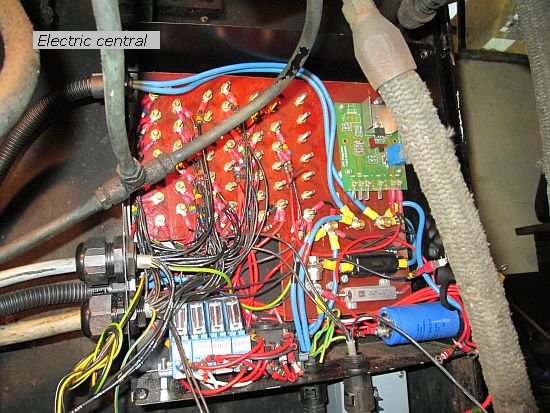
Indeed, I was reflecting on the fact that back in the early 1990s, I was persuaded to adopt a 'standard' wiring number system. Instead of just numbering each wire in sequence 1,2, 3 and so on, blocks of numbers were allocated to different functions - so 100's became engine wiring (starter, run solenoid, temperature and pressure switches, etc) 200's became desk control, functions, 300's became pneumatics, and so on. Any cable ending in -99 was a negative return to battery. And it then became logical that each cable number should be common to different locos: thus I know that if I encounter say wire 103, it is for the engine oil pressure switch. Certainly there are anomalies as the original system hadn't got the philosophy fully mapped, and the whole system started to struggle a bit when I applied it to a twin-engined Janus - solution, 103 for engine 1, but 153 for engine 2. Claire was partially re-wired a decade or so ago, and although I have largely replaced it all with fresh wiring now, I was reminded how beneficial it can be when re-cabling the gearbox detection switches: I could identify the forward and reverse switches by the cable numbers, which had always been the same.
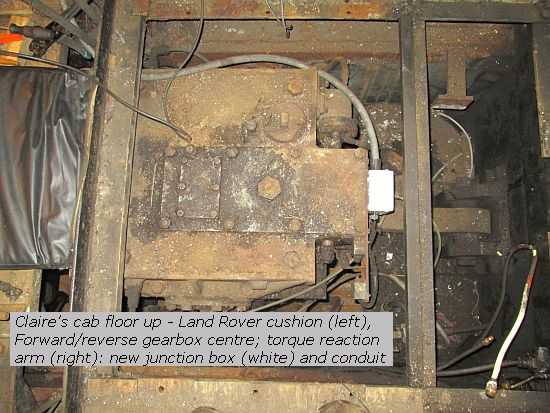
There is still much to do on the loco but I ma beginning to see the end of the job - just hope that lockdown doesn't screw things up for me! Andrew tells me a new video has appeared of the 2010 gala at Butterley where 14 901 performed - strange to think that it it is a decade ago and the old girl has been stood down until we can tackle re-powering it. And so that's about it. I hope you all stay Covid-free and cope through the coming weeks. As usual I regard the workshops as my workplace as well as part of my living area so I'll continue on and be here next week to spout on about it. See ya then.