
Of oils and such
18th October 2020
Here we are again.
Once again the pressure is on to complete some commercial work as the bills all have to be paid. This particular loco has been mentioned in this blog before so I make no apologies for letting it feature again. We finished last week with an engine that ran and wouldn't stop, and by the time that had been sorted it was too late ( = nearly dark) to get any further. During the week things hadn't stood still but I hadn't had time to shunt everything out the way once more to permit this loco to be fired up again outside. So by Saturday, it was time to get back to it and Charlie did the neccessary. We filled the transmission system up in stages: stopping the engine once the oil level had dipped out of the sight gauge so there was no chance of the charge pump running dry.
People have asked why I run converters on hydraulic oil rather than engine fuel - actually, some have poo-poo'd it, believing that they 'know better' and asserting that there is no difference in performance between the two. Indeed there isn't, except in one important respect, and that is 'lubriscocity'. In the olden days, diesel fuel (aka gas oil) had good lubriscocity, but it also had sulphur, and the processes used at the refineries to extract the sulphur have the unfortunate side effect of also adversely affecting lubriscocity. Thus components within and around the converter that rather appreciated that lubrication, your charge pump, for instance, are prone to greater wear if you continue with modern gas oils. Besides, you're also more prone to condensate in your fuel system. The engine can generally cope with this, but once fuel gets into the converter 'loop' it tends to stay there, and the lowest part of the fuel system in the loco becomes the very bottom of the converter. And where does condensate tend to congregate? I have had converters in for repair where the bearings have shown evidence of water damage - in an environment that should have been 100% gas oil. So I recommend all users to switch to hydraulic oil in converters in place of diesel - yes, you have to top it up now and again, but it is better for the long term health of the converter and ancillaries.(As an aside, the manufacturers recommend an oil called 'Torq30': I've tried it a couple of times, the second to convince myself that the strange experiences I'd had first time weren't a fluke. For one thing this stuff was so thick it was reluctant to flow down a pipe anywhere less than half-inch bore, it seemed, and once in, if it got too hot its viscosity seemed to disappear altogether.)
Anyway, we had a few minor leaks - spreading my regrettable reputation for not having tightened some connections up properly - but when base pressure started to appear on the gauge in the cab, that should have been it, but the oil level in the sight glass continued to fall, suggesting that somewhere it was still getting out. A quick examination of everything showed that a connection on the side of the converter was leaking, and to my relief, it wasn't one I'd done. (That makes me feel like a draughtsman we had back at Hills. It was said that if the Workshops men found something wrong on a drawing it was invariably his mistake, so that his nicknmame became Bollock-chops, as it was always him dropping them. When one day another draughtsman managed an entertaining clanger whereby two seperate components ended up drawn in the same physical space, Bollock-chops was inspired to go round the Workshops saying delightedly to anyone who'd listen 'It wasn't me! It wasn't me!'). Anyway to rectify this leak meant draining the system down again, and so we dragged the loco a bit further up the sidings where a slim press-ganged member of the team could be prevailed on to crawl under and extract the plug from the bottom of the converter and collect the oil, ready for sorting it today.
In the end, another eagle-eyed colleague spotted that it was not in fact a loose connection but the special cast fitting that forms the exit from the converter had a long standing crack that had opened up under the force of the tapered pipe fitting now screwed in. I did have a pattern for casting new ones of these, but the foundry lost it some years ago, seems I must think about recreating it as it took the last of my stock replacing it. So back together the system was filled for a second time and at last remained as oil tight as I'd expect.
You might think here that I am choosing my words carefully, and why would you need to top up the oil from time to time? I am. The two shaft seals on the converter were probably start of the art in their day, I'm sure, but the manufacturers never expected perfection, and a converter whose seal(s) leak at a rate of one drop every 10 seconds from new was deemed acceptable. Indeed, if it got to one drop every 5 seconds, it was due to come out and be replaced. That is not to say they all leak from new - they don't. My regular repairer will not let one back to the customer if it does driip on test, but it is a common failing. RS8 for example, has a tank under the converter whose job it was to collect the drips from the converter seals by means of special pipes.
I once entertained the CEO of the Twin Disc licencee in Japan ('Nico') during my YEC days at Long Marston. We got on to leakage and my guest was most insistent that their seal arrangements didn't leak (I was also aware, from days at Hills, that the Nico '138' converter did not give the same performance at the Twin Disc CF13800 it was supposed to be the equivalent of, so didn't really see much point in using their version but didn't want to be confrontational when I wasn't likely to buy new converters anyway). On the other hand, in the days when the test track was being refurbished and electrified through Old Dalby for the Virgin Pendolinos, Alstom took one of Mett Camms' Hunslet 0-4-0DHs and tried to use it as a trip loco. As it kept shutting down on overheat, somebody wired out the switch. (Why? That's another story, suffice it that the heat load is much greater from the converter than the engine, and to protect those vital shaft seals, you must prevent excess temperatures in the converter fluid coming into contact.) Anyway, the loco suffered a brake cylinder seal failure and one of my fitters was called out to change it, and I brought the seal down from my stores at Rotherham to meet him. I stuck around in case I could help, and when the job was finished he fired the loco up to restore the air pressure and test it. Immediately from over a cross member in the chassis a stream of liquid flowed. 'What's that?' I asked the fitter, expecting that it had a nasty coolant leak. 'Oh,' he said in his Brummy accent 'that's the rear converter seal, they've bridged out the shutdowns and cooked it'. And so it was, that loco was liberally dowsing the track with fuel - far more than it could ever have burnt through the engine. There are ways of extending the capabilities of the loco to being more than just a shunter, but shorting out temperature switches isn't one of them.
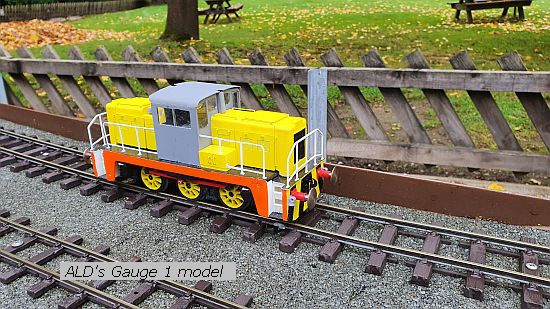
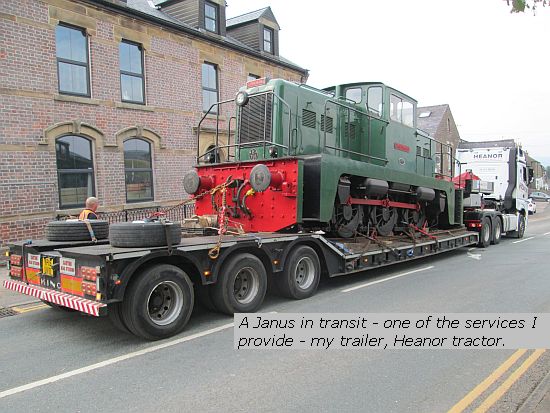
Another loco that is at Darley Dale on the commercial list is a 'Janus'. Our good friends at ALD Models have developed their prototype Gauge 1 Janus, created in 3D printing from the original Yorkshire drawings. So here it is on tests and demonstrations earlier today, and for comparison, the real life Janus that we were moving down from Kirkby Stephen not so long ago.
It hasn't all been commercial work this week though. There has been much tidying going on, and one of those last bits of the workshop floor that had never been sealed and painted, mainly because it had got into constant use, was at last treated and tonight is drying in bright green. But it isn't very photogenic, so you'll just have to take my word for it.
And what of the immediate future? Chesterfield and the surrounding areas of NE Derbyshire have been put into a higher level of pandemic alert, but so far we are still fairly relaxed. Not complacent, obviously, hand sanitiser has been added to the arsenal of soaps and barrier creams over by the sink, as well as other precautions. Will we too see further lockdowns in the near future? Who can say. But infection aside I should be back next week with more to say. See ya then.

It is 1963. Beeching is slashing through the
railway network. In a remote coastal village, an unlikely
trio - an MP, a garage owner and an undertaker - band
together to save their railway.
But with no practical rail experience between them, they
must learn fast if they are to get the tracks and
stations repaired well enough to pass inspection by the
Railway Inspectorate's Major Pitfall. Or will
the domineering Mrs Smith-Bishop
succeed in stopping them in their tracks?
Follow their trials and tribulations through
the eyes of George Haskett, as aided and abetted
by a variety of colourful characters, they battle their way
through bulls and bulldozers, snow and sleepers,
bureaucracy and sabotage, to re-open -
The Railway to Merhead.