
Of goodbye to the girls
19th July 2020
I had some nice compliments and congratulations on achieving the tenth anniversary - even a special mention on Natpres, I hear. Ta muchly.
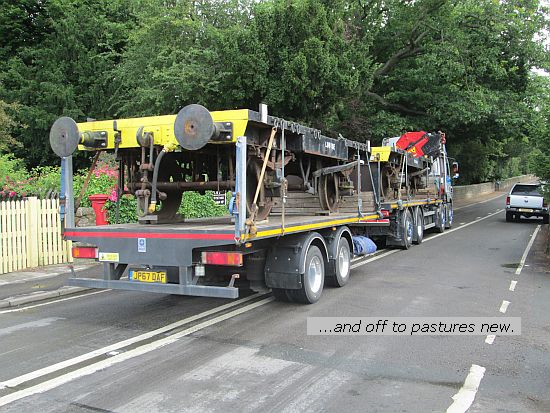
Yes, the title: first thing Monday one of Mr Punchard's HIAB waggons and trailer turned up to take Thelma and Louise away. (There's got to be a joke about it being 'so much easier than it was in the film' there somewhere, but I'll work on it.)
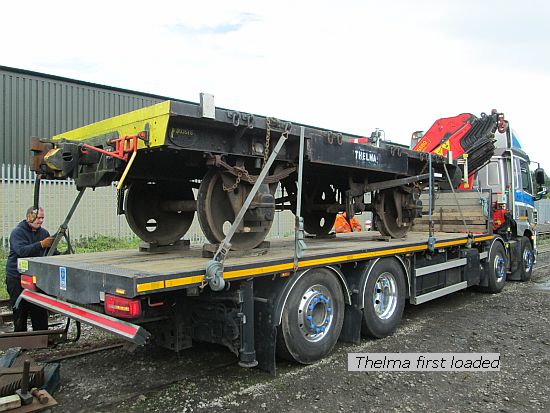
The procedure was for the trailer to be dropped off in the station car park, the waggon come across and loaded wagon 1 (which turned out to be Thelma) return to the car park and transfer Thelma from waggon to trailer, then back over to collect Louise. Finally back across, hook up the trailer and go.
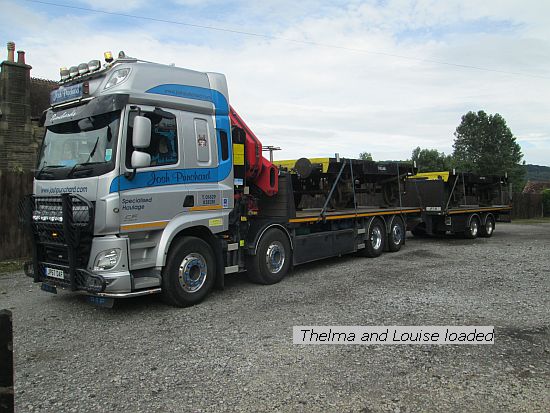
That's so much easier than attempting to reverse the trailer into the yard at our side, especially when the HIAB is only just able to lift that weight at the radius that would put the wagon on the trailer. You may be wondering why my low loader wasn't deployed for this, and the answer is a matter of legalities. The low loader is a 'special types' trailer: in other words, it falls outside the 'normal' artic trailers that can only run up to a maximum of 44tons gross. As a 'special type' trailer it is not subject to MoT (but woe-betide me if it is inspected out on the road and found to be defective or inadequately maintained) but the load it is to carry must be of a certain tonnage to justify its use and that load must not be divisible. From the point of view of length, we could easily have fitted Thelma and Louise on, but as the two were divisible it would have been illegal. Taking them one at a time would have been uneconomic, and Mr Punchard gave us an unusually favourable rate.
We have been promising a major 'shunt around' for several weeks now, and the departure of the two conflats was the excuse for finally getting around to it later in the week. For one thing we have a loco in for a customer of mine which has no drawhook at one end and we've been dragging it to and fro with a sling and a shackle: it needed parking somewhere where this deficiency would not be any hassle until they get around to issuing an order for me to proceed with the work. The Hunslet 0-6-0 also lacks buffers: not so much a problem shunting as being minus a drawhook but somewhere further down the middle siding out of the way is more convenient. The primary shunting loco for this was Ludwig Mond, though Charlie did its bit despite the charge cicrcuit being u/s. But there were a number of interruptions when Ludwig refused to reverse. Andrew had earlier been underneath and attempted to adjust the unloader valve: this is the Westinghouse type with independent cut in/cut out adjusters. He had been succesful in raising the cut out pressure a bit, but the cut in setting instead of rising, lowered itself further. (No, he didn't turn it the wrong way...) The only solution when the problem occurred (because of low pressure protection switches) was to drop main res pressure by repeatedly applying and releasing the straight air brake for several minutes, watching the gauge needle until it fell to about 45, whereupon the needle would twitch and start to rise again.
Another little irritation was when I looked out and saw a dozen or more wasps congregating around the casings just in front of the cab. A little later they were around Charlie, then James (that was also being shunted) and finally even more were in and around D9500. I came to the conclusion that there's a nest in the latter, and when their home relocated unexpectedly, distressed wasps headed for whichever loco was nearest where they thought their home ought to be. (No, I don't think Derbyshire has bred a species of gricer-wasps - they don't make notebooks small enough for them to put the numbers in.) But we finished the shunt without incident and the wasps hopefully found their home OK, even if a few feet further up the siding than it was previously.
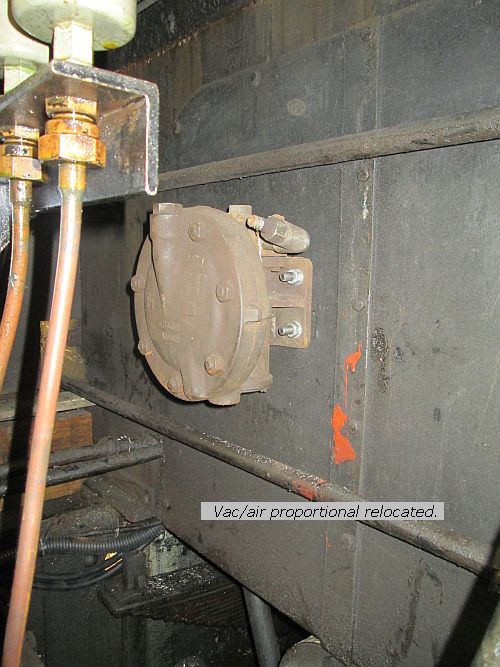
The weekend arrived with both me and Andrew occupied on separate projects, though in my case, largely a commercial one. Andrew was wrapping up bits on Ashdown, but then put his foot on a pipe which made a crunching noise and deformed. Given that this was the feed pipe to the brake cylinder, he concluded that maybe it ought be renewed before the loco leaves and on giving it a more thorough inspection, concluded that the modifications made by a group in South Wales who fitted the vac braking system was even worse than we had realised. To recap, early on we discarded their exhauster installation because it was appalling, they had not fitted a vacuum filter and so drawn debris into the exhauster and we removed the driver's brake valve because it was put centrally in the cab (so awkward to reach from both sides!) and too close to the brake handwheel that it violated one's knuckles. Now he came to look at the vac/air proportional valve (the bit wot puts the loco brakes on if the vac drops, eg. because of a separation) and found a connecting hose rubbing on the propshaft, another stretched to its limit and the brake cylinder air directed through a double-check valve (a traditional railway industry term, it's a shuttle valve in industrial pneumatics) that was only 1/4 bore in a 1/2 inch line: that's a restriction that will slow application and release. So it's come out and the proportional valve itself mounted properly on the cab back bulkhead. (Andrew also tells me he will fit a suitable vac reservoir to it which it didn't have before).
Am I being unfair to those well meaning volunteers who put it all in? I don't know what resources they had at their disposal, nor what budget to carry out the task, but it makes me realise that today the role of an ICP should be preventing sub-standard works being utilised on trains used by members of the public.
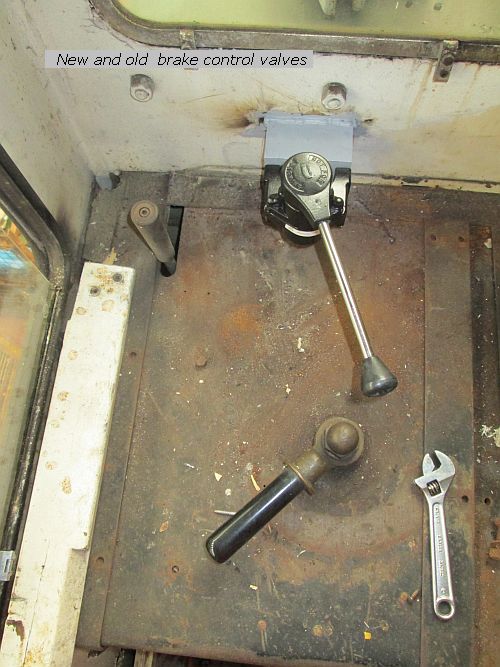
The new brake control valves have been fitted: which brings me as an aside to an amusing exchange of e-mails with someone during the week who accused me of infringing his IPR when using the AV2 on Ashdown. It transpired that he is utilising the valve controlled from the loco straight air brake valve, which is not how it is supposed to work. We are using the valve in the way that Westinghouse intended. Here's the loco straight air brake valve (below) and the new vac brake control valve (above).
Some sense of normality must be returning. On Saturday we had enthusiasts on the footpath asking if they could see a particular loco. Interesting trying to do a guided tour while socially distancing when one of the party is hard-of-hearing and kept coming closer in order to pick up what I was saying. As he did, I would take a safety-step away to maintain at least a metre and he would follow: should have been a very fast tour!
During a nice sunny afternoon today, we took Ludwig a bit up the yard to where Andrew could again squeeze underneath and set about changing the defective governor valve. Such a task is awkward for entry and egress, so my role was to wait alongside and act as 'gofer'. Afterwards the air system was governing at about 150 (the pneumatics are to main line spec of 10 bar working pressure) reloading at about 110. Provided this proves reliable it should stop Ludwig's reversing foible for the foreseeable future.
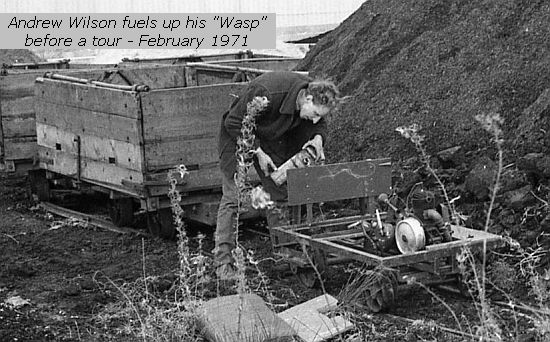
While I've been writing this, news has come through that an old friend Andrew Wilson, died this evening of cancer. Though I hadn't seen him for a few years now - last time was a chance encounter at Tywyn Pendre - I had met him in company with Rich Morris (he too now no longer with us) and Pete Nicholson. On our first excursion he had brought the 'Wasp' a 2ft gauge railcar ( 2 seater) powered by a motorbike engine and gearbox. I travelled many miles on it - the more because as the youngest I had to sit on the Wasp in the back of a Morris 1000 van as the front seats were occupied. Later I met him in London to pick up a self-drive 7.5tonner. First stop was Lincolnshire to collect some 1.5 cu yard skip wagons for the Talyllyn, then due west to Tywyn, but it was late and garages were all closed: we freewheeled down the Talyllyn pass to the lake with the engine off to save what little fuel we had left. Later that weekend we travelled back down south from Wakefield with my Hudson Hunslet diesel loco sat on the back, bound for Farnham and the Wey Valley LR. RIP Andrew.
And that's it as this blog passes into its second decade. The trailer's headed out this week for some TLC ahead of several planned moves. What else will happen? Dunno, You'll have to come back and find out. See ya then.