
Of conduit and fish tails
5th July 2020
The lockdown is being eased. Will all be as before?
Before kicking off, I felt I must draw your attention to a piece in this month's Railway Magazine. Talking of various heritage railways' plans to get re-started, it says, and I quote...
Face masks will be required while travelling on the trains, which includes the planned dining services...
I am sure railways throughout the country have been devising innovative ways of complying with the government guidelines while re-establishing as much of the product offering as possible, but I can't quite see how that will work.
So what's been happening this week? Been a bit frustrating, in a way. The parts for the new vac brake control system were due but haven't arrived, after conversations with my belt supplier a selection of drive belts for Ashdown and another loco arrived but none have fitted right.
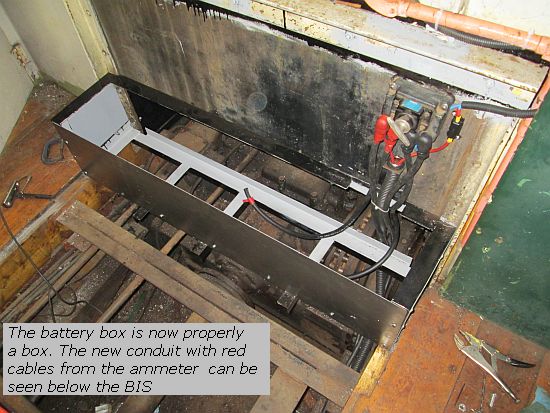
And much time has been wasted though, trying to pull wires through flexible conduits. As at last week, we had deduced that the cables to the ammeter ran all the way from the AVR at the front left of the loco to the ammeter in the cab front bulkhead. They were two hefty pieces of cable - bigger in fact than the wire which would then convey the power back down the loco top the rest of the electrics. (Actually, I glanced again through the drivers' manual which came with the loco from Pontypool and Blaenavon and there it shows a Battery Isolation Switch which it says was located at front right of the loco: it wasn't there when we got it though.) Anyway these two heavy cables were pulled back to the ammeter and I worked out where to interpose them in the electrical scheme I had re-wired at the back of the cab. I dug out a length of 20mm flex conduit, laid it out in position, tie wrapping it where appropriate and set about getting a cable through.
Most flex conduits, at least the lighter ones, are formed of convoiuted moulded plastic and thus have ridges at ninety degress to the 'flow' of the wires. Try to push a wire through for any length and you can be sure that at one bend or another the leading end will dig into a ridge and refuse to advance further. You can often get around this with small wires by simply bending the end back on itself, and the rounded nose finds its way to daylight at the far end. But you can't bend a thick cable back on itself, though in this case it was sufficiently rigid that the first cable emerged without too much hassle. So I tried the second. Now I know from experience that the cables I would normally use for this purpose will slide down a 16mm flexible conduit, but try as I might, I could not get this second cable through where its mate had already gone.
Now, bear in mind to do this I have had to climb inside the casings, over the throttle linkage and the left hand starter motor and balance myself uncomfortably on top of the fluid coupling in an environment that is altogether grubby, warm and dark. After ten minutes of trying I pull the first cable back, and try the trick of sending them both through together. Failure. Grumpily I climb out again, and concluding the secret is to slide them through with the conduit as straight as possible, detach it all from the route I had carefully created, slide it back under the cab bulkhead, return to my little grotto on the other side of the cab bulkhead with the conduit now streaming out of the loco onto the shed floor, and proceed to try, try again. No, it is not the bends that are stopping this, the cables simply refuse to go far through the flex conduit together.
There is of course a solution for getting stubborn cables through conduits. It's called a 'pull-thru'. We have two, but for some reason lost in the mists of time, our original one has always been called a 'fish-tail'. The Fish tail is a length of plastic-covered, spiralled wire with a loop on the end. It is sufficiently rigid to be pushed through any number of twists and turns and still emerge at the far end. The other is a new acquisition, and is a length of flat spring steel strip with a rivetted brass roller on the end that also guides itself through many a convolution. Once through, you secure your cableto the end with insulating tape and simply pull it back through. Or in this case, it goes so far, locks up solid and further brute force merely detaches said cables from pull-thru as the insulating tape surrenders.. I try a cunning plan, slide one cable through on its own (easy) then use the pull-thru for the second. But if the two cables together are sufficiently broad enough that they won't go through, having one already there and try to pass a second taped to the pull-thru' is doomed to failure.
There were of course, two obvious solutions. One was to change the flex conduit for something bigger, the other was to change the wires for my usual smaller ones. The latter may be obvious but for some reason I was reluctant to change. Had I done so the originals would merely have been consigned to the pile for weighing in and they were, after all, of bigger section than mine and that was no disadvantage. Fortunately I did have some bigger flex conduit, but unlike the lightweight, convoluted plastic this was a spiral aluminium with external plastic coating. It weighs quite a bit more, especially as it was a nominal 30mm bore. It is also 'floppier' and it was obvious that the cables wouldn't hold it in place under the new battery isolation switch without assistance. So a support bracket was manufactured and fitted, and the ammeter put back into circuit.
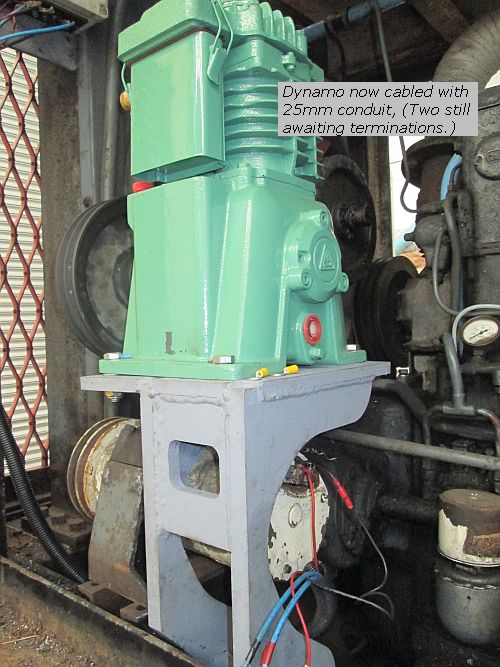
Back at the other end of the loco, it was time to re-instate the wires to the dynamo. Andrew had removed the old rigid conduit some time ago as it took wires down the the batteries and back again, and I had fed a new length of 20mm flex from near the AVR down to the dynamo. This flex had 5 wires to carry - two new thicker ones for Dynamo pos and neg, and 3 smaller cables, two for dynamo field and one from the oil pressure switch which operates a relay on the AVR so that the dynamo field is turned 'off' when the engine is stopped. Easy on a 20mm conduit, surely: after all, the two cables for dynamo pos and neg will go through a 16mm one. I started to get a feeling of deja vu. No, it was just too much. I even tried breaking into the middle of the 20mm with a union and trying to get the cables through in two stages...
Well, that was as far as I had got by Thursday afternoon, and as part of a trip to various suppliers in Sheffield on Friday, (though it started with a detour to Shirebrook to collect a Euro-stillage) I picked up some 25mm flex conduit. Sadly the hoses for the compressor weren't ready so a return trip will be neccessary on Tuesday. Saturday and Andrew was down in Northampton inspecting a Class 360 before it left for Ilford, so after a morning's admin I wandered down to the shed on my own and, amongst other things, cabled up a dynamo using the 25mm conduit.
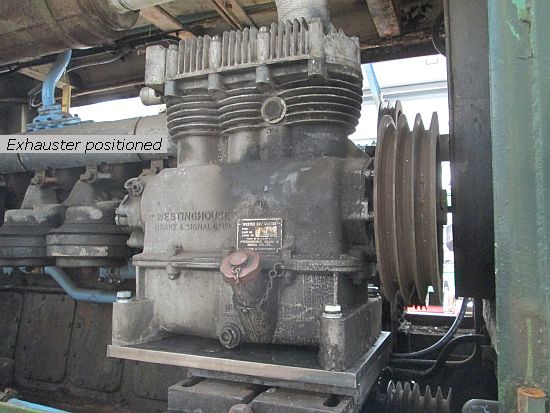
Sunday however he was raring to go and cracked on with fitting the covers to the battery box. The belts were trialled and found to be too long in every case. The exhauster was finally mounted to its base: I think we can avoid putting a power bulge on to the casing side (as originally I drew it out to be) but we must relocate one of the oil bath air cleaners to avoid fouling the oil pump on the exhauster.
While Andrew was on these tasks, I was outside on a commercial job, preparing a loco for a power unit change. And a horrible, dirty, greasy thing it is too. There is a tendency to over-grease torque converters. There are but two nipples and the rules at TH were two pumps of a grease gun per nipple only, and only when oil changing (so roughly at 200-250 hours). I once had a converter in for attention that when we detached it from the engine, was over a quarter inch thick in grease the entire inside of the bell housing. This loco has been spitting gresase out the rear bearing, so it's plastered up the frame sides, under the air cleaner, over the propshaft - ugh.
So that's about it for this week. A crane is booked shortly: Thelma and Louise are due to leave before long so must be emptied. Let's hope the weather is better than today. And next week l suppose marks the tenth anniversary of this blog. Hmm. What shall I do to mark the occasion? Until then, take care, socially distance and see ya then.