
Of a decade
12th July 2020
TENTH ANNIVERSARY EDITION,
Ten years, 520-ish editions and still going strong(?)
A decade ago, I had come across a website sponsored by Mr P Waterman called 'Railnuts" which invited all those keen on railways to contribute. I had been toying with writing about what Andrew and I then got up to and so in July 2010, I started a first entry. It was short, oblique and I wondered if it would get any sort of response. It did, somebody commented that I had done it all wrong! I persevered and after a few weeks even had Mr Waterman saying that he must 'pop in and meet you guys' (he still hasn't). Unfortunately Railnuts suffered from Hackers, the bane of any site that tries to make access free and simple. (We've had a bit of it on here but the security has been beefed up to keep pace). I could have merely transferred the lot to somewhere like Blogger but that seemed little different to Railnuts yet much more 'diluted' so readers would be hard-pressed to find you. I could have moved on to Facebook but that is one place that I continue to avoid. So instead I opted to go it alone and Weekend Rails was born
I never anticipated what this site would end up recording, and every now and again I delve back into the archives to see just what I was doing way back when. If only I'd had the benefit of foresight! Back in 2010 we went from railway to railway where Andrew's locos were based, clocking up the miles, never able to please everyone who expected, despite what we said, that we would turn up every week to work on that one loco. And our productive time was limited by travel, unpacking and re-packing.
A year or so later, my father died and the weekend when I should have been at Scunthorpe aiding Andrew in installing the engine to the 03, I was down on the south coast registering the death and cancelling the milk and papers. Some months later probate was sorted (having a sister in a senior legal position position does have some benefits) and we agreed to establish a proper base where we might speed up restoration of one loco at a time. But Rowsley was all spoken-for, assured Mrs Statham, 'but you can have Darley Dale'.
That took us on another adventure. Darley Dale yard was far bigger, but we'd need to be self-sufficient, no Peak Rail crane or JCB to borrow for a quick lift. But Darley Dale had been Peak Rail's base in the open air, and the local council environmental chaps had a pile of complaints about noise and smoke they said. No developments at Darley Dale, thank you. Reluctantly they gave us a British noise Standard to comply with. We brought in consultants who did a survey over a weekend, concluding that the HGV traffic over the level crossing was noisier than we would ever be and that, within the terms laid down by the environmental chaps we would be 'unlikely to give rise to complaint'. The Environmental chaps couldn't accept this: OK, they said, but weekdays only, you mustn't use the shed after noon on Saturdays and no Sundays. But we carried out the tests over a weekend for that reason, we pointed out. The Enviromental chaps didn't want to budge: we went higher and eventually got planning permission.
Up to then, I had a shed 'kit' which as I hadn't taken delivery of and I was being charged storage. I didn't have a written agreement with Peak Rail either and the latter would not begin negotiations until I had Planning Permission, so it was March 2013 that we started to draw up an agreement (it finally ran to about 9 pages) and was signed on behalf of Peak Rail by the Managing Director in mid June. Even then the site wasn't ready for us to start building and we had to wait nearly 6 months, eventually bringing in contractors to break up concrete, etc., before foundation work began in January 2014. (As an aside, some of you may recall a newsletter put out by Peak Rail under the signature of Mr Waterman stating that there is no written agreement for the shed. That was simply incorrect as were other statements made at the time.)
So here we are today with a shed that is envied by many people. I've continued working to finish paying for it (as I've said before I'm a self-employed pensioner) and added a low load trailer that enables us to get most of our locos in and out without inconveniencing Peak Rail too often in exercising the right granted under the Agreement to operate between Darley Dale and Rowsley to get things in and out. Are we restoring locos faster than before? Sometimes I think not. We spread ourselves as thin as ever over several projects, but we are doing a far better standard of work as our facilities have developed. That overhead crane may still be as far away as ever, and as fast as we clear a bit of space, something seems to come and fill it up.
This week, for example. both Andrew and I have been out and about on our respective employments, him in his full time job for a Train Operating Company, and me pursuing a loco enhancement contract at a quarry and picking up parts for work in hand. But Friday though was the day re-arranged for a visit from our friendly local crane company and we had 4 hours - from 08.00 to noon, to get as much done as possible. Given that Andrew has a full time job I was lucky that Jagger had time off and was able to assist. So there are no pictures as I was just too busy. Scrap wheelsets made it to the scrap bin, while the scrap bin itself was relocated to somewhere where, provided the weather is dry, the forklift can reach easily. The two stage ramp sections came off the RRA and were relocated where they'll be more useful. Some of Thelma and Louise were unloaded, as was the spare 6RPHL Mk1 (bought for Coronation) to free space on the German flat to take some of the engines and such from the conflats. In the midst of it all an engine and torque converter were taken out of a loco for a commercial job of mine. Pack up time was noon (he had another job booked in Sheffield for the afternoon) and inevitably some jobs on the list were not completed, but then it was always a 'get as many done as you can' list anyway.
Charlie has been giving cause for concern lately. While it was away on holiday, the company using it tried hauling a train from the front handrail rather than the drawhook and demolished it. Fair do's, they manufactured a new handrail that looks better than the original, but after it returned (lockdown time) it has started but the alternator warning light never quite extinguished and the batteries seemed to be getting worse. On Friday, as I fired it up to move the train forward and clear access for the crane, it seemed ok, but when I came to start it again to propel the train back, it wasn't having anything of it. Fortunately RS8 was stood nearby so Jagger and I borrowed its batteries and got Charlie going again.
The rest of the afternoon was spent tidying up, putting things back, sheeting things down and so on. Oh and cups of tea as aside from a shower mid morning, it had been thirsty work. Jagger stayed overnight to Saturday and I let him know that I'd be down for nine-thirty, with Andrew a bit later. I duly did so and as the valves required for Ashdown had finally arrived, I made up a couple of brackets ready for Andrew to fit.
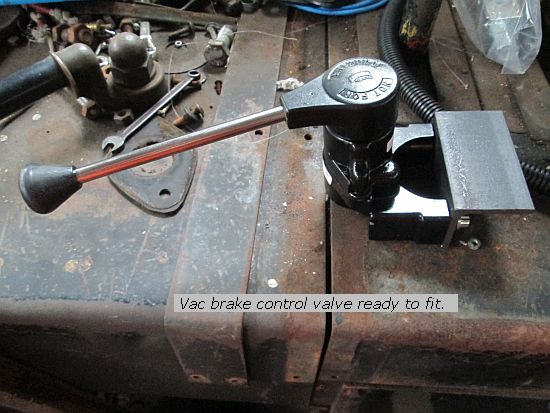
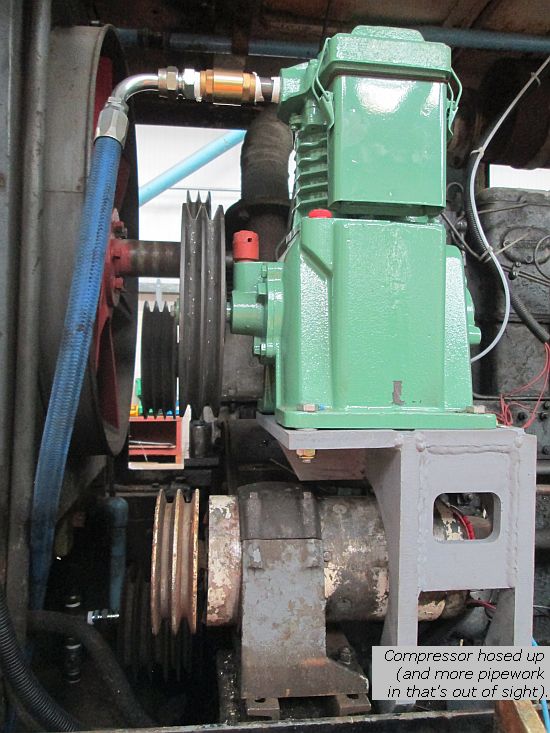
When Jagger surfaced (he woke up HAPpy) I set him off doing some pressure washing and then sent him to change the alternator on Charlie. I should have sorted out the drive belts for Ashdown during the week but with one thing and another that had passed me by, so Andrew contended himself with fitting the flexible air hoses I had sourced for him to get the pneumatics almost complete.
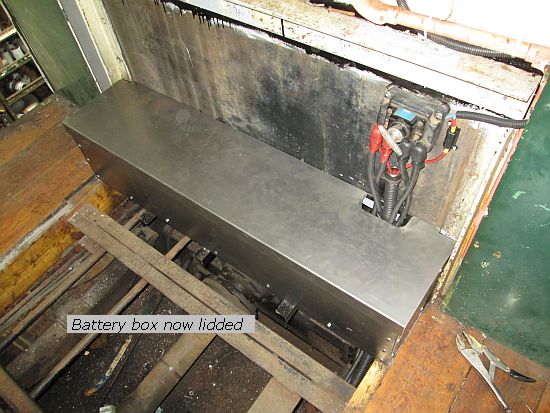
He had during the week had an evening in which he fitted the batteries, so I terminated the battery leads off and he cut and trialled in place the lid, which just needs painting and fixing down.
Back out on Charlie, Jagger was having no luck - the replacement alternator (thought to be good but I don't have an exchange one in stock right now) did no better than the first, neither did a change of voltage regulator. Trouble was, I could see battery volts at the alternator, and if I disconnected alternator -ve and ran the engine, there would be a rise in alternator voltage over battery volts but only about 1volt, and this disappeared if I reconnected the lead. If I disconnected the F terminal at the alternator I could see a voltage which suggested that the regulator was trying, but not that hard.
Jagger headed home Saturday night and Andrew and I returned on Sunday with a moving day planned. But first I had run off the wiring diagram for Charlie so that I could check through and see if there were any loose terminals that might account for it. After pulling the locos back to allow the forklift to come out and play, I headed up to Charlie, refitted an alternator and compared the wiring for the two smaller wires (F and A) back to the junction box. We had pondered whether the fabricators had in fact disconnected the alternator before welding up those new handrails: for as Corporal Jones would say 'they don't like it up 'em'. If my reading is correct, the alternator had had the A and F terminals crossed, but reversing them meant that the warning light stayed on fully rather than dimming at all, so I'm still none the wiser. Next week I must check the wiring all the way back to the desk, sort out a fresh, known alternator and voltage reg and start from scratch.
Andrew meanwhile was causing mayhem at the shed front. As a lorry is expected shortly to remove Thelma and Louise, he needed space on the ground to unload those bits still on, without monopolising so much that the low loader couldn't get in to collect Ashdown. Meanwhile there were pallets on the floor that needed to go into the PCV ready for its departure but crates and stillages that needed to come out to make space there. What with pallet trucks needed up in the PCV to move crates and pallets, a load of old office wall dividers (they came in a container we bought) that have been extracted for disposal, 2ft gauge wheelsets, air receivers, engines, buffers, buckeyes and a torque converter, it all had to be moved, put down, picked back up again and relocated. Time consuming and neither really progressive nor photogenic. Still the yard looks a little tidier - I think. Once Thelma and Louise have departed there's another shunt planned, though first Andrew intends changing the compressor governor on Ludwig Mond, as it has been getting increasingly cantankerous of late. When the air pressure falls it first won't change direction and you have to sit there and wait until the pressure starts to build again. Jagger and I had to twiddle our thumbs ten minutes on Saturday - it had fallen to 60 - (it should have cut back in about 80-85) went on slowly falling and eventually cut back in at 45! It gets rather frustrating, and the governor valve itself is away under the front of the loco, difficult to get to, naturally.
Well that's about it for the tenth anniversary. If I'm still doing this in ten years time (and still no recognition for tenacity) I shall probably look back at the Covid-experience and how we all coped, or didn't as the case is yet to see. Maybe by then Adolf will be running round in concert with a 2HAP, two class 14s will be in action, the 03 returned from Midsomer Norton and I'll finally have retired and found time to write my memoirs. But all that is to come. Until next week, take care, and keep your distance: see ya then...