
Of wheels, valves and racking.
15th March 2020
Hiya, back again.
I've promised not to say too much about Coronavirus this week. Not that I said much last time but then everyone is getting a virus-overload from other media. Despite our Government not imposing a lock-down or even banning 'large gatherings' the trend is most definitely gaining momentum. Local meetings of the Peak Railway Association have been postponed: our visits from Phoenix Railtours and the Industrial Railway Society put off. But it is the fear within the public that the heritage railway market will be beholden to. I drove to Norfolk and back on Friday and got the feeling that road traffic was distinctly 'light': meanwhile trains I saw past the shed over this weekend - and of course this is purely subjective - looked to have many empty seats. Are they staying at home to avoid risk of contact? Andrew predicted during the week that heritage railways can 'forget Easter'. We shall have to see.
Jagger has been back again this week, and unusually we had a works train, the tool'n'mess carriage and a Lowmac, propelled by D8, pass by.
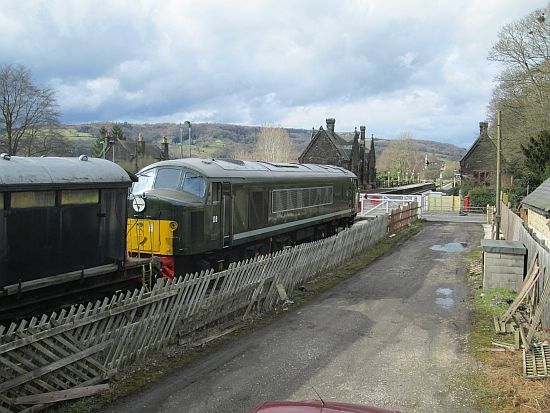
Here it is on the return journey, waiting for the gates to be opened. Jagger gave me a hand on some work of mine, and progressed some other jobs of his own, plus gave us all the gossip of Scunthorpe as it transferred from UK to Chinese ownership.
But it has been the weekend where most obvious progress has taken place, with both Andrew and Ben Riley hard at work. Andrew had some new racking to assemble using the box steel he had ordered from Twiggs last week, and put the engine turnover stand to novel use as a fabrication manipulator.
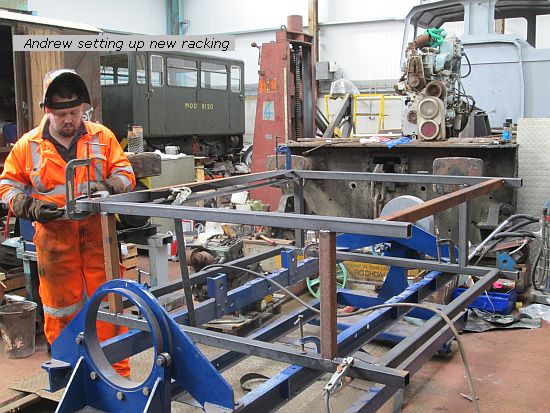
Later it was put into the box van and loaded with bits: he has two more 'units' to build which will join it in the van but will be painted first - this unit will then be unloaded and painted: or so he plans
I spent a frustrating Saturday afternoon on Ludwig Mond. If you lift the cab floor boards you find a mass of steel and copper pipework of traditional loco engineering. And there's the problem. On the one hand, I've commented before that GEC were fond of welding steel pipes where they pass through bulkheads. It's a practice which I don't agree with, as apart from setting up stresses in the pipework, the welding process is liable to thin the pipe walls and we've had to replace quite a bit of pipework already, aside from that pipe that finally pinholed through and dumped fuel onto the floor at Rocks by Rail. But under the cab floor is another unsuitable place to put valves, because there is a tendency for 'product' (depending where the loco works) to get in and combine with moisture to form a nice paste to aid corrosion. (It corrodes steel pipes too and you can see a couple of pieces we replaced in hoses earlier).
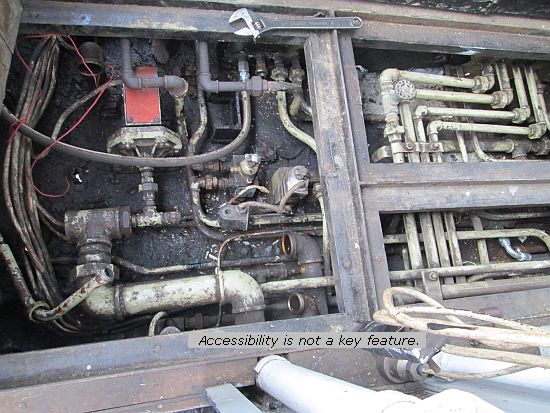
At Hills we grew adept at putting valves into the cab cupboards, where any product would drop away by gravity, but the constant ventings were not conducive to our efforts for reducing cab noise-levels. On my own remanufactures I grouped valves onto a subframe and put it in a place that I aimed to keep reasonably clean and away from driver's ears. The third problem with GEC's positioning is simply one of access. Since the valves nearest to or mounted on the running plate are most susceptible to corrosion, they and the associated piping are most lilely to need attention, but the pipes higher up, plus the floorboard supporting framework, were installed later and thus prevent good access by spanners, adjustables or Stillsons. In Ludwig's case, we know that 5 valves - all identical Martonair ones (long since obsolete) - have been leaking profusely and only the fact that Ludwig has the big 50cfm Westinghouse compressor has allowed us to run reliably. But Ludwig is likely to be off on holiday and these really need to be sorted, so I set about investigating. The plan is to replace various functions (such as horn and sanders) with direct acting valves (the Martonair are pilotted so have additional small copper pipes going to them) of smaller bores (but sufficient for purpose).
An early surprise was to find, hidden under other pipes, that these functions in particular could be isolated, which simplified things a little, and I planned to remove the manifold from which these copper lines departed and instead make it the source for my new valves, which then deliver into the original pipes. So much for theory, all I had to do was remove a 6 inch length of copper pipe and a manifold held by two bolts. The copper was connected in Enots fittings, which memory said used metric spanner sizes, but whose access was constrained by pipework above, and even when unscrewed, being tubenuts onto olives, needed the manifold to be detached in order to be separated. The loco was finished in 1979 so should be metric and sure enough a 10mm socket engaged with the first of the fixings. A half turn and it sheared, leaving half the M6 sticking up from the floor like a peg. I turned to the other one - this wasn't M6. Actually in the end it came out relatively easily: when I saw it it looked like 3/16 UNC; it was clearly bodged-in. But the manifold was still securely held to the floor, and no amount of hammer and chisel action (of course, no half-decent hammer could be brought to bear) would disturb it, and the peg reinforced it.
In desperation I destroyed the copper pipe and eventually the manifold came out. Doesn't sound to have taken all that long? Yes, but Ludwig is some way outside and every time I had to return for another spanner, chisel, mole wrench, socket, etc etc took 3 or 4 minutes to exit the cab, walk back to the shed, find tool and return to loco. By lunch time I had removed it all and, apart from hoping that Andrew wouldn't suddenly want to start it to shunt (since although I had stopped the leaks from the 5 corroded valves, I had now a 1/2 inch hole which would be asking rather a lot of the compressor) I looked forward to making progress in installing the replacement valves that I had to hand.
But the afternoon passed trying to get a suitable pipe installed together with a few fittings, a strainer and a ball valve together and air-tight within the limits of spanner, fingers and temper. The only way to screw in the pipe that I'd cut and threaded was by mole wrench, in about 10 degree increments before said mole encountered pipework on either side. Longer and there was nowhere to screw on an elbow to get clear of the running plate.
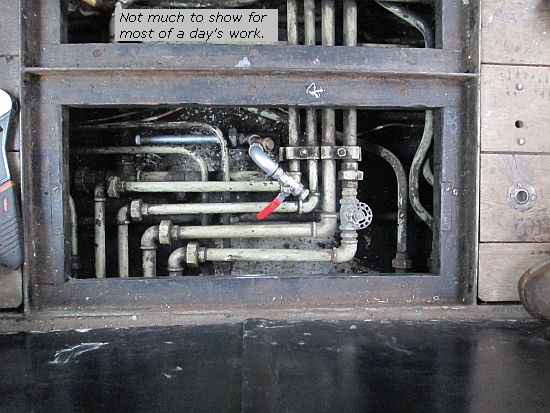
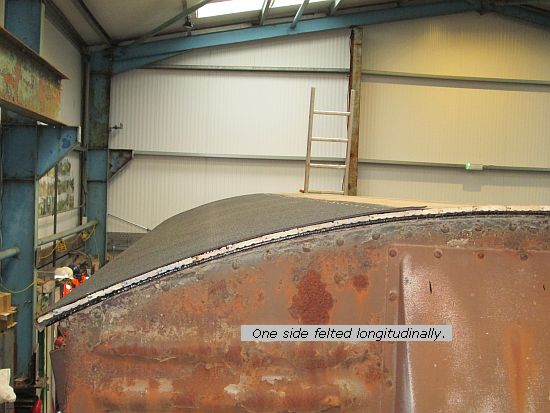
Having completed that though, I turned the valve off to close the 'ole, packed up the tools and went back inside. Ben meanwhile, had also spent a while outside. I had heard repeated hammerings whilst I had been swearing about GEC fitters and designers but not paid much attention. He had been knocking cotter pins out of the bogie pivots of the Midland bogie well wagon as it is planned to get it off its bogies shortly. But as Andrew had brought down supplies of roofing felt and fixings, he moved on to the box van, and by the end of the day the first strip had been laid longitudinally and sealed down to the timber.
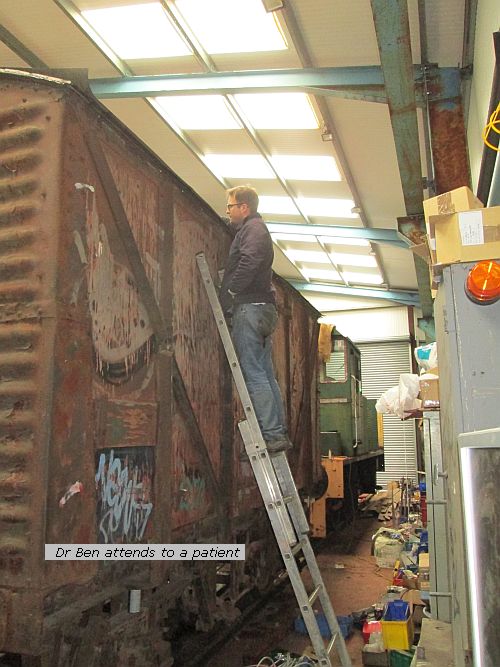
Here is something on which Andrew and I disagreed. Having once refelted a roof (or rather aided someone else in the process) I would have put the strips transversely, overlapping each one so that the prevailing wind trailed the joints, but Andrew preferred the longitudinal method relying on sealant and the end angles to hold it all down. By the end of Sunday both the side sheets were on and Ben had nailed them firmly over the roof edges, ready for the centre strip, maybe next weekend.
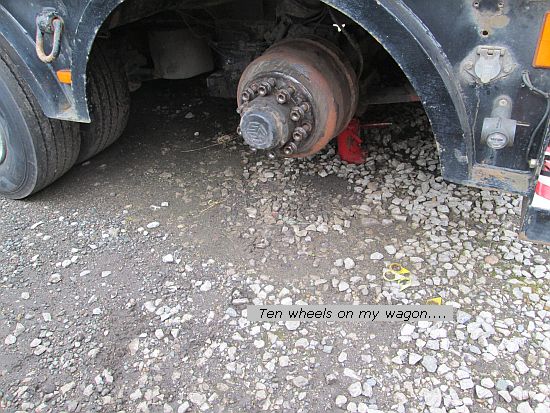
Another bit of progress this week was on the trailer. When it returned from its last job it had a damaged tyre and as the rim (wheel centre) was also damaged (from before I bought it), I had acquired two brand new tyres/rims to replace, as mentioned a few weeks ago. You might have assumed that by now they were on, but actually they have been languishing in the shed. Why? Well, Andrew forbad me to bring in the tyre-fitting firm from Rowsley (like last time) on the grounds that we needed to be able to do this ourselves, but whoever put those nuts on didn't stop at the correct torque. I haven't given you a blow-by-blow story but a 3/4 inch breaker bar and socket made no impression. So Plan B was to use air wrenches ('windy guns') but they need impact sockets so he had to buy one. The first windy gun we tried had no effect, but air air hoses were a bit small bore so I was ordered to buy another 1/2 bore of 15metres and we tried again, shifting one but failing on 9. Phil G brought another windy gun and shifted a second. There are special tools for this job. They comprise a gearbox with about a 50:1 ratio, with a stabilising foot which swings out to lock the tool against the rim. It shifted one, and on another attempt the foot broke off! This week, another such tool arrived, and the superior foot (and price) finally released the other nuts and the two old wheels came off, one to scrap and one to become another spare. The two new ones will be on shortly ready for a list of jobs the trailer has in store.
Ben had departed to catch the last train back to Rowsley and Andrew and I were discussing something on Ashdown when a voice called out from the doorway which we thought was Ben, but turned out to be someone after photographing RS8. Serves us right for leaving the gate open! We duly obliged, and followed it up with a cuppa. Our visitor was as a young man, a Dinting volunteer who remembered RS8 there well. Andrew muttered to me that we must get RS8 in and sort out those outstanding jobs. True, but there are a lot of other outstanding jobs too. Perhaps I should self-isolate myself to the shed. As long as I remember to connect the oxygen bottle to the face mask and not the acetylene...
Oops, back on that virus again. Lots of things supposed to happen this week. Will they? Let's hope so. If the virus hasn't got me I'll be back next Sunday: See ya then.