
Of reminiscences
9th February 2020
Been a bit of a looking back week as I went over old ground comparing photo and reality.
Jagger arrived on Monday, none too early which was useful as I could get some other work out of the way first. Jagger had helped on RS8 when his holidays from work had coincided, but he'd been away when the handover took place and thus I'm ashamed to admit I'd overlooked him. During last week I had obtained from our friends at Tarmac a spare RS8 mug, which was duly presented to him and immediately adopted as his official tea receptacle. It was a bit of a bits-and-bobs day, which is to admit that I don't really recall doing anything too specific, though I was painting bits and laying out and drilling a panel for wiring up a loco.
On Tuesday I hit the road south for a couple of sales calls, arranged so that on Tuesday evening I'd be in Farnham to meet up with two local historians and discuss my (fading) memories of the Wey Valley Light Railway. Armed with about 50 b&w photos and colour slides, we spent the evening over dinner examining them and explaining how things had been some 49 years ago.
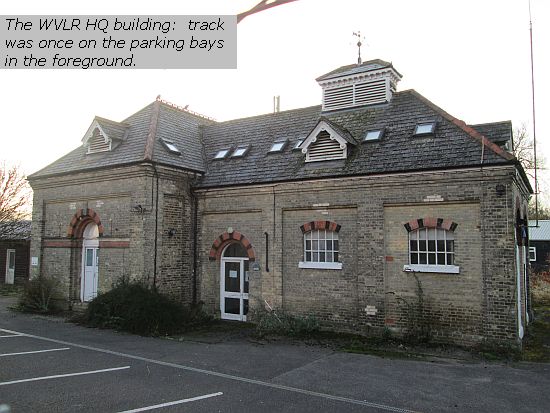
The following morning I popped down the lane to the old pumping station which had been the headquarters of the MPVSU those many years ago. It still stands, empty now and with an uncertain future. It is un-protected as it has no unique architectural features, but wouldn't it be great if it could be dismantled and reassembled at the Old Kiln Light Railway, catching up with the WVLR which relocated there around 1982? The story was supposed to be in the Farnham Herald newspaper last Thursday.
After some noise tests on Wednesday, I called in at Roger W's to collect some bits that Andrew had acquired through ebay and (Roger had kindly picked up), plus some other tools and materials he was throwing our way which included a two-man black metal trunk. Inside was a large manual hydraulic pump and various bits to go on it including those sharp jaw things that firemen use to cut the rooves off crashed cars. As I drove back north I was hoping to witness an RTA and be able to leap into action, rescuing the trapped driver as flames licked around the fuel tank... though with my luck he'd probably sue me afterwards for criminal damage to his motor.
On Thursday up here I had an eye-test booked, and was meant to take the Lister LV2 fuel pumps with me for TLC, but forgot all about it in the rush after doing my usual 'I'll just respond to this e-mail before I set off..'. On Friday at last I managed to get down to the shed again, and as the weather forecast for the weekend did not look optimistic, emptied the van and then resumed work on the fence, before realising that I didn't have enough servicable boards from the old fence to finish the job, the last few being much more rotten at the bottom than I had been aware.
On Saturday we had the AGM of the Peak Railway Association, so it seemed pointless going down and getting dirty before the meeting and insufficient time to bother after. Andrew didn't wish to attend the meeting, so did some work on Ashdown, as it is prepared for its forthcoming departure. So Steph and I did attend the meeting. For a company (limited by guarantee) that has moved from a £5k surplus to a £5k deficit in a year, had significant drops in turnover, membership income and even raffle ticket sales, I thought the Board got off lightly, though a member I was speaking to later took heart in what he saw as an increasing disatisfaction amongst the rank and file members. It was admitted that membership has fallen for the last two years, and that the railway in consequence is short of volunteers. One member, also a director in another group, told the Board of one method they are using to recruit and keep young working members and told them quite forcefully that they need to come up with fresh ideas and initiatives, that the 'old methods' won't work any more. I for one applauded.
Overnight the weather turned wet and windy and we woke up to find more sections of the tatty fence at Briddon Country Pile to have succumbed. Nonetheless after lunch I headed down to the shed to check that things were OK. The slot drain at the Matlock end of the shed was working well, especially as we had put a branch in so that it effectively helped to drain the footpath which floods regularly at this point and was probably 2 or 3 inches deep. The turnout that splits the two shed tracks was also over sleeper level in floodwater, which was slowly flowing down to the slot drain such that two or three of the locos outside the shed were stood an inch deep. Inside however we had the return of the ornamental pond, though as I arrived it had only just started and was still slowly working its way north. As the footpath outside was so flooded, the water ponds at the side of the shed and once over the foundations, trickles in over the floor at several places. I hurriedly used bricks and sand in an attenmpt to damn it and prevent it going all the way down, but doubt if I was too succesful. By the end of the afternoon, the turnout was almost dry and other ponds and flows had reduced.
This week the Dartmoor Railway went into administration. When I worked for RMS Locotec, Dartmoor was the apple of John Hummel's eye. John was the RMS part of RMS Locotec, and if my understanding is correct, RMS won a contract to maintain the line to Meldon quarry which belonged to the aggregates company that had bought it from BR. It was maintained so that aggregates trains could safely operate but John saw it as a stepping stone to greater things, and brought the quarry company and county council together so that tourist shuttles could commence between Okehampton and Meldon, terminating by the famous spindly viaduct from whence the trackbed continued as footpath.
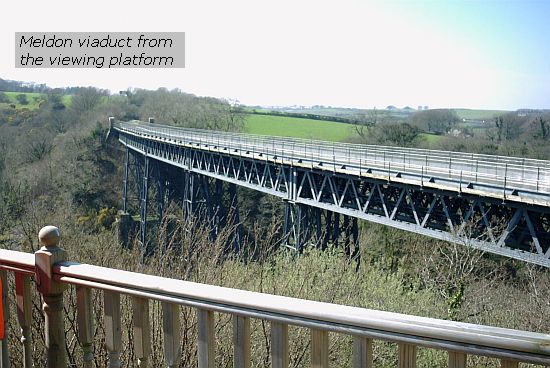
He moved down to Okehampton and soon developed a reputation as the man on 'community railways' which was a buzz-name that seems to have died out again over the last decade. Because of that reputation, Ealing Community Transport (ECT) tried to head-hunt him, and ended up buying RMS Locotec to get both him and Dartmoor Railway. Some time later ECT advertised for a new manager for Dartmoor, and I applied. I neglected to tell anyone at RMS Locotec, and somehow my name didn't ring any bells with anyone at ECT, and the first person to clock me was the Health & Safety guy who was employed by the quarry company but was a regular at RMS for meetings and doing the official tour for the applicants on the day. I soon realised that as he said something he would glance my way in case he was saying something that I'd disagree with!
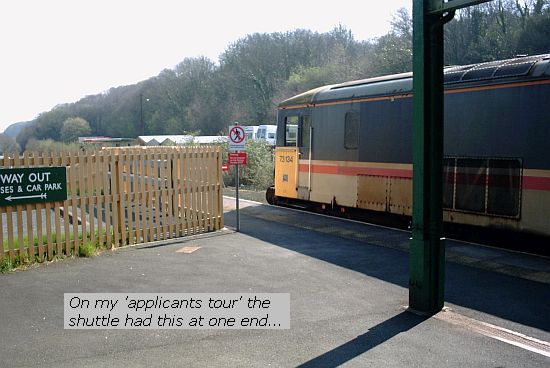
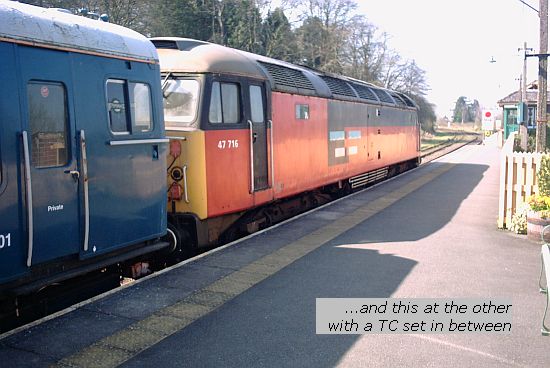
I didn't get as far as having an interview and in due course received a 'best of luck with your future career' letter from ECT, at which point I let management at RMS Locotec know and they were aghast that I'd gone after it and that ECT had treated me so off-handedly. The reason for needing the manager though was that just after the ECT take-over, Weardale Railway had got into difficulties and we had directed ECT to them as another candidate for their community railway empire. Then the Locotec MD departed and rather than replace him, John elected to look after all 3 enterprises, spending a day at Okehampton, up to RMS for a day or so then on to Weardale and back Friday afternoon.
The new manager for Dartmoor was duly appointed and appeared at RMS offices for a joint team-building meeting. I was curious to see how he shaped up, having been told unofficially that the job had always been his because John wanted it so: the ad just a formality. This guy had come to railway management from 'selling white goods', and when called on to introduce himself and speak of his plans for Dartmoor, he stared down at his notes and hummed and hawed his way through them. He did not come over as a dynamic leader that day.
ECT had up to then been a cash-rich company and if there was one thing we knew how to do at Locotec it was to spend others' cash. Locos would come back in for up-grading with new engines and control systems before going out again at the same hire rates. We put proposals in to ECT for projects and they sent a cheque, but never (from what I saw) came back to check whether we had stuck to budget or got the return we had forecast on their dosh. They didn't understand our business and relied maybe on John who was too busy commuting up and down like Holman Stephens on steroids to keep tabs.
I got out in 2007, and not long after it seemed as though Locotec had brought ECT to its knees. The railway businesses were bought by the American firm Iowa Pacific and a UK holding company British American Railway Services, was set up, to look after Weardale, Dartmoor, Locotec and the new Devon & Cornwall Railways which was to be a main line player. Did things change? I heard from old contacts that Iowa Pacific kept sending BARS money rather like ECT had done. They had ideas of loading open cast coal on Weardale and hauling it out onto Network Rail, so the line was refurbished. I thought the business model might work in the States (where 'short lines' abound but are a tad longer than anything we have here and the regulatory system very different).. Recently DCR got sold, and as Iowa Pacific went into admin in the States, the 3 remaining parts of the BARS empire were put up for sale with glowing descriptions. Now Dartmoor is in admin and John Hummel is probably turning in his grave (he died of cancer some years ago). The moral of all this? We've all seen the high profile near-miss at the West Somerset. I've heard of another line farther north that came close to going under in the last 12 months. Now Dartmoor has teetered and fallen. Make no mistake, heritage railways are subject to the laws of supply and demand and not immune from financial failure. Every heritage railway needs to come up with new ideas and income streams since doing it 'just like we've always done' is not a sure bet for survival.
And on that philosophical note I'll leave you. Not sure what I'm doing this week, but I'll be here same time, same website, to let you know. See ya then.