
Of invisible wire rope
26th January 2020
The Geoffrey Briddon Building has been humming with progress this week. Not only that, by locking up time there has still been some vestiges of daylight. Can it be spring?
There is a lot to get through this week, as I hinted last week we had both Operation Wheelset and Operation Van Roof getting under way. But my visit down Memory Lane to Farnham brought forth comments, including those of a former stalwart of the Farnham model railway group whose annual exhibition at The Maltings in Farnham was graced with a temporary Wey Valley railway for several years in the latter 1970s. These reminiscences have been passed on to the local historian who kicked all this off. Ironically one of my correspondents and his brother both volunteered at Peak Rail in the Buxton days - it is a really strange small world this preservation movement.
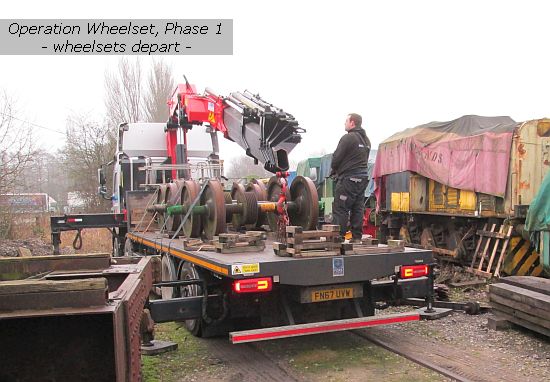
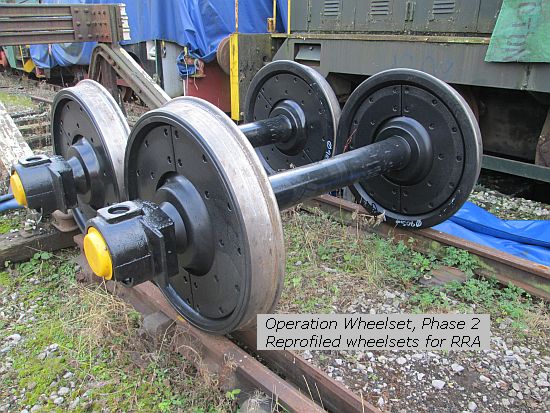
Anyway, back to events at hand. Both Operations kicked off on Wednesday, and had me down at silly o'clock to load up a collection of wheelsets for a deal or two that Andrew had lined up. For some time now he has had a number of wheelsets standing between our workshop and the Peak Rail 'Conference Room' and I won't say they were unsightly (they did add some ambience to the railway workshop environs) but they weren't doing all that much. Some of them had been determined as scrap for one reason or another, others had merit for re-use for others' purposes, but until it was proven that the forklift could safely travel this far off concrete, we had no means of moving them. Operation Wheelset saw the entire lot relocated, either off site or farther up ready for a further burning session. The lorry returned on Thursday with two freshly-reprofiled wheelsets together with servicable bearings ready to go under the RRA, which is due to be taken off its wheels and grounded for sandblasting this summer.
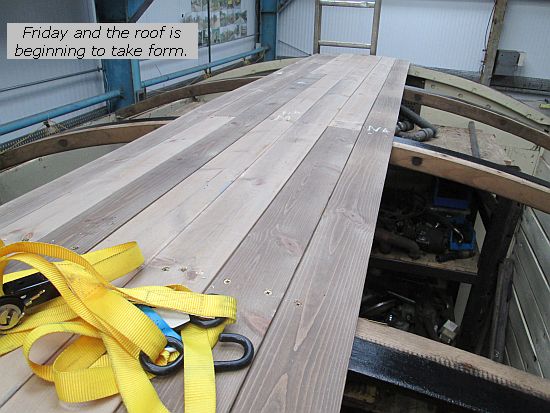
Operation Van Roof got under way rather later Wednesday morning, when Dr Ben Riley arrived armed with various power tools to make a start on the new roof for the 12ton box van. I have - years ago at Long Marston - aided a colleague in repairing a plywood van roof and re-sheeting it, but this was the first time I had seen a planked version in hand and there was an interesting meeting of minds before the job started. For not only had Andrew's selection of 12mm tongued and grooved rather than 18mm thick material (which would have been wider), but I suggested to Ben that instead of using traditional woodscrews (which require you to drill a pilot hole, a clearance hole through the plank and a countersink in the top else the wood tends to split) he might try one of the more modern 'machined' woodscrews which are intended to drill their own hole as they go in.
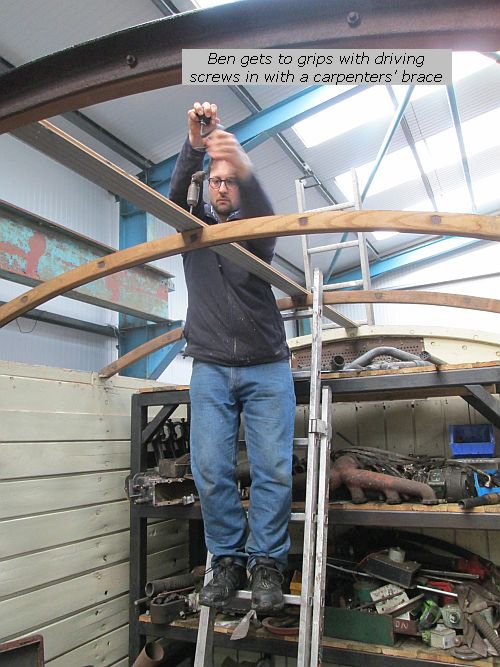
Moreover, I introduced him to my 5 inch capenters' brace which was already loaded with a 5432 Stanley Pozidriv bit bought in the days I worked for Stanley Tools (1975-77). Ben having been brought up in the age of powered devices for everything, I was surprised to find did not own such a basic woodworking tool as a 'brace, but after trying them out took to it like the proverbial duck, and went off to the builders merchants next door to buy a box of screws of a size suitable.
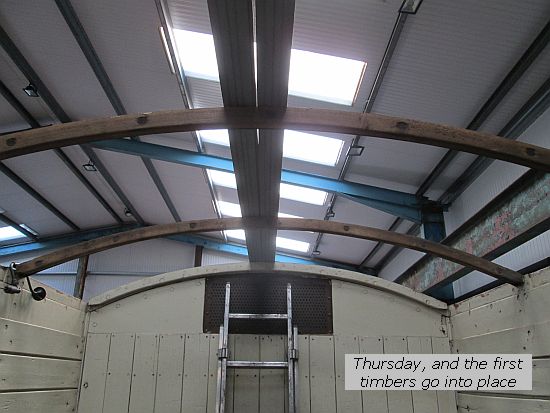
A long period of planning and planing, etc followed, so only later in the afternoon did the first planks go up, on what was, he hoped, the centre line of the roof. In practice it was advisable to pilot out holes for the screws at the very end of a plank, but the reduction in time compared to drill, drill and countersink was immense. The tongues on the planks having been reduced in length and other minor changes made to encourage the planks to accept the radius of the roof, once I finally remembered where I'd last seen the nylon-faced mallet (soft to get the planks to mate without damaging the timber) work progressed steadily through Thursday and Friday, with the last job every day being to prime the underside of planks pre-cut to the plan so that they'd be dry and ready to screw on the next day.
On Saturday we were joined by Andrew who had decided that it was time to continue the general tidying up of the workshop. With the aid of a pallet truck, he brought out the defective Hydrovane compressor and replaced it with the 'temporary' reciprocating one which is serving us very well, and hooked it up to the air main that runs down the eastern side of the shed. Not content with that, the 'Wickstead' mechanical hacksaw, redundant now its more modern replacement is to hand, was brought out and the new one took its place.
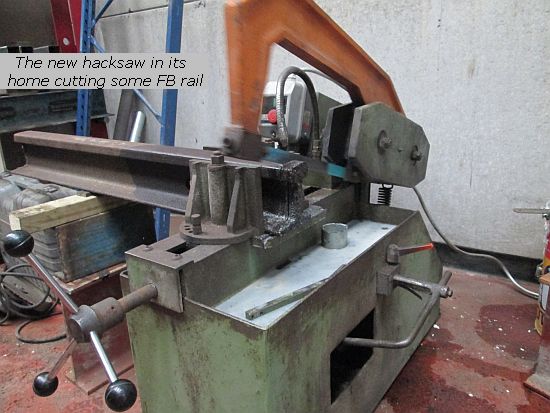
He set it to work cutting a length of Flatbottom rail destined to form two bridging pieces between the halves of the pre-fabricated loading ramp. With a dollop of extra cooling fluid added you could leave it to get on while you did something else. The bracket for the winch going on the low loader had been painted, and I had cut a plate to carry the control valve and tapped mounting holes into the edge of the channel.
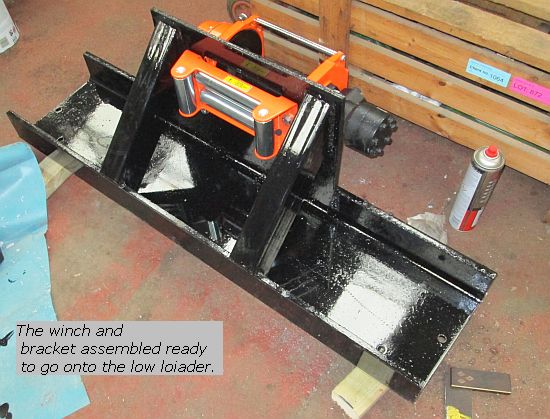
The winch itself was therefore bolted on (easier to swing it in one go). Now, the eagle-eyed amongst you might have noticed that the winch has an invisible wire wope. This is perfectly sound and proven in service, but in order to satisfy some Health & Safety experts who don't seem to be able to take our word for it (and, I do admit, that it can be a little difficult on occasion to find the invisible hook on the end of the invisible rope, but that cannot be taken as proof that it isn't there) we shall wind in a new visible wire rope once the hydraulics on the winch can be powered up, for which we need a working engine, pump, reservoir, tank and hoses. But for now the winch and bracket were installed to the swan neck and sheeted down.
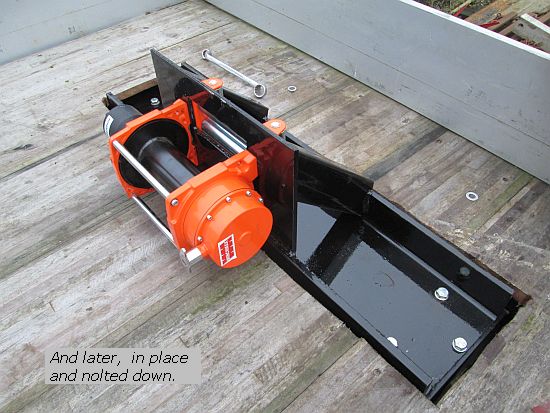
I'll get the control valve on in the next few days. Meanwhile Ben was dropping hints about needing better access to the sides of the box van as the planking neared the outer reaches.

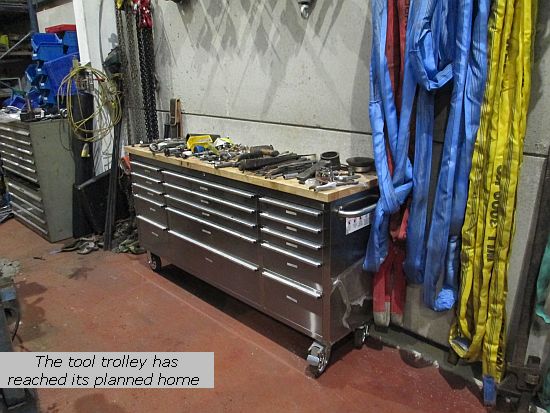
One of the big obstructions to this was the tool trolley, which can be a bit of a menace as there is a slight slope to the floor and the drawers are so free-moving that they can mysteriously open themselves when your back is turned. But the planned home for the tool trolley was occupied by the engine turnover stand, whose planned home was in the 12T box van. (Yes, the one having the new roof).. Andrew decided that the turnover stand could make a start in that direction, and after the turnover stand was found temporary accomodation and I had been prevailed on to vacuum up the floor where it had lain, the tool trolley was ceremoniously moved to its planned home under the lifting equipment rack, and being somewhat narrower than the turnover stand, opened up a walking space that has been somewhat constrained for the last few years
Incidentally, comparing the turnover stand to the box van and especially the doorway, did concern me a little. On Saturday night I did a quick CAD drawing of the van interior, doorway and a turnover stand, proving categorically that it won't fit if presented on the level! When the time comes, hopefully soon, it will have to be carefully turned on its side and presented end-on in through the doors. Andrew was heard to mutter about removing the castors (which are not all functional and wouldn't take kindly to the floor of the box van) and fit some type of wheel running on guide rails sat across the van floor, so that it can be moved nearer the doorway to facilitate loading/unloading engines, but nowhere else: it would then have a 'gauge' around about 7 or 8 feet.
Sunday and before Andrew arrived Jagger appeared followed by Ben, who romped back into action on the roof. It was a morning for tea, as having had a cuppa to regail Jagger after his drive from Lincolnshire, we had another for a VIP guest. First thing I had set the hacksaw running on the third cut of the FB rail, basically to split the length which had now lost its rough, gas-cut ends for smoothly sawn ones, into two equal portions. So far these two cuts had been made on the blade that the saw came with, of indetermined age or service use, and moreover of 6TPI (by the look of it) rather than the 4 indicated by the instruction plate for this thickness of cut. After about 15 minutes I stopped it and seeing how far it had progressed and how few teeth it had left to go further (I think the teeth in my mouth scored better), put it out of its misery. I fear some new blades are required forthwith.
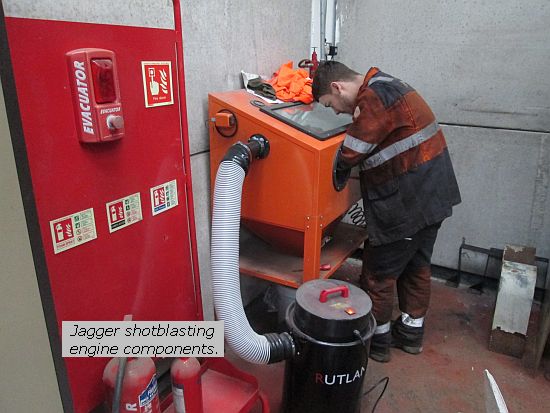
Indeed, after all the progress of the last few days today was rather a disappointment, Andrew moving to observe it is after all the last weekend of the month. Jagger was oscillating between shotblasting an engine fuel pump bracket, to passing materials up to Ben over to swinging a starting handle on the Lister LV2 which, after I had made up new rocker cover joints and fitted a fuel tank, we had ceremoniously filled with fuel. Andrew had had the plasma cutter out and extended the mounting hole which hadn't quite lined up so the Lister was bolted to its base and the pump removed. But we weren't apparently getting fuel through to the fuel pumps. This was remedied by swapping back to its original tank, but try as we might it wouldn't go, other than on a squirt of ether. This might mean it's time to get the pumps and injectors overhauled, but that is not in our timetable and some serious alternatives were being argued by the end of the afternoon.
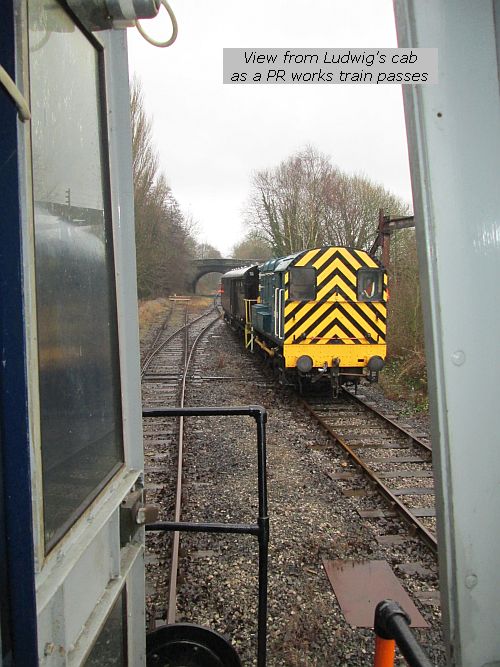
Peak Rail had had a works train further south and while we were out with Ludwig (that loco has had a lot of exercise this week) this returned. We heard remarks about 'Oh, it's an ICI one' from the p/way volunteers on the verandah of the mess van. Ben hitched a ride, taking with him two pieces of timber that went over the doors of the box van, as patterns for replication. For by mid afternoon the box van roof woodwork was all but finished.
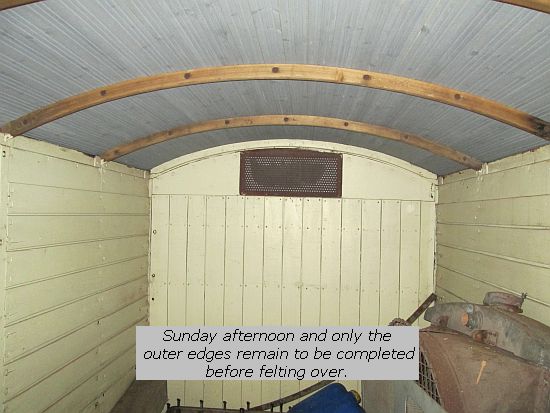
The extreme edge planks need trimming and drilling to be bolted to the top of the sides, and after that roofing felt must be secured and the ends clamped under the angles that still await cleaning up. But internally it looks finished and I may make a start on the striplights before a turnover stand gets in the way...
And that's about it for the week. Will I have as much to report and pictures to show next time? You know how to find out. See ya then.