
Of departures and books
23rd February 2020
I had an e-mail this evening from a volunteer at Bala Lake, saying that he'd seen snow on the mountain tops in the last day or so. He hadn't seen it earlier because before he couldn't see the mountain tops. I'm getting a bit tired of all this wind and rain coming across the Atlantic. I think I'll blame Trump.
There's a distinct lack of photographs this week. Partly because I haven't had the camera with me earlier in the week and partly because there hasn't been that much to photograph. A couple of years or so ago, we had a phone call from a friend asking if we could get them out of a fix. They had a Wickham target trolley on a car transporter and for some reason it was unable to be unloaded where it had been sent to, and the driver was due to collect a car and take it south. He was duly re-directed to us and the Wickham was given sanctuary 'for a few weeks'. Weeks became rather longer, and along the way the Rail Trolley Trust established a base at Statfold. A few weeks ago we suggested that as we would need a lorry to take the bent wheelset from the Brewery for repair, how about if the same vehicle took the target trolley to Statfold? A deal was struck, and Wednesday was allocated. Andrew had arranged the lorry to arrive at 08.30, but typically having got to the shed by 08.00 in order to open up and get the locos etc drawn out the way, a friendly face appeared at the door and asked if he was at the right place at 08.05. I said 'if he was a lorry driver he was, if he was anything else get orfof my land'.
By about 08.45 the target trolley, spare axle and Brewery wheelset were aboard and I was about to put everything back and get on with my day. I look forward to photos of the Target Trolley charging around the Statfold circuit, unmanned, with RTT members frantically running after it.
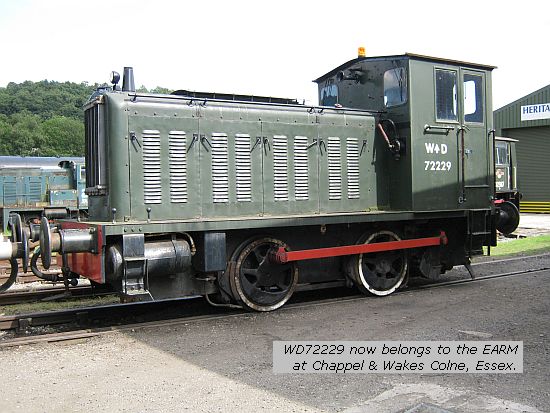
There's been another significant development this week. Andrew's ex WD 0-4-0DM has left the collection, agreement having been reached for the East Anglian Railway Museum to acquire it from him. I know I said that I would get Andrew's website up-to-date over Christmas and I still haven't that merely adds another reason why I ought to get on with it.
Over the last few weeks I have been digging through my old photographs in response to various enquirers, and some have been scanned by an IRS member in Leeds, showing me what can be produced with a flatbed scanner designed for the purpose. The scanner here in my little office copes with A4 documents but 35mm negs are way out of its league, but the scans I saw of my own negs from the 1970s were astonishing in their detail. So I splashed out this week and acquired one myself, and have spent a happy evening poring over negs that I have never had time to print before. You may see the results in future editions of the blog.
By Saturday though it was time to return to the shed, and for once it wasn't actually raining. The fence works are still not quite finished: there is a last couple of feet to the front wall that will be secured permanently to the nearest post, so that was made up as a pre-fab section but when I went looking for some chair screws to fix it I couldn't find any, so contended myself with dowsing it, and some of the new boards I had put up a week or two ago between storms, with preservative. Andrew arrived down an hour or so after me, and decided on some trailer maintenance, in this case lubricating the binder threads. We have plans to modify the trailer to have (crane) rails permanently on the deck, and I have a scheme on CAD that gives a better ramp arrangement than hitherto, but requires removal of the treadplating by the neck. I got as far as marking the trailer centre line a few weeks ago, but weather has since been against me, so again the windy but dry weather was an opportunity to mark out where to cut. Andrew reckoned that if I started by cutting the welds, he could easily slice through the treadplate with the plasma cutter, rather than use a grinder with slitting discs.
Once I have one side removed and can see exactly what is underneath, I can get the neccessary profiles ordered up and the bits assembled, hopefully making loading and unloading locos that much easier. Before the afternoon ended we had a conference over on Ashdown, to resolve the best way forward with the installation of the replacement exhauster promised before the loco departs.
Once again it was an afternoon only session today and surprisingly it was also dry, so I got out the 110V extension cable and a freshly-repaired grinder (the outcome of a donation made by Tony S some weeks ago) and had a crack at the trailer treadplate. I am used to treadplate that's only 6mm or so thick, like that job lot we bought twelve months back. But no, this stuff must be 10 or 12mm, and Andrew is quite right, it would be heavy on slitting discs. But he had arrived down with the intention of putting the plasma cutter gun back together (he had had to buy spares for it) only to discover that it wouldn't strike up and there's something else wrong, so I continued with the slitting discs, even though I wore out about 8 or 9 at a quid or so each and still didn't get it all cut. Annoying. I'll watch the weather and see if I can't get back down again and finish the job on the first side at least.
Meanwhile Andrew had moved over to the Lister engine. Yesterday he had remarked that first job was to drain the fuel tank, which we'd filled to overflowing in the expectation of it running several weeks ago. So I set about draining it but nothing came out, and when I peered inside there was no fuel in the tank. Where had it gone? No need to look far, just pull out the dipstick and a black thin mix of fuel and lube oil emerged. That, as Andrew remarked, proves that one fuel pump at least is duff and that a fuel cut-off cock is a good idea. So today he set about changing the injectors and pumps with the overhauled units which had mostly come off the other LV2, and at the end of the afternoon we refitted the fuel tank, which now has the appropriate Lister filter in its bottom and an isolating tap underneath. Next task wil be to drain its oil and refill with fresh, before priming and seeing if it will at last go. The winch awaits.
Our afternon was interrupted with Steph arriving with grandson, so after a cuppa Ludwig was fired up and ran up and down a few times for the young one's benefit. Such training is essential. After Andrew had departed, I returned to Ashdown and manhandled the air compressor off ready for some detailed measurements and a possible revised installation on that side of the loco. It ain't 'alf oily there.
As I left site, our neighbour came over to tell me how pleased he is at the fence work and not to worry about preservative as he has plenty. Considering how long it has taken that was a relief.
![IMG 6924[1]](/images/blog/2020/Feb/IMG_6924[1].jpg)
It's not often I do book reviews here, but there's seldom I get a book that deserves it. Here's the exception. If you say the word Sentinel to most railway enthusiasts they have some vague notion about peculiar steam locos and railcars, and if they have any nounce about industrials they might know of the attractive diesel hydraulics but as BR never bought any most others dismiss the marque. Sentinel were only in the railway business for about 50 years, and for a lot of that were not admitted to the trade body - the Locomotive and Allied Manufacturers Association, later RIA - because of 'ungentlemanly sales practices': i.e. a Sentinel demonstrator loco would show you what it could do before you bought. Yet in that period Sentinel showed that enterprise and confidence in new ideas that industry lacks today. They took the twin cylinder, double-acting steam engine and a vertical water tube boiler (so much more efficient. size for size, than the fire-tube Stephenson style horizontal) and put it into locos and railcars and despatched them across the world.
![IMG 6927[1]](/images/blog/2020/Feb/IMG_6927[1].jpg)
Even into the fifties they were still developing steam technology and only the Clean Air Act and BR's public decision to abandon steam propulsion worked against them. Yet as late as 1956-7, a 200hp loco with a '3 pass' system (the incoming water being pre-heated firstly by exhaust steam, then by two exhaust gas heat exchangers before reaching the boiler itself, by which time it was pretty much ready to boil if it hadn't quite already!) was turning in efficiency figures which were astounding. I was converted to a Sentinel 'fan' when I worked at Thomas Hill, and so when I met John Hutchings and his co-researcher Robin Waywell, I was happy to help.
![IMG 6925[1]](/images/blog/2020/Feb/IMG_6925[1].jpg)
John's book has finally been published this week by the Industrial Railway Society, and it is an outstanding history in its thoroughness. There are I suppose two types of such histories. Those written by former employees tend to play down the company's failures out of loyalty (if not personal involvement), those written by outsiders tend to lack the first hand knowledge and technical understanding. John, having had access to both former employees and significant volumes of technical and commercial material, keeps clear of either shortcoming. It must be the most detailed history of any locomotive builder yet produced and I can thoroughly recommend it. Buy it here.
And that's about it for this installment. Maybe next weekend we'll get that Lister going at last and I'll be getting the ramp re-arranged for the trailer. As for the rest of the week, I may have a day trip to the southwest - the M5 can be so pretty at this time of year. Other than that, I'll be here next Sunday, see ya then.