
Of axles and history
19th January 2020
Once again I was reminded that things that I regarded as just 'wot I once did' are becoming looked on as 'history' by others. Makes me feel old: stop it.
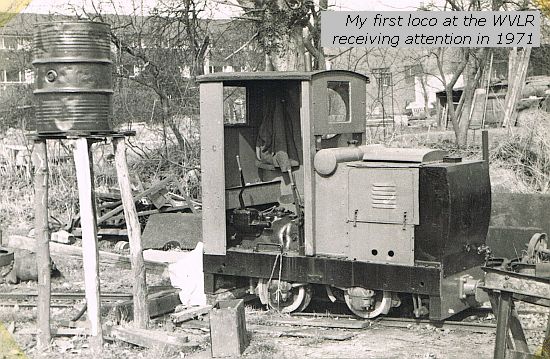
First thing Monday morning I had an unusual enquiry. Somebody doing research into the 'Wey Valley Light Railway' had got hold of my e-mail after finding a picture of me on Flickr driving my first ever loco - a 1938 Ruston 2ft gauge diesel mechanical - and wanted to know more about the railway, which was a project begun by the Moor Park Venture Scouts in Farham in Surrey. My enquirer insisted he wasn't a railway buff, merely a local historian, so I took an hour or two out to draft up some notes and scan a few photos of which I had reasonably sized prints. When I first bought a loco, way, way back in 1970, I needed somewhere to take it. Living in Surbiton the obvious location would have been the erstwhile Brockham museum, but it was already full to bursting point and had had one Ruston stolen by scrap metal thieves. But I was put in touch with one of the MPVSU organisers and one bright winter's day found myself in an ex-butchers' delivery van being chauffered from Farnham station to a former sewage pumping station which had become their HQ (after a new one had replaced it, obviously). So in February 1971, (in the middle of a postal strike which in those days had made communications rather more difficult) two Devonshire Farmers on their way east, diverted into a derelict brickworks in Gillingham, Dorset and collected two locomotives, one bound for Farnham and the other for Brockham. The previous day 4 of us had dragged these two locos, and a third, across 30 yards of soft-ish mud with a Land Rover, and a rope. The rope had come from the auction of the Dinorwic quarries in December 1969, and its owner was very proud of it. It was however an old, hemp rope, and years later, having spent 3 months in the wire rope industry, I did start to wonder whether it had in fact been the hemp core for a wire rope. We'll never know, but this rope fell to pieces as soon as we tried hauling anything with it and we found it essential to double it up and double it up again before it would take the load that the land Rover versus 3 tons of flanged wheels in mud presented to it.
Anyway these farmers delivererd my Ruston to the WVLR and so initiated me into railway preservation. I was learning to drive but could not then afford a car, so apart from later occasional loans of the family Hillman Imp, I travelled from Surbiton to Farnham by train and walked from railway station to pumping station carrying tools, lunch, overalls, etc in a bag intended for carrying cricket gear.
Back to this week, and, my enquirer promptly came back asking more questions. Having not given him much loco information because he said he wasn't a railway buff, it was apparent that he seemed to want to know just how many locos there had been, and whether the railway had ever carried passengers. So I sat down and compiled some more notes. To the best of my knowledge, the railway at the pumping station never carried passengers, but the MPVSU owned a Bedford RL (ex Army) Lorry, and a Bedford QL to which they had fitted a jib at the back so that it could be used as a rudimentary crane. They had managed to persuade the local vehicle licencing office (we had such things in those days) to categorise it as an agricultural tractor as the road fund licence was lower. (Those of you who have read 'The Railway to Merhead' - and shame on you if you haven't, still available from me or Amazon - will recall that Frank, the slightly suspect plant hirer, operates a complete road crane taxed as a tractor - that was my nod to the MPVSU). Thus with Jubilee track panels they could create a portable railway, and did so at the Farnham Town Show in 1971 and 1972. For 1971 they borrowed a Lister loco - 6299 - from Pete Nicholson (he who writes Classic Traction in Railway Magazine today). This was, in hindisght, a leap of faith, as the loco had only just been restored and was hardly tested. And as Pete only had a scooter licence at the time (and thus unfamiliar with automotive clutches), it fell to me to drive it up and down on that temporary railway for the first time in preservation.
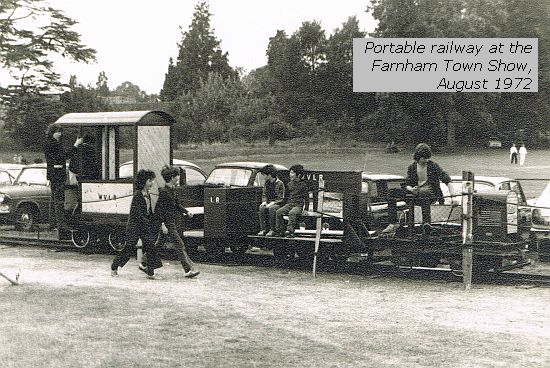
In 1972 they borrowed another - 9256 - from Pete Vallins. Listers were lightweight locos, normally about a ton-and-a-half with the ballast weights on and totally nut and bolt construction. Thus one was rescued fom a brickworks over in Essex by means of its new owner dismantling it week by week and bringing it home as a kit in the back of a minivan. I ended up taking another loco to Farnham in 1972 - a Hudson-Hunslet which I had bought from a plant dealer in Wakefield. This time it was craned onto a self-drive lorry which a friend had hired, and I can only conclude I was somewhat niave in that I hadn't worried overly as to how we were going to get it off. The QL with its jib was scarcely man-enough for the task (hence not taking heavier locos on these portable railways) and by the time we arrived at Farnham it was almost dark. The solution was to dig two holes, back the lorry into them so that the height was reduced and the deck sloped towards the exit point, and build a ramp comprising a panel of Jubilee track and an upturned skip bucket (tipper wagon body) as a support halfway along. There was one other minor problem to all this - the brakes on the loco were seized. Years of standing in the rain had meant that the brake operating shaft, which passed vertically through the cab floor and wrapped a chain around itself, tramway style, was absolutely solid and in the released position. Thus there was nothing for it, working by the light of car headlamps parked either side, but to bar the loco gently on timbers to the end of the deck, guide it on to the waiting rails and launch it down the ramp into the darkness.
By a miracle it found its way onto the track at the bottom (with a shower of sparks as the buffer beamns slid over the rails at the transition, its momentum being quite considerable by then) and rolled away in to the darkness, taking no harm from the experience. (Years later, having removed the cab side sheets I succeeded in getting the brake shaft to rotate - it bent an 18 inch Stillsons doing so, but then I did have an 10ft length of scaffold tube on it...), Anyway, my enquirer has got quite effusive with his thanks for what I provided, promising to buy me lunch if I am ever in Farnham and I'm prepared to chat some more.
What happened to the WVLR? My gradual relocation from Surbition to Sheffield, resulting in no small measure with meeting Steph, had me uplift the locos and wagons I had taken to Farnham and I severed my connection. Some time later, the local Council arranged for re-development of the site, and failed to let the MPVSU know. Contractors turned up and started digging up the track. The WVLR ceased to exist, but its track and rolling stock became what is now the Old Kiln Light Railway down at Tilford.
Jagger came over for a day this week. He spent most of the day armed witb a paint brush, firstly on the top edges of the box van and secondly priming some of our timber pieces ready for the new roof. Andrew had suggested laying these out on Adolf as being about the only space we have in the shed that wouldn't be blocking access to anything else. I was up at the laser cutters this week, and came back with the first set of bits to make the new corner steps for Adolf, but sadly there hasn't been time to weld these together yet. For at the weekend Andrew planned some more tidying up, but first order of business was to shift everything so that the forklift could lift out the new mechanical hacksaw.
I hinted at this last week. Just before Christmas we had succesfully bid on a much more modern hacksaw on e-bay, but agreed with the seller to leave it and we would arrange collection in the new year, once he had put it on a pallet. He then forgot to let us know, but Monday last week I issued instructions to Palletline, it was uplifted on Wednesday and arrived at the Sheffield franchisee on Thursday morning, whence I collected it in the van. (Why? Well I have long had an account with Sheffield but Darley Dale comes under the Derby franchisee, so I continue to take to or collect from Sheffield.) Thus I was stuck with the van full of hacksaw. The old Wickstead(?) hacksaw with which the shed has been equipped since we set up here is a traditional type whose cutting force is dictated by the weight of the bow. It works at only one speed and has a slight defect in the controls that lift the bow or control its lowering on to the job. Neither of us are especially happy using it. By contrast, this one has a lighter bow, 3-speeds of cutting and adjustable cutting pressure. It also takes up less floor space.
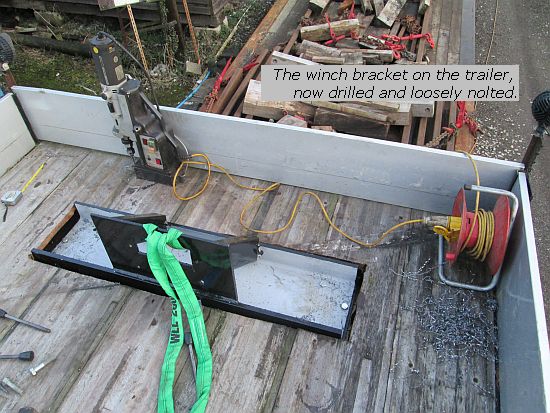
Anyway, once out of the van, it was left while we got on with other things. I was condemned to the swan neck of the low loader, Andrew having dropped the winch bracket into place. My task, in a biting cold wind with no shelter, was to mark and drill six 16mm holes with the mag drill and a rotabroach to hold bracket to trailer steelwork once the former has been finish painted.
Meanwhile Andrew was fussing around the back of the shed, succesfully getting the forklift stuck in soft ground! Later in the day we took a close look at the 'saw, and unable to resist, plugged it in to a 3-phase supply and sawed through a piece of tube (actually it as to shorten my rail roller, which is now finished awaiting trials) and declared that it was definitely an advance on the old Wickstead.
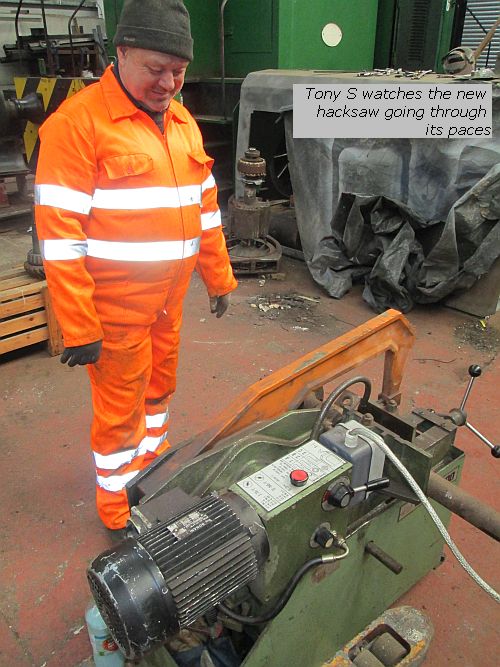
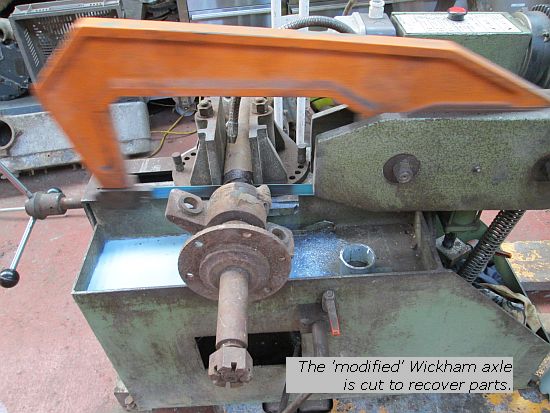
Today we were joined by Tony S. who brought with him a 'modified' drive axle from a Wickham trolley. Unpowered axles on Wickhams are different to powered ones, and if ours is to have 2 powered axles, we need the bearings and hubs to make one. This one had presumably been bent or broken at some time, and 'repaired' by sleeving it with a length of thick walled tube. Cue the new hacksaw to cut it first in half, and then near the bearings ready to be dismantled.
Andrew meanwhile was in a gassy mood, finished cutting up the milk tanker chassis ready to go in the scrap bin, plus cutting out a section of frame to form a bedframe for the Lister power pack. Various other things got moved around by the forklift, fortunately without sticking it today. Ludwig Mond has been in action both days, although the low coolant warning has now returned - we have a leak to trace. Tony moved on to the Baguley Brewery, jacking it up ready to extract the bent axle. I found myself assisting each and every one when required, and making the tea, though as things got quiet I slid the power pack on to its new base hoping that the fixing hole centres might just be the same as those vacated by the LPW2 that had formerly been on it. No such luck, so I marked out the first two holes ready to drill.
And that's about it. All going to plan, the next few days should see both Operation Van Roof and Operation Wheelset get under way. More details on that this time, next week. See ya then?