
Of a list of Listers
12th January 2020
I haven't - yet- accidentally put 2019 instead of 2020. Have you?
I suppose we are slowly getting back into the swing of things, but there are a large number of side issues going on at present which don't really have a place on this blog, but do distract us from more pleasant occupations. The fence works at the north end of the site are almost finished. And although Darley Dale yard is somewhat cluttered with locos and rolling stock - (I had an enquiry from someone - I think a former Tunstead quarry employee - who wants to bring his grandson to see RS8. He explained he is 'just getting back into it' after years ago spotting at Millers Dale armed with an Ian Allan book. I assured him that there would be other things to see here too, but not neccessarily to be found in a combo. What else is there, he asked. First thing last Monday morning I listed out all the locomotives, rolling stock and sundries and e-mailed him the list. Wow, was all he could say.) we still have things to come home or visit for attention.
So we continue to try and get the place sorted out, but sometimes it doesn't seem to be any better, or maybe worse. Scattered around the floor, you may have noticed, is a collection of various stationary engines usually acquired with ideas in mind or which were bought with specific projects planned but where something better has later come along. For example we bought a single-cylinder Lombardini, but twin pot Listers, both LV and LT became available later so the Lombardini is judged to be excess. You'd think with our prowess at e-bay it would be easy to move it on. Think again, Andrew has listed it twice, on a cash-on-collection basis, and both times the only interested purchaser has demanded that we strap it to a pallet and despatch it to Croatia or Bulgaria or somewhere equally remote.. What part of 'collection' did he not understand? I think the second time Andrew even stressed it was a UK sale only. It gives you the suspicion that we agree to what was asked, the engine departs and the purchaser then tells e-bay that the engine has never been received and claims a refund - e-bay and paypal do tend to err on the side of the buyer.
So the Lombardini continues to occupy a piece of floor. There are two Lister LV2's nearby, one hand start, the other electric. The electric one is earmarked for the reconstituted Wickham, though other than this will be a hydraulic drive Wickham (given that there is little enough genuine Wickham still remaining it can hardly be sacrosanct) how it will be arranged, and how many wheels it will drive, is still undecided. The other hand start LV2 didn't seem to have a home to go to, but over the last couple of weeks a plan has emerged, after Andrew acquired a Lister LPW2 (which needn't concern us as the engine from it has already been sold on). Between the various permutations we had a couple of bell housings, sundry pumps and a drive components.
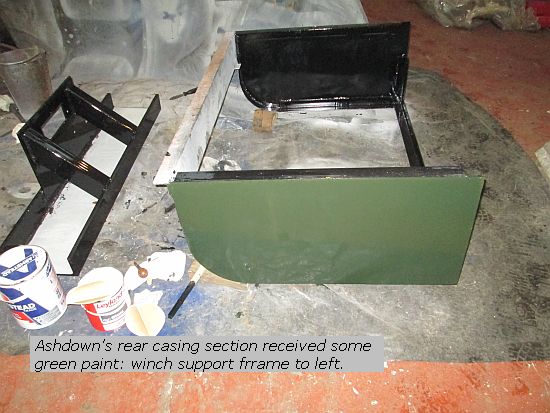
Andrew decided that the first thing to do was to get the hand-start LV2 together as a hydraulic power pack to drive the winch which I bought many months ago for the low-loader. Some places seem to think that to load or unload a loco in any way other than on the end of a winch cable is unacceptably dangerous. We could debate this at some length, but whenever a loco is operational, and the gradient of your ramp is not too steep, it is just as safe to drive it on or off as winch it or propel with a barrier. But the winch was planned in to give us the options, and the bracketry has been a long time getting finished. The power for the winch was to be the Hatz power unit, and may yet be so, but for the moment that is off the menu as Andrew has decided that for 'Phase 1' it will be this Lister, as one of the pumps should be adequate for the task.
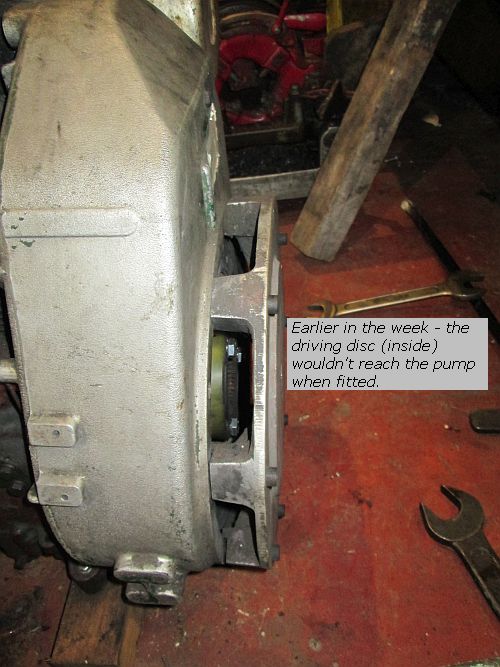
Last week we got the kit put together, using a 'proper' flywheel adaptor bought from an e-bay seller, only to discover that there was a gap between the driving element of the coupling and its mating piece attached to the pump. Andrew had gone off planning to cut a piece of 20mm thick steel into a circle and drill it to act as a spacer. After he'd gone I came across a 25mm thick disc, a spare profile from something I'd called up several years ago, and only a millimetre or so smaller than that he envisaged cutting. So on Saturday, his first task was to mark up and drill this disc reasonably accurately so that the driving element of the coupling was moved into the realms of the driven element of the pump. I have often quoted the adage about the 'hardest job in engineering being to get a hole in the right place'. Despite the steadily improving facilities we have at Darley Dale - the pillar drill being one that I now do not understand why I was so reluctant to adopt as it has earned its keep several times over - not only did Andrew break a couple of drills but in the end he had to open out a couple of holes a bit in order to get all 3 caphead drive bolts to find their tapped holes on the other side. But in the end it all went back together, and after finding the capheads on the driving member were now so close to the bellhousing as to touch (remove caps, substitute ordinary hex head) it seemed as though we were making progress. The LV2 is mounted at present on a pair of bits of timber, and as it has no fuel whatsoever in the tank we had had no opportunity to see if it runs. That may appear a trifle niave, and something that we must remedy very soon, (but not with a 'dry' pump attached) so we went on a hunt for suitable bits of steel to provide it with a greater, firmer base (trying to turn it over almost does just that) and concluded that the framework under the sold LPW2 (yes, I know I said it needn't concern you and it doesn't, but it came on a rough-and ready trolley with an oil cooler and reservoir and while the last two will be salvaged, most of the trolley is destined for the scrap bin) can be cut to size and the LV2 mounted to it, possibly with the reservoir salvaged from the LT2 power pack acquired earlier. I trust you're all following this.
Meanwhile the fuel tank from the hand start LV2 doesn't have a cap, and where it bolts to the rocker box the LV2's aluminium threaded recess has been broken open. But that on the electric start LV2 is OK, and as Andrew envisages a larger, remote fuel tank on the Wickham, the tank and rocker box lid on the electric-start LV2 have migrated their way over. Of course, one of the reasons why the hand-start LV2 bucks and broncos when you try to turn it over is because the de-compressor screws are out of adjustment, so I endeavoured to reset them. It needs new rocker cover joints before we re-assemble, and a piece of the spill return pipe is missing, but I suspect that it will be an early candidate for mounting and firing up, followed by mounting on the trailer.
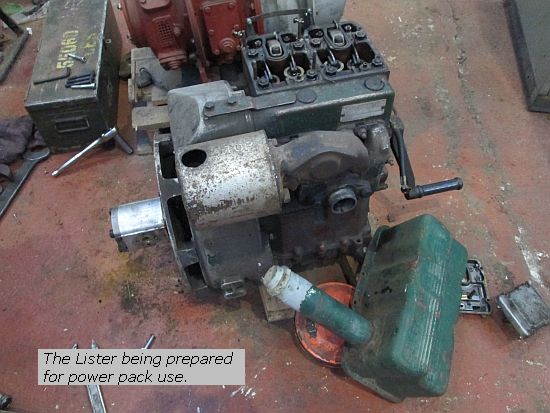
But that is its function for Phase 1, and on Saturday, in between showers, we took a look at its application under Phase 2. The Hatramm has waited patiently for quite some time, and its crane would be a useful asset, but we haven't the time to commit to getting the whole thing running at present. What if though, we installed a donkey engine to provide the hydraulic power? The flow/pressure requirements of the winch versus the hydraulic crane are rather different, but the overall power is much the same, so, once the low loader has a replacement power pack, the LV2 can be relocated to the Hatramm and used to get the latter running - if only as a mobile crane+flatbed.
Of course, you may be wondering why go to the trouble of getting this LV2 rigged up on the low loader just to replace it in due course and re-deploy it on the Hatramm. Me too. Andrew's present justification (having done his sums) is that the hydraulic reservoir on the Hatz sled is too small for the winch flow: the oil would be circulated 2 or 3 times a minute which would lead to temperature rise and degradation. That and although we have the governor spring required to raise the Hatz from its present 1800rpm maximum to the required 3000rpm, we haven't actually had time to figure out how to change it. On that basis the Hatz could remain resident in the shed for a while longer, though I'll take a look at creating a larger reservoir for it.
Jagger was with us for a couple of days during the week, and most of his time was spent on the box van, cleaning the rust from the top of the roof supports, knocking out the remains of any bolts that I hadn't fully drifted through, and starting painting the top metal surfaces before a roof begins to appear on them. He wants to see this project progress as he looks forward to getting Jack's engine in and working on it (and we'd like to recover the floor space)
I mentioned last week that Andrew had located a job lot of tongued and grooved boarding for the roof of the box van. Well today was the day and he had arranged with our neighbour to turn out with his Land Rover and trailer to collect it, as lengths up to 5metres don't fit well in the van. At 2pm we arrived at a farm in a little village not far from Crich. The Farmer explained that this was the remnants of a much bigger job lot of t&g he had bought to floor his house and when the Landy arrived a strapped up bundle was lowered carefully straight on to the trailer. Within a few minutes we were on our way back north and opened up just in time for the Landy to back in. Unloading took rather longer - initially out of the trailer and on to the low loader so that the neighbour could get home - then walking it up in smaller bundles and through the big doors as it was far too long to swing through the personnel door.
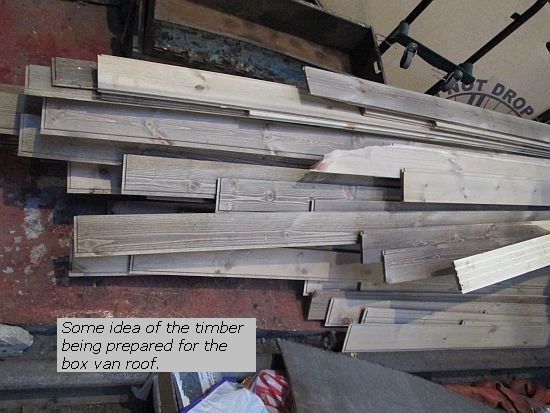
Here's a modest impression of the quantity acquired - there's enough to do quite a bit more than one box van roof. It is nominally half an inch thick, which has caused consternation in certain quarters as three-quarters is the 'norm' and mutterings about 'falling through if walked upon'. Now, the roof sheets we removed were much thinner ply, and if the holes through reinforcements are ever to line up again increasing the thickness won't help: but why should you want to walk upon it anyway and if a burly farmer is content to walk upon it every day, then maybe it is up to the occasional visitation from a low-flying volunteer or overweight gull. Anyway, the next stage is for CinC B Riley to assess what bits to use so that we can start getting undercoat applied to the inside before they are screwed to the roof supports, in a planned blitz of the job. Quite where we can spread it all out for painting is another matter. Perhaps a quick look in the PCV might be fruitful
But that's about it for this week. Return next week to find out whether the LV2 bursts into life or we do something completely different, like swap hacksaws. See ya then.