
Of repowers and allegiance
19th April 2020
As we continue in this surreal existence, another tale of 40 years ago to pass the time...
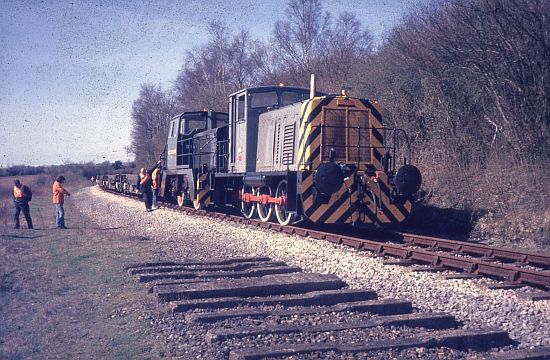
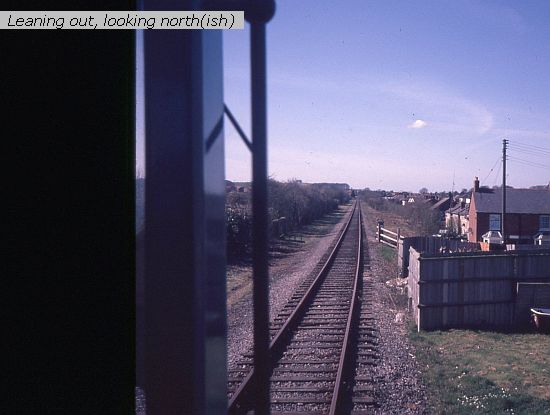
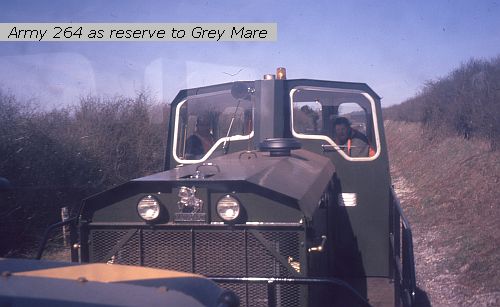
One of the interesting results of last week's blog first though was that I was contacted by the former Trainload Freight South Performance Manager who was not only able to tell me the date (which I couldn't be bothered look up) but the loco's refrence number (which I knew but didn't think anyone else wold be particularly interested in), and had also 'produced the operating instructions authorising movement over the TLF-controlled branch line' and accompanied the run with the TLF Ops Supervisor, Eastleigh. I've come across a couple more slides this week of that occasion - one at the former Red Post Junction (BR main line to the left) and another as Grey Mare returned up the line to Ludgershall.
So what can I say this week? I had half-planned to tell you a long and involved account, but I should maybe take some time and care writing it up as some of the protagonists are very much alive! So instead, a tale of repowers and poltics.....
Once upon a time, when the Army had a big commitment to railways and many depots up and down the country had rail sidings and locos to traverse over them, they had bought locomotives from just about everyone. From Scotland they had North British 0-4-0DHs and the Barclay 0-4-0DMs. From the northwest they had 0-4-0DMs from Vulcan, from the east 0-6-0DHs and 4wDMs from Ruston and from the south they had all manner of powered trolleys from Wickham. They had even bought a solitary 0-8-0DH by Sentinel, but then inexplicably followed it up with 0-8-0DHs from Barclay.
When, in the mid 1970s, they proposed to buy a batch of new diesel hydraulics there was hot competition and nowhere more than between Thomas Hill and Hunslet. In the end, Hills won, though my boss told me that as he manned an exhibition stand in Birmingham, a certain well-known Hunslet salesman came on the stand and basically said 'you may have won the first 6 for the MoD but we'll get the next ones'. When I joined TH in 1978 those first 6 had already been delivered, though in fact it had become 7 as a Royal Ordnance Factory became in urgent need of a loco so one of the Army's was routed to it and a 7th put into build in its place. Shortly after I had started my boss disappeared off with the MD for the day. Such was our good relations with Army railway staff that they had been invited to attend the official naming by the Queen of Army 253 'Conductor' (which apparently has some military significance which escapes me).
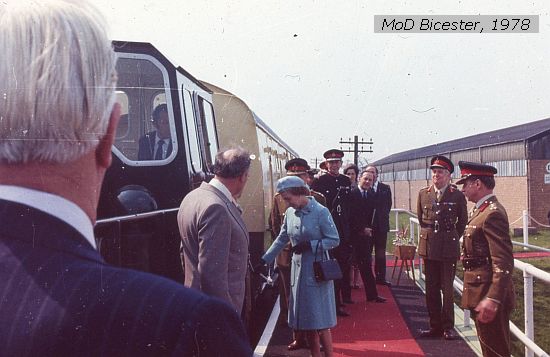
As you can see it was a very informal affair.(Photo:- the late J N Capes)
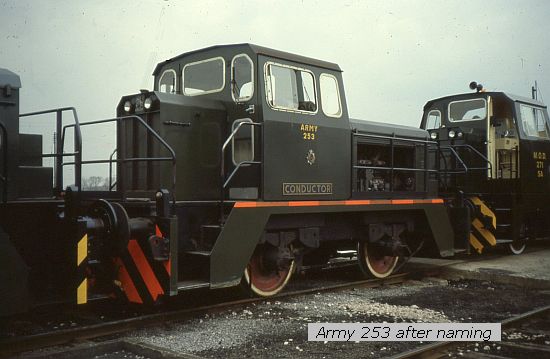
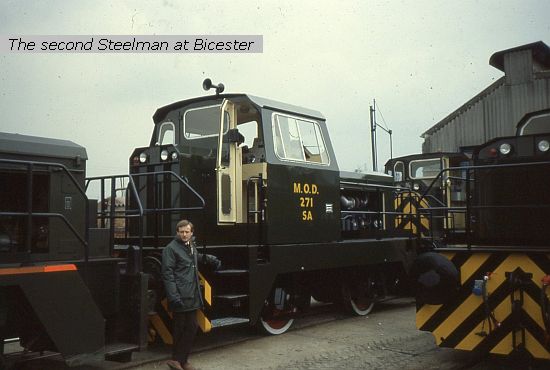
Well, Hunslet didn't win the next order, nor the one after that, so a total of 18 standard Thomas Hill chain drive four wheelers were eventually delivered to the Army and a couple more, one reduced from 35 to 29 tons and given additional flameproofing for ROF plants. The next locos for the MoD broke the mould in more ways than one. We had re-introduced the Sentinel 'Steelman' design and extended it to be a 2 axle loco as well as a 3 axle one. In fact at that tender stage we offered 3 different designs - the chain drive and shaft drive 4 wheelers and the shaft drive 6 wheeler at 45 tons. In addition, disatisfaction with the Rolls-Royce engine was growing within the Army railway personnel. It wasn't, they pointed out, on the MoD approved engines list, and as Thomas Hill was by now no longer a R-R subsidiary we were not bound to fit them. Thus it was agreed to offer no less than 6 different engines against these 3 different designs (Cummins, Caterpillar, Dorman, Gardner, the Rolls/Perkins and another).. At this point I dug my heels in. 3 designs, 6 engines, that might mean 18 different prices, 18 different tender forms, specifications, recommended spares packs, etc., etc. There was a danger, I argued, that it could become so confusing that we lose the tender by complication and by the limited time I would have to put all that lot together. Much better, I said, to say '3 designs, one price per design, any engine, same price', and my philosophy won the day. Besides, we knew which way the Army personnel's aspirations lay, they wanted the Cummins 855.
This won us no prizes at Shrewsbury, by then adjusting to life as Perkins Engines (Shrewsbury) Limited whose updated C6T was cheaper and seemed to think we should continue to support their product come-what-may. We won the tender with the 2 axle Steelman, and I received a congratulatory letter from a senior person at Shrewsbury saying that it had always been their (RR- Sentinel) intention to develop the Steelman concept into a 2-axle format. I'm ashamed to admit now that I replied with a dig as to how it had only been achieved with the Cummins! The first Steelmans (Steelmen? Steelmani?) went to Bicester and the first questions started to come back - what have you done that's so different? How come these new locos only need refuelling once a week instead of twice? To be fair, despite insisting that they built the best diesel engine in the world, and having the automotive derivative of the C6 dubbed 'the motorway miser' by a haulage magazine, Rolls had recognised that the efficiency of the C range was falling behind the competition and had initiated a development programme using a Swiss consultancy. The re-designed pistons and combustion space came as Perkins took over, and the engine later was re-badged as the Perkins 2006.
With Cummins now well-in with the Army railways, they looked towards the other 18 Vanguards, keen to fit the same 855 as was in the Steelman for commonality. They proposed converting one as a prototype. Here we ran up against a problem. Thomas Hill management took the view that these were 'our' locos and therefore Cummins should pay us to fit their engine. I didn't agree. The over-riding importance was surely that the installation should be got right, as there would then be 17 more to follow, and if Cummins wanted to take lead position and so ensure that the installation met all their requirements for warranty and reliability, and the Army were prepared to let them have 'their' loco to do it, why should we object? (Besides, if it went 'tits up' we wouldn't be associated!) Cummins initimated this was what they intended to do: I was told officially not to assist Cummins in any way. Privately I explained the situation and said if I could help, don't hesitate to ask.
The work was carried out in the open air in the factory car park at Daventry and featured loco 253 again - I have some pictures somewhere - and went back into traffic alongside the Rolls powered Vanguards and the Cummins-powered Steelman(s). This provoked a reaction from Shrewsbury, who wanted to put their new 2006 engine in in place of a C6T for comparison. Hills management were happy to do it, at Perkins' cost, but Shrewsbury seemed to think that this should be done for free and when Hills wouldn't agree, went off in a huff. The Army let them have 257 'Tela' and Perkins paid Wilmotts to put the 2006 in it at Long Marston - for years after Wilmotts trotted out a letter from Perkins congratulating them on the quality of the work. The Army guys though, were unperturbed, telling us (off the record) that they'd allowed Perkins to fit one out of 'even handed-ness' but there was no way they'd go down that route, the Cummins was too good an engine.
It was at this point that Hills had begun to lose its way, and I left at the end of 1988, forming the Yorkshire Engine Company Ltd in the closing days of the year. We were not the original YEC (nor ever claimed to be) but the name was too good to let go by, even though a well-known Sheffield solicitors then tried to sue us on behalf of clients 'employed by us between 1948 and 1962' (or such) 'and now clinically deaf'. I commiserated but pointed out that they were 'pursuing the wrong company'; even then several solicitors in the same practice repeated the claim and one threatened to take it further 'because we had not replied'. I suggested that in future they might think to check the date of registration of a company before pursuing it.
Anyway, it ought to have been plain sailing for Hills to get 16 or 17 repowers of the Army locos to Cummins: it was standard policy within MoD that whenever a piece of kit came up for overhaul or similar, it went back to the original manufacturer for it to be done. But something had come up between Cummins and Hills, and instead Cummins for whatever reason built an allegiance with BREL at Crewe. They took the order for the repowers and all 17 - including 'Tela' - went to Crewe to be converted - a bitter blow no doubt for Hills and Perkins.
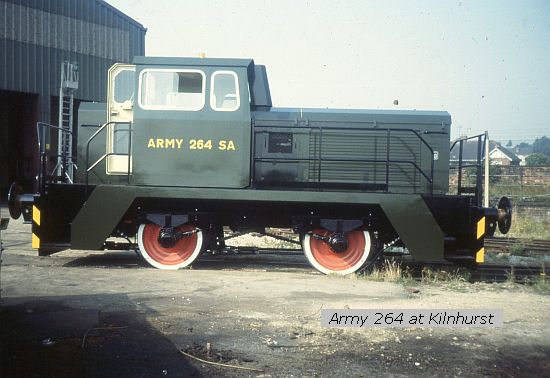
Army 264 (above) pictured ex works at Kilnhurst but by the time of the Grey Mare run in 1994 it had been re-powered to Cummins. The clue is the air intake 'mushroom' sticking proud of the casing top.
After a few months of tactful silence, Cummins got in touch and we started talking about collaborations that would benefit both parties. My first success was to win an order for Balfour Beatty for use at the Channel Tunnel construction at Cheriton. I was providing a 55ton 0-6-0DH of Hunslet origin, which came out of preservation. It was powered by a Rolls-Royce C8T - the 8 pot version of the Army's 6-potters. The loco came with no worksplates or other badges, so I created a 'remanufactured' worksplate that fitted the Hunslet hole centres and filled an otherwise unsightly blank at each casing end with Yorkshire Engine badgeplates, again utilising the Hunslet fixing centres. I could have supplied this loco merely tarted up (and maybe made more money!) but instead Cummins brokered a deal with BREL and the loco went to Crewe. I could not with this loco, get Cummins to accept my preferences for converter cooling (the loco was though retro-fitted later) but they did accept my stipulations on the exhaust system. I will never forget the Cummins man saying 'b****y hell that's quiet' the first time it was fired up, in the dark of a winters evening in the Crewe works complex. (The converter cooling came good with the Grey Mare and another project - but not tonight.)
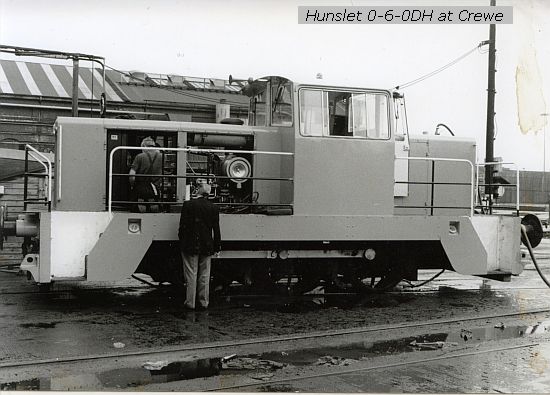
Here it is nearing completion, with the late Derrick Hobson, former Thomas Hill Service Department manager but by then retired and doing part time for me - inspecting the installation. In due course the loco went to Cheriton, and the official photographer there took a superb, carefully lit picture of it in the ballon loop tunnel which then appeared as a front cover of the monthly magazine which the project published. My Yorkshire Engine badge was picked out in a spotlight. Up to this point, it seems Hunslet-Barclay (which had been formed in January '89 after the Leeds factory was wound down) had quoted Balfour Beatty but were unaware who had the order. The first I knew was a phone call from the H-B salesman, Mungo D, telling me that their MD was on the war path and wanted the Yorkshire Engine badgeplate taking off. I responded with that it was no longer my loco anyway and I did not think I had done anything wrong. Mungo was sympathetic but said not to be surprised if I heard more - when I did it was from solicitors MacLay, Murray and Spens...
So that's it for this week. One of my correspondents complains that 'his' railway museum (he's Chairman) is all locked up and 'the place is effectively abandoned and tumbleweed blows across the yard like a mid-west Ghost town'. Meanwhile it seems if you can't preserve it, model it, and the model railway business has gone into boom-times. Now there's a thought. For now though, I'll be back next week with something which I hope will entertain and educate. See ya then.