
Of Locomotive Management, Part 2
3rd May 2020
Well, I thought I'd finish last week's story. So far so good, no solicitors letters or gagging orders, but sadly no cash offers NOT to finish it. Aah well...
I knew somewhere I had a folder with copies of reports about this whole episode but it was only about Tuesday this week that I came across it. Admittedly, it did show my memory isn't quite as good as I would like to think. It reminded me of my having rushed back to Hope from a prior meeting further south one day in June '86 to attend what was officially a 'site safety survey' in company with our MD and a senior BCI manager. The 'safety' pretext was because the whole Locomotive Management thing had to be kept secret at that stage: it was ironic therefore that out of the three of us walking the track, I was the only one to have thought to bring a hivi vest!
The notes also showed me that the order was eventually placed in February '87 and both locos were therefore delivered about a week later. Derrick Hobson was sent in to commission them and hit problems quickly. Despite our efforts to increase the locomotive weight, the Valiants were prone to start slipping and if you managed to get the full train load out of the works area and thus down the first slope of the W, there was a flange lubricator on the next up-grade and you could apparently guarantee that the loco would slip within 20 yards either side of it, and in some cases come to a stand, either from slipping or the vibration causing a relay to trip an emergency stop. Derrick called in moral support, in the shape of former Service Workshop manager Mick B. Now either Mick hadn't been briefed on the background, or possibly he had his own views on my specification for the locos, because it seems he proceeded to tell the drivers that these two locos should be tandemised together to operate trains that big! Given that they'd been sold on the premise of working the trains unaided, this was not a very diplomatic thing to say.
They then told Blue Circle that you should drive downhill with brakes on, sufficient to need power on the loco but at the expense of brake blocks and fuel. Blue Circle took a dim view of this and declared it unacceptable. They parked the locos up and went back to using the BR 08: a rather unpleasant high level meeting followed, and I found myself ordered to go to Hope and assess things. I took with me a new, promising young man called Alan R, (who was happy to go as he happened to have a girlfriend who lived in Hope village) on Friday 20th March, arriving on site at 07.00.
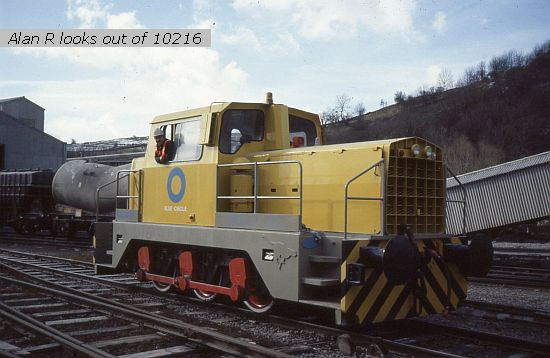
We fired both locos up and did stall tests. Loco 10216, tried first while the rail was still cold and frosty, started slipping at about 24/25.000 lbs on the drawbar, but with the rail dried we succeeded in sustaining 40000lbs for a couple of minutes until the converter was nudging up to around 200 deg F (it must have been cold - on a hot day we'd have been lucky to do that for 30 seconds). Loco 10108 on the other hand wouldn't go above 37-38,000lbs but its throttle control seemed to have an intermittent issue. I repeated the tests with the throttle at each notch in turn. This showed that 10216 was max-ing at 1450rpm (a bit low in truth) but maintaining 37,000lbs, whereas 10108 ran up to 1600rpm but only sustained 36,000lbs: so was the clutch slipping slightly or the converter not behaving as well? (Both engines, unloaded were governed up to 2100).
I didn't have time to find out. Instead I niaively tried to take a train of 962tons with 10216, but with the BR 08 preceeding me 'in sight' ready to come back to my aid. Even getting out the works area was a trial, moving from one notch to the next increased the rpm by 300, but there was no subtlety in it, it just jumped. I got the train moving, but acceleration was not helped by going up a notch - the sudden rise in rpm caused the wheels to spin: you had to drop back 2 notches and sand to recover and then bring it back to where you were, by which time you'd lost momentum. In the end we ignominiously had to resort to assistance from the 08 to get me as far as the top of the first downhill, after which it detached and went ahead.
I got going again and soon had the speed rising, in fact we touched 14-15mph and I had to give the train a shot of air for fear of temperature rise in the converter, releasing the brake and opening the throttle fully after the curve by the Peakshole Water bridge. Consequently we had insufficient momentum and topped the next rise at a mere 2mph. The following down was at 1 in 50, so we sped up fast and touched 20mph and with the converter coming up on 220 deg F I had no option other than to hit the brakes again, with the inevitable result that as 10216 encountered the grade up (initially 1 in 102) it started slipping with only 20,000lbs showing on the dynamometer, and eventually came to a stand. Again I had to call the 08 back, but even the two of us had difficulty getting the train rolling again and the 08 slipped going up to the Edale Road viaduct.
The only return traffic present in the exchange yard was a rake of empty vac-braked Presflos, some 460tons. Even then I had to brake a little going down the initial grade to keep the converter within bounds and consequently only cleared the Castleton road bridge at 5mph. Alan and I retired for lunch, then rode the 08 for the afternoon to get a better feel for things. In particular, they took back the Presflos I had brought in, now full and grossing about 1000tons. The drivers had told us they didn't like taking such train weights and I could see why, as having managed to pass the point where I had stalled that morning, the speed came down to 2.5 mph and wheelsip began. The shunter and I spent the next 5 minutes walking alongside hand sanding, with Alan recording the traction genny steady at 800amps (overload) and the drawbar pull at 24-26,000lbs.
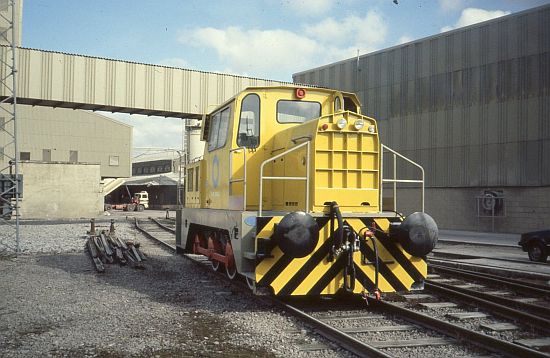
I presented my report to a special meeting at Kilnhurst the following day (a Saturday). Somewhere along the way, I had been told what had happened at the meeting when 'they' had agreed to change my Works Order. The quote that sticks in my mind was someone had declared that 'Rolls-Royce built the engines, Rolls-Royce built the converters, they put them together and they know more about it than Peter Briddon' and with that the decision had been made to install the standard package and in particular to set the fuel pumps at around 350bhp, not the 400 I'd called for. But there was another reason behind this: the coolant pumps on the C range engines are rather lethargic compared to other manufacturers, and this could become a serious issue when the engine rating went up. You wanted the coolant to impact the liners and so extract the heat. There was a tendency for the coolant to meander casually on the shortest route and miss the liners altogether, and this became more serious at 400bhp. Rolls were aware of this - there was a modification called a 'baffled crankcase' which compelled the coolant to do its job.
But when I presented my report I was only aware that the engines were below power and on those pulls I wanted every horsepower I could have. I repeated that we needed to get the heat out of the converter and that aspects of our control system, notably the stepped throttle, were really counter-productive. Action was quick: that relay panel (that had a tendency to bounce under wheelsip and cause mayhem with relay contacts) was re-mounted on softer bungees, the fuel pumps were re-set to produce 400bhp (but crucially nobody said anything about the crankcases not being baffled) and a fitter went out with another heat exchanger, which he installed on 10216 side-by-side to double the potential heat transfer from converter to engine coolant (but of course the ability to get the heat out and away was still a function of the engine rpm, fan and radiator). The throttle lever disappeared. Instead for trial 10216 was provided with a standard carbon-tracked volume control and knob, but as this was too small a plywood disc about 4 inches in diameter had been epoxied to it.
A week later, Saturday 28th, I was back at Hope with the Sales Director at 06.00. We took both locos, I had 10216 while he drove 10108. I lead and had no problem with the converter temp whereas the Sales Director had to hold back as 10108's converter got warm on the downhills. 10108 preceeded me back as I brought 900tons (20 HAAs) with 10216. It was raining, so I quietly asked the Sales Director to operate his sanders on the up-hills, in the hope that when I reached them, I would have firm sand to keep 10216 gripping (one of 10216's sanders wasn't working in that direction anyway!)
The variable throttle control was superb! You could bring the loco to just below the point of slip and hold it there. As for the journey, I remember having to brake on the initial downhill, though kept it on too long as the converter was quite comfortable by the bottom but I didn't have the momentum I could have utilised. Consequently I reached the works with only 2-3 mph at the final summit, but I was confident that with more practice I would have done better and with extra converter cooling it would have been easier still. Unfortunately our MD took the view that BCI had 'had enough out of us: we said it could do 900 tons and you've proved it' and apart from bringing 10108 up to the same standard that was as far as we would go.
My throttle control had to be changed though: the original notch lever had had an additional function - it signalled the vigilance system each time it was changed but the volume control didn't. Consequently in 'permanentising' it they used the same tuppeny-halfpenny volume control but substituted a metal knob, 4 inches in diameter and about 1 thick, with a sensor underneath which would detect the knob's movement and so signal the vigilance that you were alive and driving.
The volume controls didn't last long: you could spin the knob and having such mass they soon demolished the end stops. The heat exchangers too, which I had seen only as a temporary method of proving the principle, became permanent - or rather not, coming detached more than once. Nonetheless I was back on site on the 31st March hoping to surpass my exploits with 10216, but there was no coal so I had to content myself with hauling a 700ton cement train out without problems.
During April, I had little to do with Hope, but by the 20th May, I was back again. 10108 was in trouble, the heat exchanger combo having come loose, split a hose and dumped coolant. We tried to refill only to discover a cylinder head core plug had blown out too. This was likely more serious, so after taking advice the decision was made to change the engine with a short motor - even then I don't think a baffled crankcase was mentioned. 10108 had another issue: the lights wouldn't changeover direction. This might seem a trivial problem but it was the second time and although previously rectified, it hadn't been investigated. They should change automatically, depending on which way the gearbox was set to go.
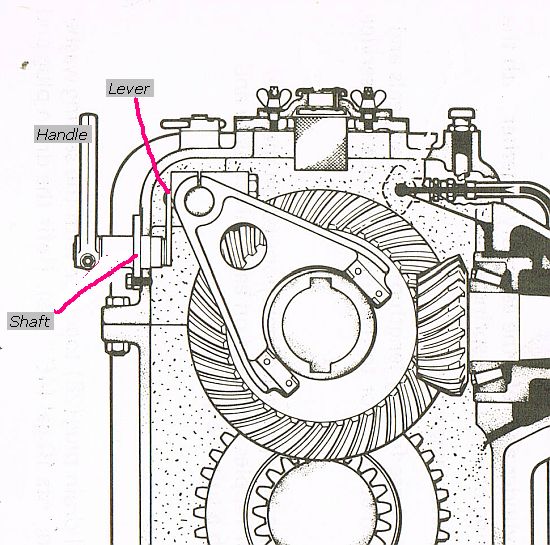
Top of an RF11 gearbox
The RF11 gearbox is a rugged beast - I'd rather have it than a Hunslet 350 any day - but it had one known weakness. Although operated pneumatically, it had an external handle so that you could, if required, pull it by hand to a mid (de-meshed) position and lock it there for towing. The handle moved to and fro through about 60 degrees with the air cylinders, as its shaft passed through the gearbox casing, to a welded lever and thence a brass block riding in the gear selector. Occasionally the internal lever was known to part company with the shaft whereupon the lever and brass block dropped farther down the gearbox. If you were about to go one way, the block and lever were thrown clear, and a fitter could drain the oil, remove the oil pump, feel around the bottom and extract the broken parts. If however, you went the other way, the gears gripped the parts in a loving embrace and something expensive suffered.
The old RF11s had handles that were cast iron, but they'd switched to aluminium and as I investigated, alarm bells rang that this hadn't been just for cost reduction. Because the handle showed plainly which way the gearbox was set, it had long been our practice to use it as a detection system. In this case we'd profiled an inch thick slab into the shape of a small spanner and bolted it to the handle, using the jaws to toggle a limit switch. We had put back all the weight the manufacturer had taken out of the handle and more, increasing the resultant shock at the end of each stroke. I went to Johnny O, our electrics chief, who had been waiting for an excuse to trial a system using magnetic sensors to spot the pistons in the gearbox cylinders. Here was his justification, and we fitted it to 10216 immediately, and 10108 before it returned to traffic.
Meanwhile I had the gearbox drained and recovered the remains of the broken bits, plus several shards of gear teeth including one piece from the final drive spur wheel that was about 5 inches long. (Incidentally, I also discovered that a Sentinel we'd rebuilt for BSC Ravenscraig had the same arrangement and it too had suffered this manual shaft failure - so two out of 3 was to my mind conclusive and the sensors became our default system). It was an unpleasant week at Hope. 10216 hung on in traffic although it was beginning to black smoke and there were complaints coming in from residents about that and the noise. I was on orders not to tell BCI about 10108's gearbox and never let them use the BR 08 (still on site, gathering dust) so 10216 had to keep going.
We got 10108 back into traffic (if you listened carefully you could hear a clunk from the missing teeth on each revolution) and I had an unpleasant meeting with the Sales Director and the MD on the 11th June. I had hoped to continue my progress with the two locos by changing the heat exchangers completely to what I was later to do as YEC, but although I had parts in hand, and a fitter and fabricator lined up for the next weekend, the MD got wind and stopped it, telling me it was Blue Circle's problem, not ours.
Politics took a hand here. The Sales Director took me on one side and told me the MD was leaving. To be exact, a Group Director was coming up on June 24th to terminate his contract: I can't say I was sorry, but we three had a meeting at Hope scheduled for that day and I was told to re-arrange it. The MD rang me to ask why, I bluffed: thank heavens he had phoned rather than confronted me at my desk!
So on the 25th I went back to Hope with the Sales Director, who was shortly after promoted to MD. We had a much more relaxed meeting than we deserved, though it only started at 4.45pm and ended at 6.45. We argued that what was really required was a pair of Steelman locos with one of the Valiants in reserve. It seemed to go well. We came away to evaluate some options, from free-wheeling converters and lock-up converters through to exhaust brakes. The basic calculation to start and haul 1000tons up 1 in 50 required a loco of 75tons or more as we had always known, and at the follow up meeting I raised with the engineers whether their concrete viaduct over the Hope-Castleton road would be OK with a (relatively) short 0-6-0 weighing 75tons: Blue Circle engineers had never looked at it and in doing so afterward discovered that the newer bogie cement wagons were already exceeding the bridge rating: a programme of strengthening took place as a result.
It was agreed that starting the 1000tons on the 1 in 50 was not essential, and that brought us back to a loco of about 65tons gross (to pull it through without neccessarily having a run at it). By now it was September, and 10216's engine finally gave up (it was presumably still running at 400bhp and un-baffled) and the loco returned to Kilnhurst. Some sort of agreement was reached that we would repower it to Cummins and a start was made. (Yeah, what I'd wanted in the first place.)
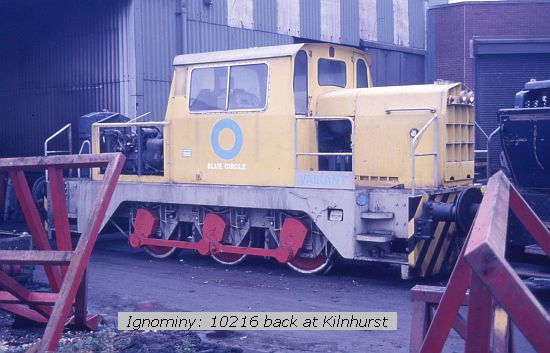
Sat on top of some files on my desk I had the 5 inch shard of broken gear that I had brought back from Hope as a macarbre souvenir. It was acting as a paperweight when one day two fitters came in to see me. They had spent the last couple of hours one told me, dragging the loco slowly up and down the workshop with a forklift. They had previously drained the oil, removed the gearbox oil pump, and while his mate had driven the forklift, he had shuffled along in the pit with a torch, peering up inside. 'Are you sure it's got broken gears?' he said accusingly. 'No' I said, 'but the one that's still at Hope has...'
Our replacement MD, the former Sales Director, upped and left in December. The final round of the Hope debacle was about to play out. The Group Director decided he would demonstrate his prowess by sorting it all. A meeting was set up early in January 1988 and prior to this he had a meeting with me and Sales Manager Larry H during which he explained his strategy would be that 'he couldn't understand what had gone wrong in the past, that it was not like our organisation to have handled things in this manner but he could assure them that it wouldn't happen again' and he would come out with an order for 2 Steelman locos. We would be there to act as his support, but only to speak when he directed us to. I had a presentation to prepare about alternative converter layouts and cooling, Larry had another piece on something else. We tried to tell him that it wouldn't be that easy, but he wouldn't listen, and given that he was the 'You're Fired' man and had been since we'd joined their group from Vickers, I prefered not to argue, even when right.
The day of the meeting came. Four Blue Circle managers sat at one end of the table and were after blood - ours. The Group Director seemingly abandoned his strategy after a few minutes as the Blue Circle guys knew far more about what had happened than he had bothered to learn. Mandated not to speak until he involved us, there was nothing Larry or I could do to help in this situation (even if we had an inkling of whether he had a Plan B and what it was) and several long, embarrassing silences ensued.
For the first five minutes after we came out of the meeting all he could say was 'F*** a duck'. We took him down to Castleton, there was a cafe there called the Three Rooves. We plied him with sweet tea (on expenses) until he recovered, it's what you do for people in shock. The outcome of this story? Hunslet got an order for a B-B DH of 80 tons, and Thomas Hills lost a customer (BCI) who had bought almost exclusively from us for 30 years. Actually, it probably marked the beginning of the end for Hills.
Now, there is a tendency to draw conclusions and moralise from stories like this. But we had all worked as a team, just a team for whom losing was preferable or at least winning was irrelevant. Someone was clearly convinced I was too big for my boots and worked to bring me down a peg or two at the company's expense. The Sales Director tended to over-sell (I see from my notes that I actually prepared the 900tons plus quote for him to make sure he didn't change it behind my back!) and the MD had his own agenda - he once told me that 'a customer was there to have his trousers taken down'. I should have had the courage of my convictions and pushed for the method of converter cooling that later succeeded - after all, the principle was there in print on the older Rolls-Royce brochures on engine and converter installations. Above all, I learned if things go wrong, and they will, you don't simply bodge it and scarper, you see it through and get it right - and you invent more and better ways to do things in the process.
I've left out a few choice bits, as even after 30 years it is probably better not to include them! Nowadays of course the Hope cement traffic is operated by Class 20s (the Hunslet having been worn out), an option that simply wasn't in our repertoire in 1987, although we did scheme rebuilding 20s as Baby 58s. Another story for another day perhaps.What to look forward to next week? Dunno. You'll just have to come back and find out. See ya then.