
Of Locomotive Management, Part 1
26th April 2020
As this pseudo-lockdown continues, I promised I'd continue with reminiscences, but I'll have to split this one into two parts. Sorry if you're only here for the pictures, but if it is a read over your morning coffee you want, - don't let it get cold...
So, in the 1980s we coined a new phrase - 'Locomotive Management'. It was at a time when BSC had discovered that the real reason overseas steelplants had so few direct employees per ton of steel produced was not that they somehow ran a massive integrated steelworks with skeleton manpower but that they had sub-contracted as much as possible outside the 'core services' to get the employees off their payroll. The same numbers of people still went in to work everyday, but most were now employed by third parties, and they could in due course bring these services into 'competitive tendering' and drive their costs down.
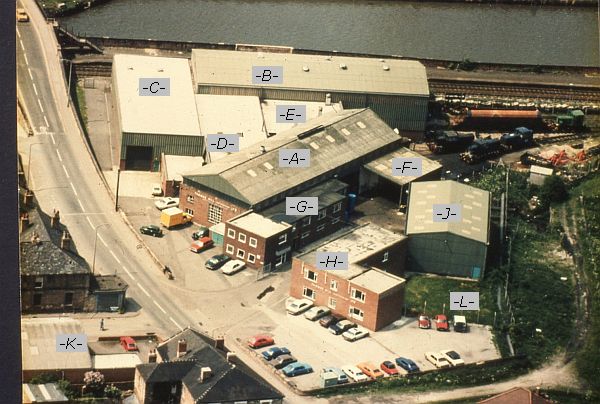
Thomas Hill's Vanguard Works from the air c.1985
A The original workshop (1959)
B The new erecting shop (1978)
C the new fabrication area
D Stores (under) Production Offices (above)
E Paintshop
F Old paintshop, now just a lean-to
G Offices, Drawing and Design offices (above)
H Accounts, Purchasing, Sales and Directors offices
J Machine shop and Service workshop
K Service Department Offices and main stores
L My Land Rover.
At Thomas Hill we reasoned that provision of locomotives and their crews could be such a service and that Thomas Hill could be a provider. Just as, years before, Yorkshire Engine had been a subsidiary of United Steels and thus had a captive market, so TH could lock the customer into our services, our parts and even our locomotives, all part of an affordable, fixed, monthly budget. We set about promoting it, indeed, I seem to recall one salesman (Nigel) was given a brief to do nothing else. We did get quite near it at BSC Shelton, but the trouble was, it appealed to those operators whose locos were long in the tooth, getting expensive to maintain, but who had looked at the prices for new and thereafter required the commercial equivalent of smelling salts. But as far as the capital costs were concerned, all we did was take our usual costing for a remanufactured or new loco, add interest charges from a leasing company, but endeavour to write the entire loco off over whatever contract period the customer was prepared to talk about (which for BSC was either three or five years). If we had to take on their labour too, at the generous terms and conditions that the unions had obtained from BSC, and add that to the mix - well, the fixed monthly budget stayed put but the affordable went out the window.
To take a detour in this story, a decade later there was one works that went down this route, but there was a twist. By now I was running my Yorkshire Engine and I received enquiries both from Marcoft and Grant Lyon to provide locomotives for a shunting contract at Trostre, a tinplate works outside Llanelli. I quoted both parties, and in due course attended site for inspections and tender meetings. By the time of the latter tenders had been submitted and these were to go over points prior to final evaluation and award. Of course there were 3 tenderers, Hunslet being the other party, so I had the weird experience of going in with one party for the first meeting, sitting outside while Hunslet went in for theirs, then march back in with my other party for the third.
Of course for my return visit this was a bit tedious, so when the Plant's boss leant back on his chair and said 'This is all a waste of time, it's not saving me anything'. I leant back on mine and said 'Well what do you expect?' which was not perhaps the most tactful way of introducing myself.
'What do you mean?' he says with a suprised expression.
'OK, you've put out a tender that basically says, this is what we do and how we do it, what is your price for doing the same. Whereas if you'd said this is what we need to do, use your skill and expertise to provide us a cost-effective solution, then you might have got a different answer.' To my left a Purchasing guy hurriedly insisted that the tender had included such wording, but I think I might have cut him down: either way the Plant boss wanted to know more.
'For example,' I resumed, 'this site is ideal for radio control'.
'What's that?' said the Plant boss, and given that Trostre was barely 30 miles from Port Talbot, one of the earlest exponents of radio controlling steelworks locos in the UK, I did ponder whether this guy should get out more.
I explained that locomotives could be radio controlled. You gave the operator a transmitter about the size of a bus conductor's ticket machine, and set the loco up so that it responded to commands from that transmitter. This is not the time to go through a detailed explanation, there are obviously various safeguards, but in essence you put control of the loco in the hands of the man on the ground, which improves safety (in a shunt yard it is usually the shunter who gets injured, never the driver) and he can also couple up and operate the turnouts. (We always lead on safety for r/c but the operators always saw manpower reductions.) So Trostre at least adopted a policy of sub-contract locomotive operation and crews, but maybe that Purchasing guy got his own back as despite my bidding to two tenderers, Hunslet got the job.
But back to the 80s and Thomas Hill. Another party that were showing interest in Locomotive Management were Blue Circle at Hope in Derbyshire. The works was connected to the Hope Valley line with a branch a mile or so long with a gradient profile the shape of a letter W, plus a long haul up through the plant to reach one end of that. They had dieselised years before with a pair of Sentinel 0-6-0s, but although excellent shunters, they could not operate the branch because their converters would overheat, and at the time of this story, they were hiring (from BR at Tnsley) an 08, which, when it broke down, BR came and replaced.
As part of our quote preparations, I went in to view their operations and if memory serves, had a dynamometer between loco and train. Their aim was to shift 1000ton trains and although I do not like 08s, I felt sorry for this one as we struggled with this weight up from the loading area to the commencement of the branch, with the dynamometer well up on the scale. The shunter walked alongside, hand sanding. The traction genny was red-lining. The wheels juddered slowly round, we were travelling at barely one mile an hour and they slipped, gripped, slipped, gripped all the way until the loco passed the summit, the load began to come off the hill and the shunter leaped aboard. Now it was helter-skelter down the first side of the W, to make sure we had sufficient momentum to clear the hump in the middle. BR may have issued an edict that 08s were not to exceed 15mph any more but the memo hadn't reached these guys and we sailed over the middle hump and kept up the pace in order to make the climb at the far side and into the exchange sidings on the other side of the valley. We came back with empties: I don't remember much of that other than watching the speedo with some alarm.
The trouble was, we listened but the principle of Locomotive Management was that we took control of the operation, so it didn;'t matter once we were in charge. You see in this business you can never sell a loco that is too large: because sooner or later the drivers will find what it is capable of and thereafter operate it to that so that they can have more time supping tea. So while Blue Circle said 'we want to shift 1000ton trains', we said to ourselves ' but if we shift it in two halves of 500tons each, that's our business'.
Yet in the midst of all this we were in a bit of confusion. What they needed, we told ourselves, was a 75ton 3 axle Steelman. But within the constraints of Locomotive Management, a brand new Steelman written down over 3 or 5 years would be unaffordable, and besides, we'd need two to provide cover. No secondhand Steelman were available, and the next best thing would be a fully-rebuilt Sentinel 0-6-0. But if the trip over the line had shown me anything, it was that an 08 punched above its weight. It may only be a 48ton 0-6-0 on paper but it was producing a tractive effort that I knew a 48ton Sentinel could not achieve. There were two obvious reasons for this, the first was that the 08 had a longer wheelbase and shorter overhangs. The Sentinel was designed from the begining for curves which an 08 couldn't contemplate, the sort of thing you found in industrial complexes. The second was that the 08 had two traction motors, one at each end, whereas the Sentinel drove at one point - the middle axle. The designers would tell you it made no difference but in practice you had to accept that the uneven transfer of thrust through the side rods would be less deleterious when the drive came in through two places.
We consulted Bill B in Drawing Office, who gave the OK for a Sentinel to be ballasted up to 55/56 tons within the limits of springs and axles. We could do this by adding additional slab as running plates and thus have more adhesive weight to offset the advantage of the 08. So far so good, but we still had the psychological problem that Blue Circle knew that their Sentinels were not capable of doing the job, and a rebuilt Sentinel would be tarred with the same brush. But what if, went our Sales Director's musings, it didn't look like a Sentinel? If we re-used the casings, but put a new cab on - a bigger, taller cab (Sentinels had always been designed around low bridges and the current fashion for crews to wear hard hats was a bit of an embarassment) that was pure Vanguard? And so we invented the Valiant.
And as we were rather short of work at the time, we started on two Valiants anyway. Under our procedures, I had the dubious privelige of writing out the Works Orders. I was, in any event, the only one with the experience of what the duty was at Hope and TH had also spent £000s on trying to achieve the Holy Grail of Quality Assurance, BS5750 Part 1 (nowadays much dumbed-down as ISO9000). We also had the initial experience of the Cummins-powered Steelman locos at MoD, so my draft for the Valiants for Blue Circle included...
+ one loco to have the RR C8TFL engine, the other a Cummins NTA855, both rated at 400bhp, 2100rpm,
+ Both up-weighted to 55/56 tons
+ Both to have additional torque converter cooling (though how this was to be achieved, and how much more, I left to the design side of the enterprise - in hindsight a serious failing on my part).
The first obstacle to my ideal appeared in the shape of the MD, who arrived at my desk demanding to know why I had specified one loco with C8 and one with the 855. I explained why, (run them side by side and ascertain the better engine for future contracts) but was told in no uncertain terms that Drawing Office had said that the chassis of a Sentinel was designed around a C8 (true) and to fit the shorter 855 in was too expensive (even apart from the cost of a new 855 being rather more than a rebuilt C8). He amended the Order to be two C8s instead.
There had been a subtle change in position at Blue Circle during all this, and maybe we had been too mixed up in our own problems to notice. The first clue I had was when the Sales Director asked me what these locos could pull over the branch as Blue Circle had asked for an alternative quote to purchase, as a comparison to Locomotive Management. I sat down and did the sums, coming back to him to say that I could guarantee 640tons on the 'standard calculations' but, provided we could take a run on the downhills so as to clear the uphills, it could do 900. (But that did mean having a loco that could run downhill with the load without overheating the torque converter.) The Sales Director wanted to say the loco could pull 1000 tons over the branch, because that's what he'd promised Blue Circle.
'No', I said.
'But if it will do 900,' he started on a different tack, 'will it do 901?'
'The calculations aren't that exact,' I said with some exaspiration, 'yeah, I suppose so.'
'Good, then I'll put it down on the quote as 900tons plus'.
It must have been late 1986 or maybe the first few days of 1987 when we received an order from Blue Circle to buy the 2 Valiants that were now well under way. Indeed, on the 23rd January I climbed over the first, then in the paintshop, and realised that the converter had the standard R-R cooling arrangement with no visible difference at all. I assumed that as the MD had changed the engine specs to both having C8s, 'they' had decided no additional converter cooling would no longer be required. Nevertheless I wrote a memo (pre e-mail days) to the then Drawing Office Manager, Tony P (and my point of contact for issuing Works Orders) that said -
'How is it,' I asked 'in a company that purports to operate to BS5750, that I can specify a locomotive in the Works Order and yet the workshops produce something different without any feedback to the originator of the order?' I never got a reply.
With an eye to our own future operation, these Valiants had left behind the familiar pneumatic/mechanical control system of the Sentinel and embraced electronic/electro-pneumatic systems which were almost ready to receive radio control. (We'd even fitted the external light boxes that would show the driver that his commands had been executed.) The throttle in particular used electronic governing with proprietory units normally utilised to achieve the close governing requirements of an AC genset, but had the facility to permit variable speed control by refrence to an external resistor(s). But the radio control units didn't permit analog signals, so you could either have a 3 position switch to give you a throttle and brake controls (characterised as a 'bit more, bit less or leave it there') or a multi-position switch that gave you fixed notches. We'd done the former for train and loco braking, the latter for throttle. As a prelude to r/c, the controls in the desk mimicked the way they would be operated on the envisaged transmitter, and in order that nobody could interfere with the controls on the opposite side of the desk to the one you were driving from, you pressed a button to take control at that side of the desk and even then throttle stayed the same until you 'passed through' the notch it was at. Sounds complicated? Yeah, inside that desk there were something of the order of 40 relays, and not a micro-processor in sight.
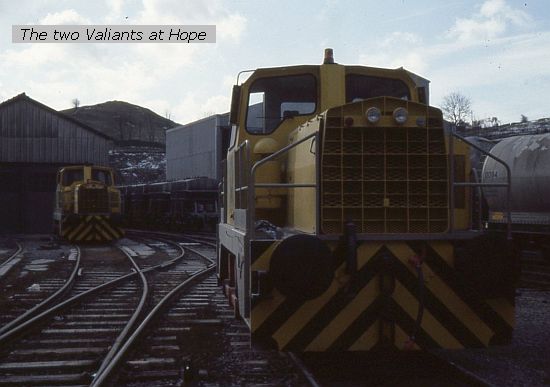
So, I think at that point, with the scene set for the two Valiants to be unleashed at Hope, I'll give you a quick preview of what they looked like (above) and continue the tale next week. Will you be back? See ya then.