
Of hot converters
11th April 2020
There was, years ago, a BBC series called 'The Survivors' (I think it was) whose premise was that a scientist in a lab accidentally breaks a petri-dish with something nasty in it. His gloves tear but he covers it all up. Then a few hours/days later, he falls ill and dies in an airport, but his cantagion is meanwhile passing to others, transported around the world and soon the human population is decimated. Survivors exist in little pockets of countryside, struggling to live and suspicious of all strangers. Remind you of anything?
Some bits I recall were filmed not far from us in Derbyshire, and the Severn Valley came into one episode where survivors were keeping the trains running because they could access a coal mine nearby. In one episode Patrick Troughton played a bargee, trading from a narrow boat loaded with wellington boots: it was after his days as Doctor Who but the character was played much the same.
Anyway, enough of all that. Welcome to another scratch edition of Weekend Rails as I struggle to think of what to write when all this isolation millarky is getting in the way. I could tell you how the replacement steering rod ends arrived from Kings having been despatched just before the company decided to close down for the duration, or how several of my regular correspondents have agreed with my vision of how things are going to go this year in the heritage railway field. But there's only so much I can spin about how life is much quieter at present and you probably know it all anyway.
I did though receive an article on RS8 from a Dinting supporter which had been printed in their magazine many years ago. Written contemporaneously, it gave some further insights into the history of the loco at Tunstead and included a line drawing (sadly too pixellated to reproduce) which appears to be an early proposal when it was realised that the radiator-engine-converter was too long to fit in from the rear axle forwards, so instead they turned the loco round and laid it out with the power unit driving the 'front' axle 'backwards'. The clue is that brake rigging and that long slot in the frame around the ashpan become the 'front' of the loco, which has gained a front walkway! Instead of course, the frame was extended 13 inches.
I promised you though some nostalgia to while away the hours of semi-lock-down and here we are. During the 1980s when I was working for Thomas Hills, I was summoned by a gentleman within the MoD to investigate why, in his words, 'he couldn't run a Vanguard downhill without it overheating'. The nearest MoD railhead to Army Railway HQ in Andover was the vehicle depot at Ludgershall (pronounced lugger-shawl) which was then operating over the former M&SWJ line out from Andover.
As a result I spent a day with a set of temperature probes on a Thomas Hill loco with a rake of warwells (MoD bogie well wagons used for carrying tanks and such) charging down the grade to Andover and watching what happened as the transmission overheated. That may sound frightfully well organised and of course it wasn't. I was provided with a collection of thermocouples and spent an hour or so sticking them to important pieces of loco with sticky tape and bringing their twisted cables back out of the casings and through a cab window where I had a single display plus a big rotary switch so that I could select any one thermocouple and read what it indicated, then log it down on a sheet of paper before turning to another. I would like to tell you that in the rush I got two wires transposed, but the reality was that I was sufficiently wet behind the ears that although I knew that there were two 'large' pipes one that took fluid (in reality, engine fuel) out of the torque converter and into a heat exchanger, and a second that brought the (hopefully) cooler fluid back from the 'exchanger for another breathless spin in the converter, I didn't actually know which was which, and was too embarassed to ask.
I had a simple solution to this conundrum: whichever was the higher temperaure had to be the outgoing flow, and the lower temp one the returning flow. I wasn't alone on this jaunt, incidentally, my role at Hills had been internal sales and they were only cautiously letting me out to see how I faired. I was chaperoned on this occasion by Sales & Service Rep George Outram, with whom I spent many happy hours at such tourist hot-spots at Sellafield and Ketton Cement. George of course, knew all about the problem (as no doubt did others within Hils, after all, my boss had described the same issues with the licence built Sentinels at work in Portugal, but dismissed it as CP trying to use a shunting loco as a light passenger hauler) but was quite content to allow me to explore the issue, probably expecting me to come up with the solution that Hills staff were wont to propose elsewhere, namely put the loco brakes on and drive against them, effectively turning a down-hill into an up-hill.
Before heading down the line we fired the loco up and once air pressure had been made set off to get some wagons together as a test load. I was of course using this period to collect test data and check that all my thermocouples were working. Soon I had a differential betwen my 'in' and 'out' pipes to the converter and I was happy, I knew which was which.
Well, once the train was formed up and the formalities sorted, we were joined by the Southern Area Railway Officer (MoD) - that cab must have been crowded - and set off out of Ludgershall, over the summit half a mile or so further on and attempted to go as fast as we could to Andover. In practice the torque converter rapidly overheated, and when the protective switch tripped, the engine was shut down and the brakes applied. Without the engine there was no cooling flow, so it took several minutes for it cool down naturally (the abiding memory is the smell of 'roasting' paint) before the engine could be re-started, bring the converter temp down to an acceptable level and set off, for another burst of speed and another sudden shutdown. Of course in each few minutes of waiting, the Southern Area Railway Officer's eyes seemed to be burning into the back of my head, and his occasional question had a clear sub-text of 'well, now you've seen it first hand, what are going to do about it?'
This was not helping my thought processes, which were already totally in disarray. For the 'in' and 'out' differential I had observed during the preliminary shunting (and thus concluded which pipe was which) had reversed significantly as we got speed up, and I was sufficiently numb from the neck up to be assuming that this meant that the fluid flow had actually reversed. Of course it hadn't, and some time later (I'd like to think it was quite quick but it probably wasn't) I realised that a heat exchanger is just that. As the other side of the heat exchanger was engine coolant, whichever was hotter would transfer heat to the less hot. During the shunting, the engine had warmed up quickly (the thermostat specifically makes that happen) but the converter was having an easy time, so was taking heat from the engine and thus my identification of 'in' and 'out' pipes had been the wrong way round. Once out on the line, the poor torque converter, sandwiched between an engine that wasn't neccessarily running flat out and a train most determined to push the loco down the hill, got very hot and bothered very quickly and so overheated.
That day set me on a course of being a lone voice at Hills against the status quo of converter cooling which some of my colleagues in the Design function of the company did not take too kindly to. There are other tales here, for perhaps another day. But for now wind the clock forward a few years.
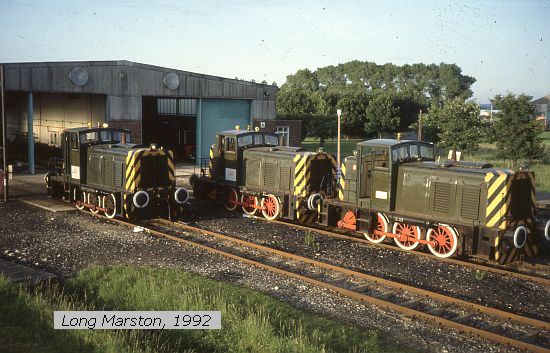
I'd left TH (well, TH made me redundant) and I was running the Yorkshire Engine Company. I'd developed good relations with the Rail Marketing division of Cummins Engine Company at Daventry, (another story for another time) and in turn they'd set the fledgling YEC up with BREL at Crewe. At that time the MoD had a fleet of Ruston LSSH 0-6-0DHs which Cummins fancied repowering from Paxman to theirs: but were liable to be sold off though. Encouraged by all of that not only did YEC buy 2 of them, but hired 3 others for use at the Channel Tunnel (another story - but here's a photo of them about ready to go down to Cheriton after we'd fitted train air braking, vigilance/deadmans and additional lights at break-neck speed).
That action had the effect of forestalling plans to declare the fleet surplus, and gave us more time to prepare the case for retaining and repowering them. Meanwhile, of the two I'd bought, one was to be parts donor, and the other, destined to become known to us as the Grey Mare, went to Crewe to have a brand new NTA855L4 installed.
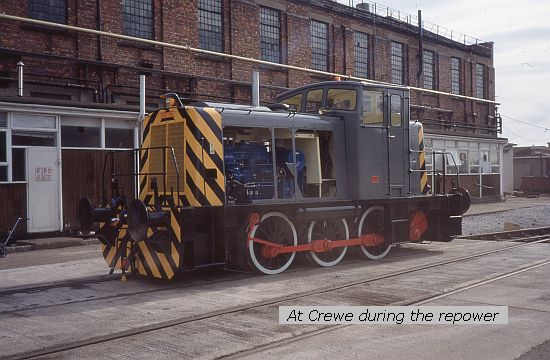
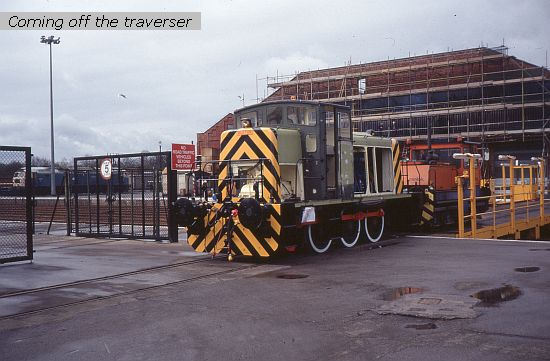
Here it is being shunted off the traverser by the BREL minilok. Compared to the original LSSH, the new power unit, with matching converter and cooler group, was much shorter than the orignal Paxmman so we shortened the casings and created a front walkway. The completed loco went off to Kineton first for trials, but the Depot Railway Superintendent had his own agenda and it spent time out of traffic with the DRS claiming I 'wasn't responding' (I knew nothing). With the prospect of BR disappearing having passed on the baton to Railtrack, we were anxious to see the loco on the line at Ludgershall to prove that what I had done was an improvement over the standard Thomas Hill product. It was firmly believed that under Railtrack regulations would change and charges too, so the Grey Mare left Kineton and headed down to Ludgershall for a Saturday morning test run.
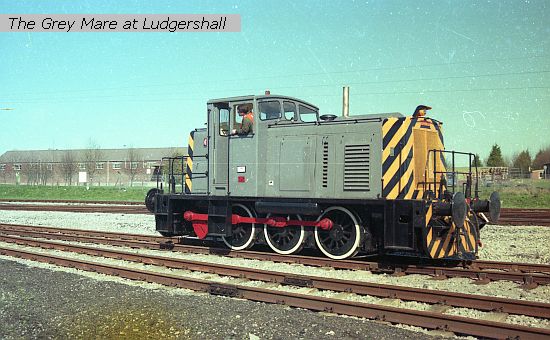
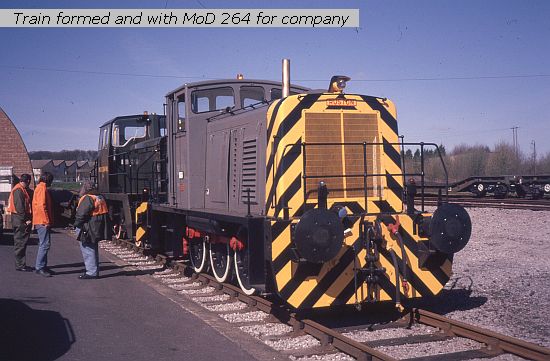
Here she is outside the Nizzen hut which was the Ludgershall loco shed. It took a while to form a train of empty Warwells, and along with it, for extra personnel transport and just in case anything went wrong, MoD Vanguard 264. I was not allowed to drive the loco, but at least I got to ride in it (on a later test run at Bicester I didn't even get that opportunity) and photography was rather more relaxed. We set off out the depot on to the M&SW, initially a slight climb, but after a passing loop (Faberstown) the track swung to the right and we commenced the long descent towards Andover. I instructed the driver, once the train was over the summit, to get speed up, then de-clutch and maintain the engine a bit above idle to keep the cooling air flowing. You couldn't do this on an MoD Vanguard, hence my having to instruct.
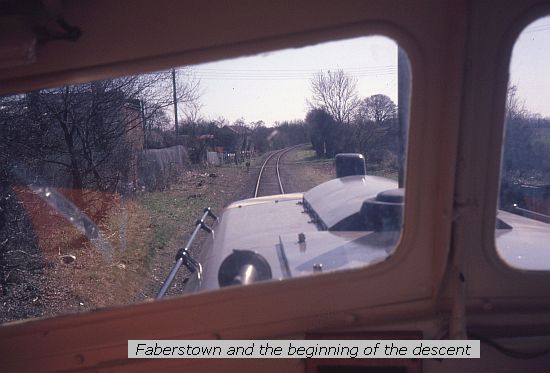
You will recall that on my earlier visit the loco had travelled a few hundred yards, then suddenly shutdown, screeched to a halt and waited for 5 minutes for things to cool before the sequence repeated. The Grey Mare however, cruised sedately down the hill, the weight of the train helping maintain speed, the transmission warming up a bit but not seriously, and me able to enjoy the ride and take the odd snap.
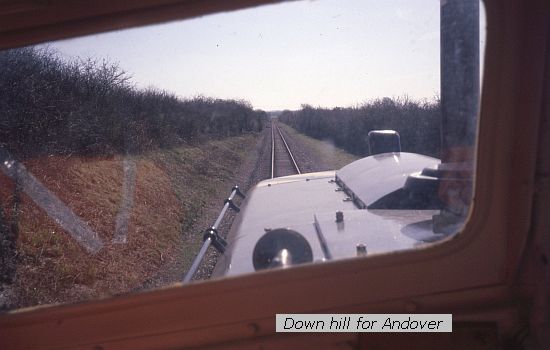
Until the bottom of the hill, that is! As the track curved left to meet up with the BR main line, there was a definite cant and the engine unceremoniously shut down, bringing us to a stand. We had incorporated into the engine cooling system a coolant level detection switch. Nothing wrong with that, it was a standard commercial switch in an enclosure alongside the radiator, with small bore connections at its top and bottom which in theory would keep the coolant level within at the same level as the coolant in the rad alongside. How high up you mounted the switch would therefore dictate the coolant level it tripped at. Cummins had mounted it fairly high up on the right hand side of the loco. Worse still, they had made the bottom connection for the switch quite high up in the engine. Thus as we'd come on to left hand cant, the switch had become almost the highest point in the cooling system, gravity moved the coolant and left the switch high and dry, causing our premature shutdown. Being a Murphy switch, we could at least override it with a finger, so we restarted, got the loco round and off the cant whereupon everything picked up again and we paralleled BR the last mile or so into Andover
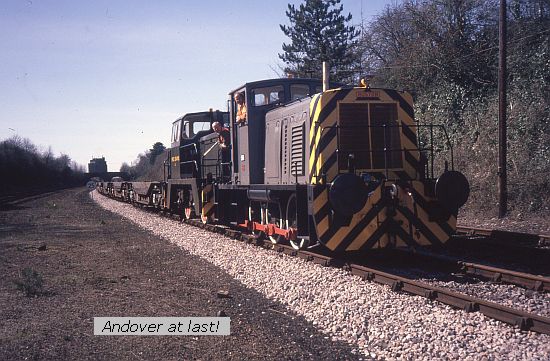
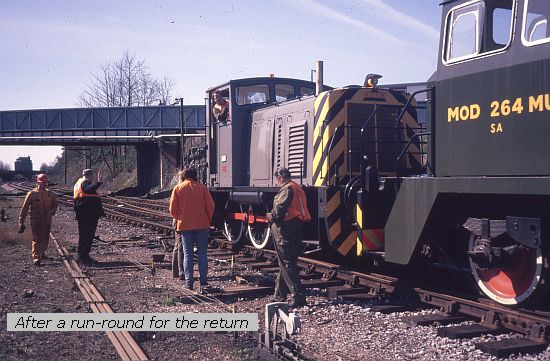
After a lot of shunting, we reformed for the return run, the Grey Mare demonstrating that just as she had come down the hill without overheating, she could haul the ensemble back up again too. After Ludgershall the Grey Mare went on to Bicester (another story) where its capabilities astounded the railway staff and returned to Kineton under a different regime. I prepared plans for not only repowering, but adding all the features that later MoD locos had, like flexibly-mounted cabs for noise reduction. But alas it was all too late. The run-down of the British Army of the Rhine brought back multitudes of squaddies and road vehicles,(not to mention warflats and a loco we know as Adolf) and an internal policy shift within the MoD wound up the Army Railway Organisation and instead made the depots responsibile for their own locos, and fewer of them at that. The remaining Rustons were eventually declared surplus after all, but not before the TA, doing an exercise to strip a Ruston, burnt through the jackshaft in order to get it out! As the Army wanted their 'training exercise kit' returned intact, I sold them back the jackshaft from my spares loco...
So that's about it for this week. Stay in, stay safe and all being well I'll think of something equally quirky to tell you about next week. See ya then.