
Of a tenth anniversary
10th May 2020
Here we are again. 60% of the public interviewed is apparently nervous to use public transport for fear of catching the virus. That will affect heritage as we come out of lockdown. I still reckon we can write 2020 off.
Rather than continue on a theme of 'industrial' exploits, I thought I'd return to my roots, so to speak, and tell a tale of one of my n.g. locos. It was not long after Steph and I married that I was tempted to buy another n.g. internal combustion loco. The price though bothered me - it was £250. Nothing by current standards, I'd buy it without thinking at that price today, but then - well I pondered. I already had 3 locos. I'd celebrated being able to open a bank account without adult supervision by doing so and buying a 2-and-a-half ton Ruston. Then I'd gone to college in Sheffield and started visiting narrow and standard gauge places of interest in the area. (I once walked the full length of Tinsley viaduct both ways - bottom deck for those that know it- because I was told reliably that a firm called N H Greaves nearby owned some locos and ought to be visible from it. It turned out that the firms offices were 'near' the viaduct [but not visible from] but the locos were in yard at Mexborough, about 12 miles away. Enthusiasm yes, research no.) Anyway, a trip to Wakefield found me a 3 ton Hunslet and that became loco number two. I'd been home for the summer vac when my mother asked for assurance that I wasn't going buy any more locos was I? I gave her a confident 'no' and about two days later received a letter from Redland Bricks accepting an offer I'd made (but some time ago and thought dead) for a Motor Rail loco. To keep it a bit of a secret from my mother I had this third loco taken to Alan Keef's yard in Oxfordshire for storage, and it was a while later in contact with him that this price for loco was discussed.
The loco was a two-and-a-half ton Planet. A baby brother to Pluto. It was sometimes called an 'Orenstein' type Planet, because the two speed gearbox was operated, O&K style, with a handwheel which you turned one way for first gear and the other for second. In truth, the gears themselves were in constant mesh, the wheel mechanism squeezed alternate clutches that were in the gearbox oil rather the same way that Rustons did with their narrow gauge locos. This particular Planet had been in preservation and sold back to Alan, who had intended to take it to the short-lived railway at Meirion Mill, near Dinas Mawddwy, but the 20hp 2-cylinder National diesel engine for some reason wouldn't run, so Alan sent a Motor Rail instead. But £250 when you're just married and in rented accomodation was a lot (purchasing any loco is only the beginning). I debated, and while I did so Alan sold the non-functioning National to someone who had one running a sawmill as spares. Without an engine the price dropped to £150 so I bought it.
By now I had got involved with the 2ft gauge line at Long Eaton, so the Planet came there along with the Motor Rail, and seeing that it had no engine, I thought it might at least look presentable, so set about scraping it down and re-painting it. Not easy in a timber shed with no electricity so only camp gas lanterns to work by. But the Long Eaton set up would have been in trouble with the Health & Safety Act (1974) under which the HMRI got sovereignty over railways down to 15". As it was I converted it to 10.25 inch gauge, but financially that failed and the 2ft gauge stuff went to Llanuwchllyn in 1977.
In 1978 I started work at Thomas Hills, and all of a sudden the world of railway engineering opened up. Back at school, only the shall-we-say less intellectually-minded pupils did Technical Drawing and Metalwork: I went on to grammar school where such vital topics as Latin were obligatory. I often wonder why it was that the education system assumes that any form of engineering is not the place for those perceived of 'higher intelligence' (and how I fooled them?).
Anyway, there I was at Hills surrounded by draughtsmen, machinists, fitters and fabricators, and locomotives having all manner of things done to them. There were files in the office on bids recently made such as to British Steel Corby to re-power their Teddy Bears (Class 14s or D95xx) from Paxman to Rolls-Royce DV8TCE (it was the denial of the spend on these locos that indicated the Minerals division at Corby was to be closed down) - and there was I with a loco in North Wales without an engine. Even then nothing might have happened had I not been appraised of another Planet loco in Essex that was for sale at a sewage works. Aah, thought I, there's an engine for mine - but what do I do with the rest of it? Well, across the other side of Sheffield was a lovely old guy called Gary Hibberd, and he too owned a Planet loco like mine. His had come from a scrap yard at Dove Holes, and though complete was in much poorer condition. In particular it had a smashed axlebox and he was fabricating a replacement.
I set up a deal whereby we bought the Essex loco jointly and took it to Alan Keef's: I to have the engine and him to have anything he needed. The loco duly was moved and out came a Lister SA3 air cooled, which was definitely not what Planet fitted. Meanwhile Gary took a train to Oxford, cycled all the way to Cote (about 15 miles as the crow flies) took a brief look at the loco and cycled back again to catch a return train to Sheffield. He rang me and asked was it OK if he kept the rest of the loco?
In due course my engine travelled up and I started on ameteur draughtmanship. The Lister, somebody told me, had come out of an Aveling Barford roller as the crankshaft, where you hand crank it on the front, stuck out by 18 inches or more and was unique for Avelings. It meant slight difficulty in positioning the engine, but I soon had basic drawings worked out (tracing paper and ink, obviously) and a workshop that would carry out 'government jobs' provided I didn't get greedy. The actual work of assembly was carried out at Llanuwchllyn, with mountings going in and a fabricated prop-shaft onto the original flexible member to the gearbox.
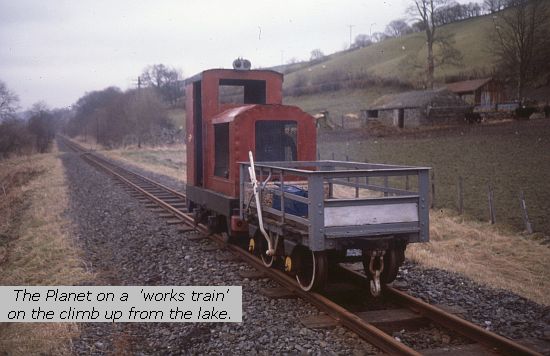
In my innocence, I had rather assumed that as this engine had come out of a Planet loco of the same type, it was a good 'match', whereas in reality someone had just had it to hand and bodged it in. My bodge was probably better, but both of us had overlooked - or disregarded - the fact that the Lister was about 35hp governed to 1800rpmm, but the old National engine was 20hp at 1200rpm. You really don't want to slow an 1800 rev engine down that far - it's below its peak torque and on a diesel-mechanical you haven't got a torque converter to cushion it. So 1800 or not, that's where it stayed but the effect was to up the top speed of the Planet by 50% (and probably shorten the clutch life, specially on 1st).
Gary Hibberd incidentally, later moved to Downton, near Salisbury, and took his locos with him. We paid him a visit in the '80s, and yes, the young handsome chap with camera and moustache is yours truly.
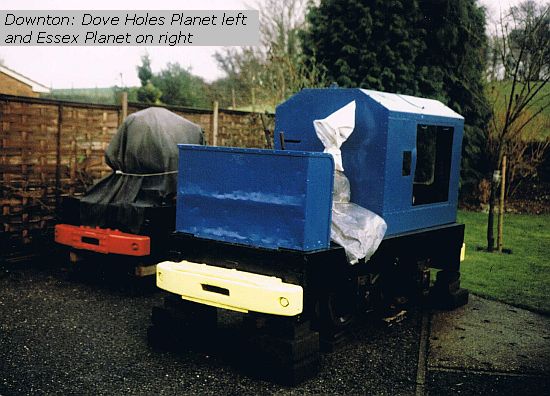
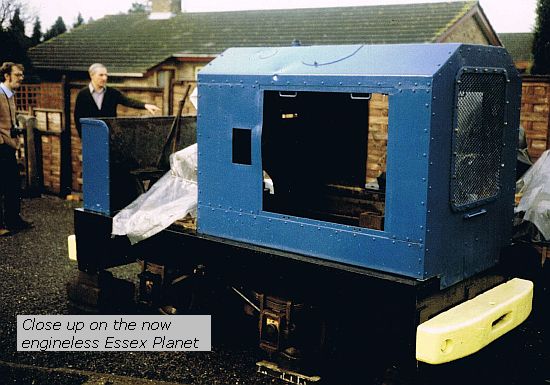
So anyway, I've set the scene, now to explain the title. In August 1972, Bala Lake Railway opened with a two-coach train to Pentrepiod (about half way to Llangower) powered by an air-cooled Ruston that had once worked at Oakeley Slate quarries. That had moved on, traded in for bigger and better, but by the time of the 10th anniversary, we decided to re-enact the opening day by way of a celebration. Re-enact though might be too grand a description. We had the original coaches, but there was no siding at Pentrepiod any more so no means to run round, and no air cooled Ruston. But we could go to Llangower and we did have an air cooled Planet. (we also had a larger Ruston, it took all my powers of persuasion to get George Barnes to agree that an air cooled Planet was more - er- appropriate!).
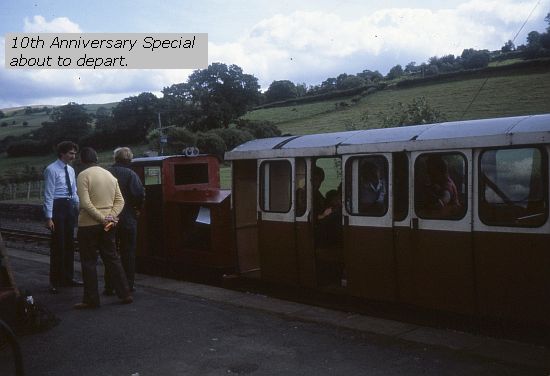
The plan was that I would depart with two coaches (the original train was two Severn-Lamb toastracks, but as they had no guard's compartment or brakes, one of the 'Wrexhams' with a brake compartment deputised) ahead of the service train, go into the loop at Llangower, and quickly run round so that by the time the following service train arrived, I was ready to set off back. The service train would use the west platform (I would be on the east platform) and go around me, via the loop. Here's my train getting ready to leave, with Chris Jackson (he of Railway Gazette and with tie) talking to prospective passengers.
The first part went smoothly. I took the train down at moderate speed to Llangower, came to a stop and congratulated myself. What I failed to do was get unhooked and run-round: for some reason that vital piece of the timetable had gone completely out of my bonse, and by the time it came back in (or maybe somebody reminded me) the service train was well in section and obstructing the line was out of the question. So my run-round took place after the service train was out of sight on its way to Bala, and by the time I was on the right end and ready to set off, we were already late for our booked time back at Llanuwchllyn.
Once started out of Llangower I held the throttle wide open (painful after a while, the throttle lever I'd fitted had a strong return spring!), determined to get back as quickly as ever I could. You could see down to the track from the driving seat - there were gaps around the gearbox and the frame members - and I realised that the rear axle was slightly bent as it wandered rythmically as the wheels turned. The gearbox began to get warm - you could feel it through your jeans - after all, it wasn't meant to take 30-odd horsepower at 1800 rpm. The lakeside section of the railway is relatively flat, but when the lake ends, the railway starts a long climb away up to Llanuwchllyn. The climb levels out as you come into Llanuwchllyn yard, but I still held the throttle on as after all, I was late. In fact, I only closed the throttle as I reached the platform end.
There is an old signalling dictum 'Your authority for speed is your ability to stop'. Most trains on Bala Lake railway stop with their coaches adjacent to the station building. I had rather assumed that Chris, in his brake carriage, would wind his brakes on, but either he was content to leave it to me or his brakes were as ineffective as mine, as pulling my brake lever as hard as I could had little effect. We came to a stand considerably farther on up the platform than was usual...
D'y'know, I'll be glad when I can get back to reporting some current stuff? Hope you're all safe and bug free. I'll be back next week with something else to say. I hope. See ya then.