
Of a recompense for mice
17th May 2020
Welcome back. Another nostalgic black&white piece this week. Am I recompensing mice? Nah, but I should have sent a bill. Read on.
I said in last week's piece about my visiting n.g. and s.g locations once I had got to Sheffield. Scanning a few pictures reminded me that one of the characteristic features of student accommodation in the 70s was the number of victorian houses hurriedly converted into student 'bedsits' by installing sinks in every room and Yale locks on every door. But adding water and drain pipes through every wall or floorboard gave instant access for rodents, which found your food stocks and had no consideration of letting their unintended benefactors sleep at nights. One student I knew insisted that he caught them in live mouse traps, amputated a leg and sent them back as a warning to the others, but gave up as he started catching 3 legged mice. (Based on my experience on trying to catch mice alive or dead I think he was having me on, but at the time I believed him).
After one night when I had had very little sleep because as a well brought-up middle class lad my slumbers were incompatable with free ranging rodents in the same room, I decided I should give myself a treat and allocated a few bob of my student grant to a bus trip to Whittington Moor and a walk to the Chesterfield Sewage works. Yes, I know this is not your average day-trip venue, but at that time it had no less than 4 Ruston diesel mechanicals (though it seemed only to need one) and tracks that stretched over the site with as much character as those grass-grown rails that had captured my interest in the narrow gauge ten years before. Of course, such was the reputation that such places acquire, they didn't get many visitors, and in those pre 'Elf and Safety days getting permission to look round was not difficult. Moreover I had with me a photo of myself with my Ruston and Hunslet n.g. diesels, which was as good as a passport to go anywhere.
So let me take you on a guided tour of a rail system that seldom saw much interest and is long since gone - but I'm going to cheat a little. For although my first visit there was in 1972, I took a friend there next year when he came to Sheffield Poly., and went again in 1974. The sun always shone, everything was rosy and life was so simple and pandemic-free. So I'm using photos from all three visits - excuse the breaks in continuity as personnel change or the loco gains a doll on its radiator. You may even spot in the background some main line, even a BR 20T brake van, for this was right alongside BR north of Chesterfield...
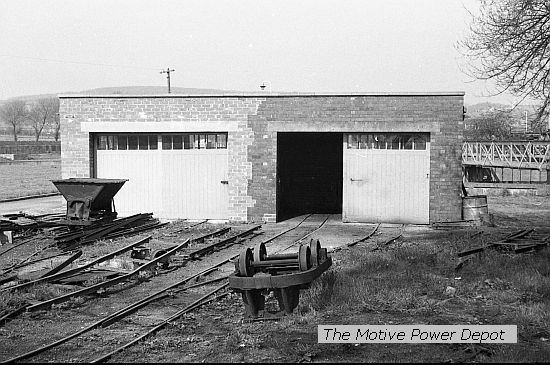
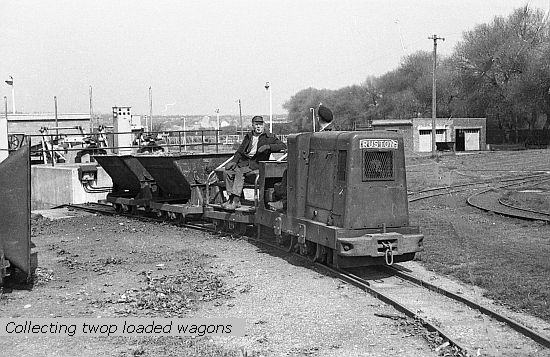
So anyway, like all good enthusiasts my first port of call was the MPD, to see what was on shed. There was a roster of 4 Rustons, 3 pre-war designs and one post war, the earliest (1934) one having the Lister engine that Rustons built under licence for a few years before deciding to build their own.
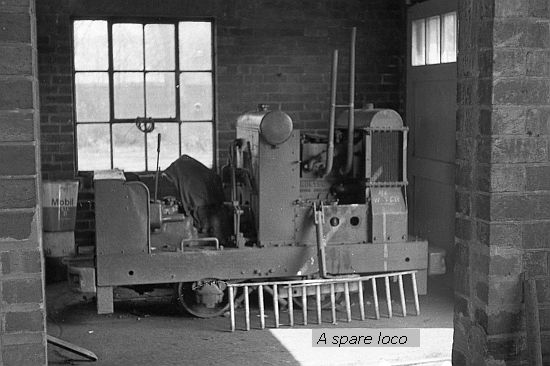
The one here though is with Ruston's own 2 cylinder - probably a 2VSO - though someone has discarded the casing top and turned the exhaust pipes up (they used to come out through those two holes - who needs silencers anyway?). On my first visit the newest Ruston - then a mere 22 years old - was awaiting its next duty outside the offices, coupled to the railway's one and only personnel carrier, so presumably first class - it had seat cushions, anyway.
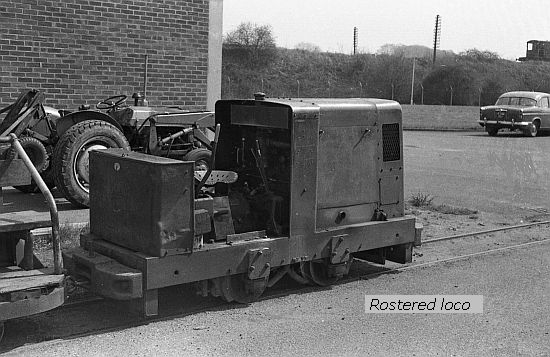
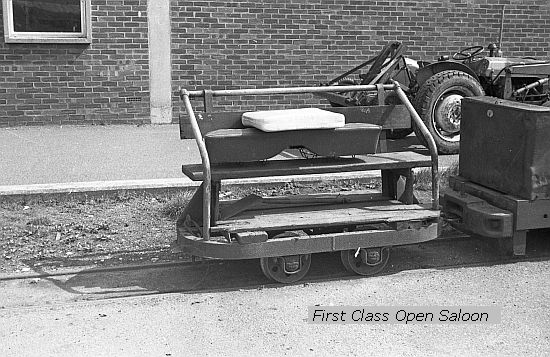
When the driver appeared I got talking and waved my photo: next minute I was invited to take the controls and spent the rest of the afternoon driving, so not many photos taken on that day! I confess I am not too familiar with the sewage processes involved save that a large flat area was laid out with concrete walls to make settling beds into which effluent was poured and allowed to dry. From time to time a concrete panel would be removed, a spur laid in from an adjacent line and the dried contents shovelled manually into skips ( 'V' tipper wagons) and taken away to make room for more.
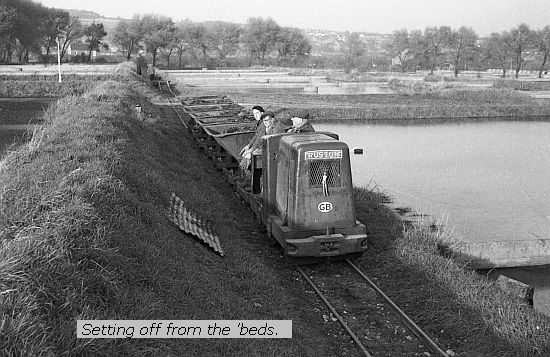
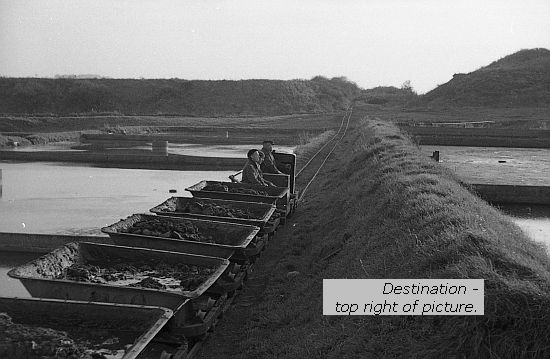
What other sewage works did with it I know not, but in Whittington Moor they trammed the loads up a hill to a large and somewhat disgusting-looking 'lake' and tipped it in. It may of course have been some sort of job creation-scheme. Dry it in the beds, take it up to the lake, re-constitute it and then use gravity to bring it back down, liquefied. to dry it all out again. If that were so, and the residents of Chesterfield were content with that, I am all in favour, it kept the narrow gauge in meaningful employment in this part of Derbyshire long after the Ashover had succumbed, and while Sheffield could boast two similar narrow gauge systems, they had but one Simplex each (I got to drive on of them, too...)
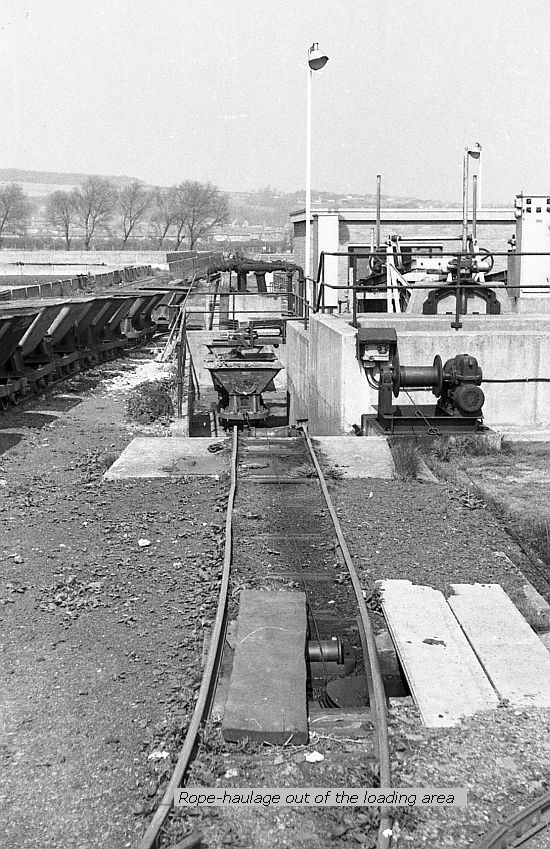
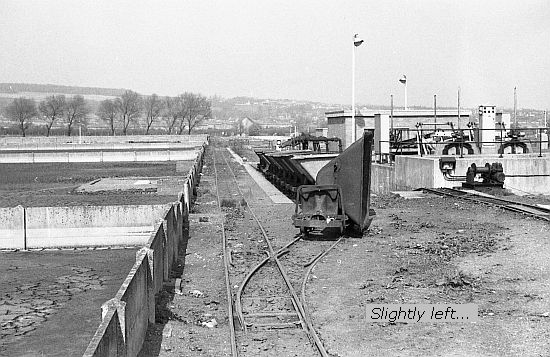
But I digress. There was also a peculiar loading area where skips were lowered down a short, vicious gradient using a winch, and hauled out again after loading the same way. Quite what was different about this product or process I didn't know, nor was I particularly keen to ask: it may have been just another twist in the continuous cycle and designed to keep curious councillors or nosey neighbours guessing.
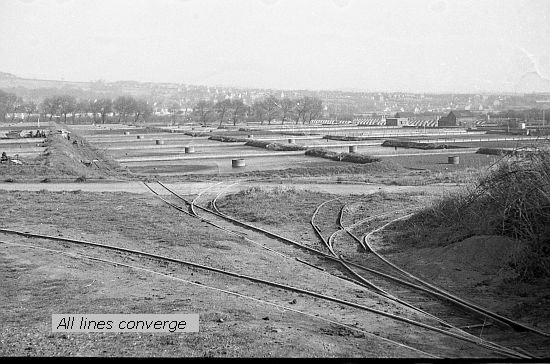
Some idea of just how big the works was can be seen from this view, looking down from part way up to the lake. Tracks bisected the area, all coming together in a shunting neck with a gradient that would give a Network Rail track gang nightmares.
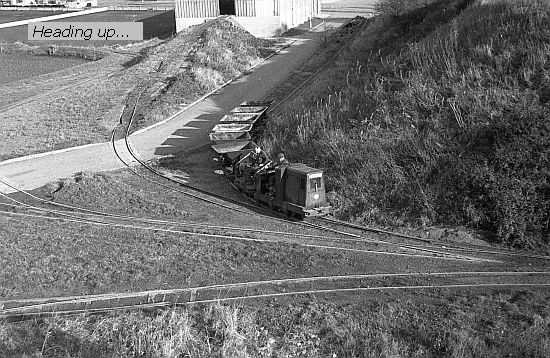
You had to charge in to this, to get your train clear of the points, your mate(s) having exited the First Class Open Saloon to change the king turnout, while some maybe walked up to the lake for the exercise (or to get away from my driving). From the neck you set off propelling now, firstly 90 degrees to the left, then straight, then through a further 180 degrees left to come up alongside the lake.
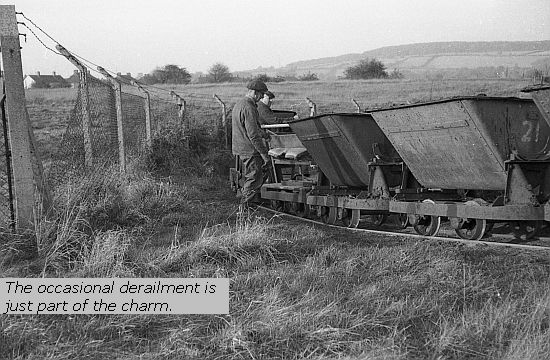
Propelling is of course slightly less predictable than hauling, and occasionally the lighter First Class Open saloon, squeezed between the skips and a 3ton Ruston, opted for an alternative route but was soon encouraged back to the 2foot. At the top the track followed the perimeter of the lake: right on the edge so that each wagon's contents could be tipped into the greeny, browny sludge.
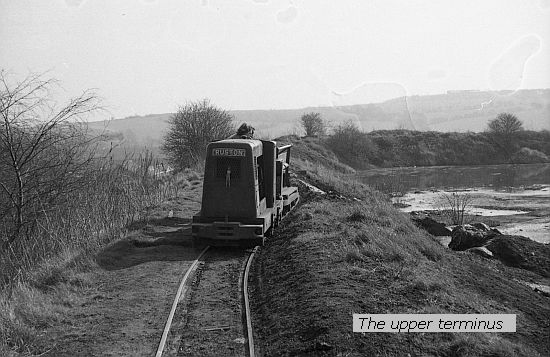
All we needed was for some alien monster to arise out of the depths, our dried and regurgitated gloop oozing down its leathery skin..
But not today. With the wagons emptied our mixed train sets off back down the hill, into the shunting neck and away again to whichever of the beds is next due for recycling.
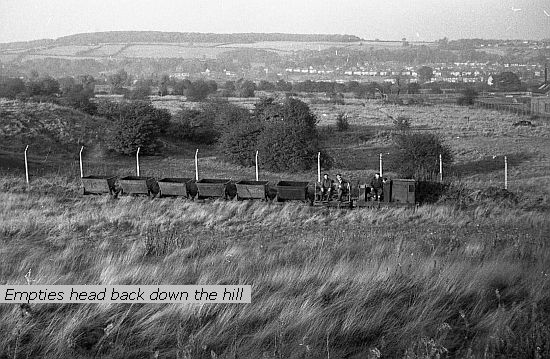
Alas, even as I gained those photos and memories, the writing was on the proverbial wall. There was talk of a new process called 'lagooning' in place of settling beds, and the railway would not be required. Had someone figuered out the Whittington Moor ruse? Were they going to cut out all the intermediate stages and just go straight to one bigger and er-better lake?
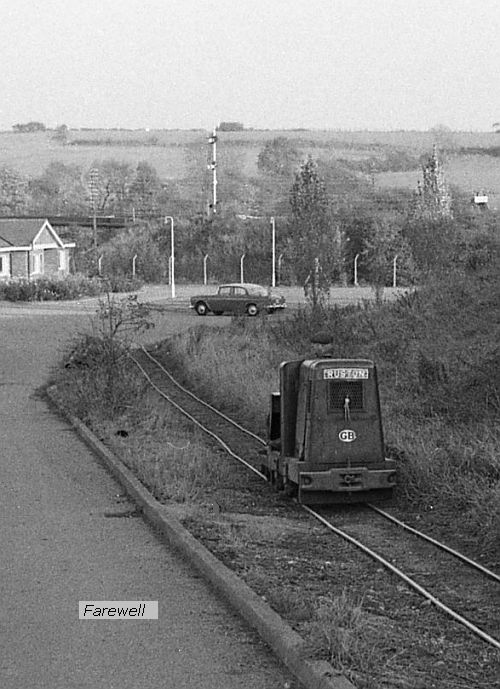
After those 3 visits, I never went again: I saw one of the locos later in Sheffield, up for sale in a plant yard on Coleford Road. It didn't have the aura that it had had on those two narrow rails between the settling beds, or fighting its way up the hill to deposit the loads into the lake. The workhorse in these pictures still exists - on the West Lancs Light Railway at Hesketh Bank - I must go across some day and share a few memories. Like its driver, who knew that Robert Hudsons supplied light railway equipment and their brand, but kept calling it Julibee instead of Jubilee.
Strangely, I never bothered to visit Blackburn Meadows, (Sheffield) where the system was similar but on standard gauge and where in a few years Thomas Hills were to deliver what I know today as Charlie. Such a system did not posess the same bucolic charm. For that matter few others did, for although I got to see sewage works systems in Nottingham, Berrylands, Leeds (the famous Knostrop set-up that 'modernised' from steam to i.c. by buying two redundant First World War armoured Simplexes, both now in museums) Macclesfield and Stoke on Trent, it was Whittington Moor that had that well-worn-but-still-functioning character that sticks most in my mind, forty years on.
Y'know, I'll be glad when this lockdown caper is finished and I can go back to reporting the real news: all this seems like marking time. I was talking to one of the smaller heritage set-ups during the week - I have an order to bring a loco of theirs in for repair and we were discussing when I could see being able to go and collect it - and I was told bluntly that they have 'written off' 2020 and are making plans for 2021. Steph and I were discussing whether the traditional 'Santas' formula will work this year. Will we be have a sufficiently 'post-pandemic' mindset to be prepared to squeeze parents, grandparents and children into a train and await some un-masked gentleman to go ho,ho,ho at much closer quarters than two metres? Will we be so used to Teams, Zoom, Skype and Portal that we will instead call up a 'virtual' Santa who sends you a present using a TNT van adorned with a reindeer? And at what point does a heritage railway commit itself to running a Santa event (even elves need a bit of notice y'know) and order presents? Will the pandemic still be on-going by then? Too few gifts and you turn people away, but too many and what does it do to cash-flow?
So for now, I'll get back to thinking what I can write about next week. Hope you'll be here and healthy to read it. See ya then.