
Of paint and pancakes
15th September 2019
Half way through September already. Where does the time go? Less than a month to my birthday then Steph's and hurtle headlong into Christmas. Bah humbug.
And so up to Tunstead on Monday with high hopes that were to be somewhat dashed, as the meeting I had been lead to expect never took place. Not only that I had brought up two tins of paint that Andrew had bought for me on Saturday whilst I was at Midsomer. The first was an undercoat, the second was supposed to be Golden Yellow - 08E51 in British Standard-speak. The first I knew that something was wrong was when I returned from the loo (50 yards up the shop, turn right, over the narrow gauge track still set in the floor and it's just a bit further) to be met with Andy H asking me if I wanted a pancake. My first thought was that he'd stopped at an Aldi on the way in but he pointed to a disc of congealed undercoat paint, fully a quarter inch thick, that he had scooped off the top of my supposedly brand new, fresh from the manufacturer, undercoat. I was not pleased, even less when he pointed out that my tin of yellow was described as Sunspot on the label and did not bear the all-important BS colour code of 08E51. There was a wailing and a gnashing of teeth. The undercoat was usable - what was left of it - but the yellow was carefully stirred and and a small test piece painted which clearly was more yellow than Golden. So we attempted to make the best of things. More casing doors were undercoated, and I managed to get the coolant side of the oil cooler re-connected with fresh silicon hose and clips.
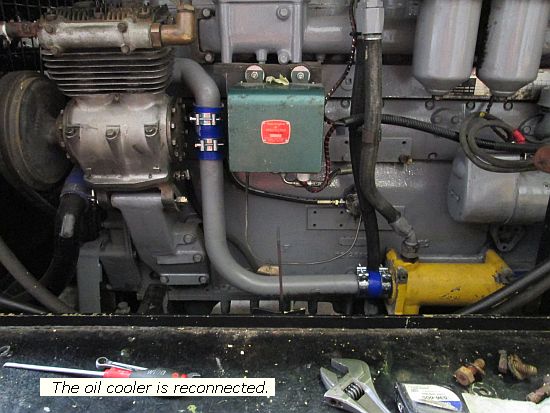
These were the last two joints on the engine that still had their original rubber hose sections with Jubilee clips, and boy were they a swine to get to fit: I ended up raiding a paint tin lid of washing up liquid from the kitchen (past the loo, up the stairs and bear right). Andy resumed painting the cab interior, this time in proper Buttermilk rather than the Magnolia I picked up in desperation months ago, and some of the casing door insides I think got Buttermilked too.
So Tuesday morning I was back down to Matlock, firstly to drop the van in for servicing and secondly armed with a pancake of undercoat on newspaper and the tin of Sunspot, I marched into Twiggs. The guy on the counter must have guessed it was a complaint because I was ushered to one side. I was expecting an arguement: I had my speeches rehearsed right up to referring to it as an 'ex parrot'. I suggested that there must be something amiss with a brand new tin of undercoat that had such a thick film on top, and that the manufacturer of the paint had described it as Sunspot, not the 08E51 Golden Yellow which the invoice had proclaimed it to be. I was quite willing to pay a proportion of the undercoat cost, I said, as we could make use of it, but I evidently had not received a usable 2.5 litres. I was expecting an argument, but I didn't get one, instead they refunded me the full cost of both undercoat and paint without delay.
Still with RS8 I had a phone call out of the blue from Derek B, one of the engineers involved in the conversion of RS8 from steam to diesel, now 96 but still alive and kicking. I had had contact before, but for some time now we had had no response either to e-mails from me or Tarmac, and our plans for a round-the-table oral history recording including him, old Tunstead employees who knew the locomotive and those involved with its restoration had been stymied by being unable to contact him. At least now I knew that he was very much still with us and hopefully we can set things up after all.
I didn't mention last week that I had had a strange e-mail arrive declaring that 'Operation Micrometer' was on and to confirm that I was available. It was the first I had heard of it but I was happy to co-operate. Basically the Ecclesbourne Valley Railway were to be the beneficiaries of a quantity of measuring equipment being donated by a well-known company in Derby. Quite how much there was to collect was unclear, only that those sent to inspect the haul had come away 'stunned' so they were lining up 4 large cars and my van to ensure being able to bring it all away. Indeed. I heard later a figure of 3 tons quoted, which if true would have meant 1 ton in mine (slightly overweight) and half a ton each in the other cars, which would have certainly been aware of it. The date set was Friday and although the time moved back from 10.30 to noon, there it stayed, and at the appointed hour I joined up with 4 redoutable personages, to be conveyed round to a two storey building and invited to remove the entire contents of 2 rooms. I had rather expected a large stores, with it all palletised, and a forklift bringing it round to the van for quick insertion and away, but no such luck. It was a handball job along a corridor, down a steep flight of stairs, out through two self-closing doors and into the vehicles outside in the sun. Fortunately whilst it was a considerable quantity (something like 100 micrometers in sizes up to about 15 inches, calibration pieces, dial gauges, sundry specalist electronic measuring equipment and a few items about which we had no idea at all,) it did not amount to 3 tons-worth or we'd have been at it until late into the evening. At a pinch I might have just about got it all in the van though close to the limits: as it was two sweaty hours had it all away and heading back to Wirksworth. As I drove it occurred to me that the EVR's publicity supremo (who was somewhere ahead of me) should have arranged it all to go to Duffield to be met by a train to bring it triumphantly up the valley, then put out a story of the EVR's 'New Measurement Train'.
Unloading at Wirksworth was much the reverse of the loading, except over shorter distances and with more bodies up steeper stairs and distributed securely in the new EVR Wirksworth Station Building, which will be an impressive sight when it is formally opened in the near future. While at Wirksworth I went and found one of the two Thomas Hill Noddy Vanguards, the derelict one in this case which is a pity as it is a conversion from a Sentinel steam loco - shades of RS8 - and was able to measure up the gearbox dipstick as it has an RF25 the same as RS8, whose dipstick disappeared long ago. Temporarily I can now dip the gearbox and establish whether we have sufficient oil, but a new replica dipstick is on the to-do list.
Saturday and I was down the shed early as Jagger was due. Some weeks ago I had built up a 'wall' of spare concrete bricks but had done so on top of an old pallet. But the pallet had collapsed under the weight (I had half-expected to find a dead bunny underneath) and the resultant scattered pile was even more unsightly than it had been before I'd started, so I elected to do it again, this time on a few concrete blocks. Jagger arrived and gave me a hand. We found ourselves discussing whether this was akin to dry stone walling, a traditional country skill that can earn reasonable money, but somehow dry concrete-brick walling doesn't have the same bucolic feel. There were more bricks on the bogie well wagon, but as this was rather inaccessible I elected to leave them where they were.
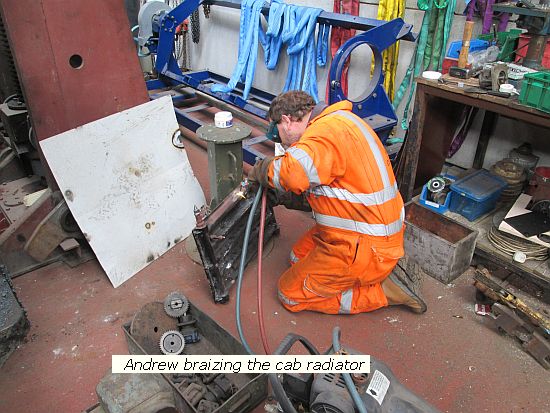
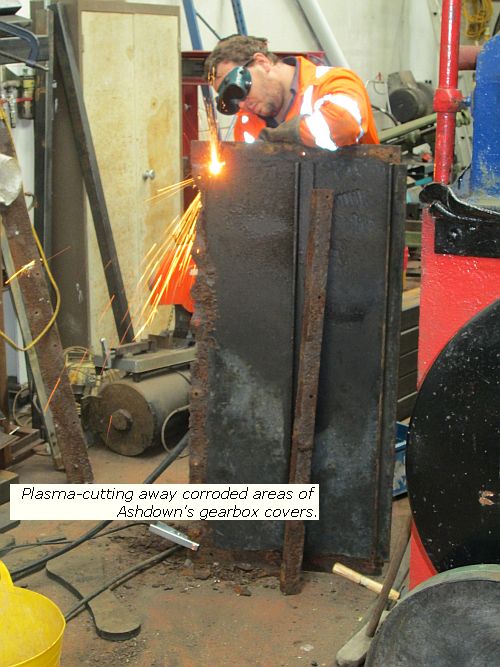
Andrew was prevailed on to have another go a braizing up the second cab radiator for RS8 after which he got his plasma cutter out for a little job for me and to trim off corroded parts of the gearbox covers for Ashdown.
After lunch he and Jagger tackled Ludwig Mond. For some weeks now the jockey pulley assembly and brand new belts have lain in the workshops, awiting the motivation to get them refitted and the loco operational. Today was that day, and I left them to it while I investigated why Claire had failed last thing last week. There was fuel getting to the float tank (the small service tank on the side of the engine) but the fuel lines thence to the fuel pump were dry. Andrew was convinced the fuel filter was blocked, so I changed it as it was probably due anyway, and manually refilled filter and lines with fuel, but I had dipped the float tank and it didn't seem as full as it perhaps should be. For now Claire was restored to life, but we shall have to keep an eye and make sure that it isn't a stuck float valve or similar. While I was having some success, Jagger and Andrew were struggling with an arrangement of belts, jockey pulleys and fixed lumps which made them question the sanity of GEC designers. In the end I was called in and between the three of us, the jockey pulley assembly was released, twisted diagonally to create sufficient room for the compressor belts to be squeezed between it and the back of the generator. Once on even re-attaching the turnbuckle was a team effort, Jagger reaching in and turning the hex after I had sighted it from the other side with a 'down a bit, left, no right, down a bit more - turn now' such was the inability to see what you were doing with your hands as far in as you could reach. This isn't the end, for now the jockey pulley assembly for the traction motor blower is to receive further new bearings, and went in to the degreaser for a clean up.
Sunday, and Andrew was anxious to continue tidying up, so I took Claire and James up to the top of the yard and Ludwig was started to see what improvement it had made and whether the untoward noises it had exhibited earlier were cured. It certainly made air pressure quicker than before, suggesting that the belts had been slipping badly with the near-solid jockey pulley. Ludwig pulled Ashdown outside so that the forklift could continue with tidying, and having thus opened the way for me and a wheelbarrow to reach the bogie well wagon, I resumed dry-concrete walling, taking the pile from the wagon and thus rendering hundreds of wood lice and several large spiders homeless.
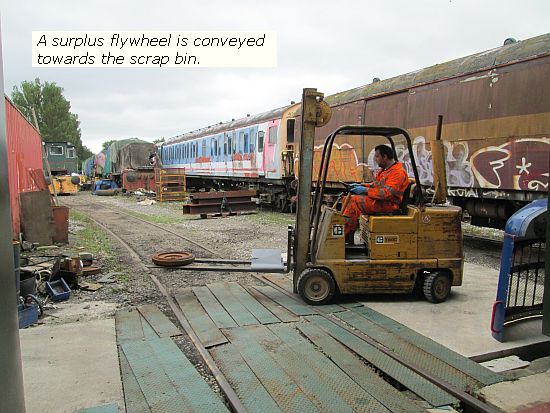
Two stillages and a large wooden crate were transferred to the PCV, and the forklift ventured as far as the scrap bin several times to add to a forthcoming visit from C F Booths', but on several occasions we were reminded that our trusty steed is not an all-terrain forklift and further concreting will be required. The last job of the day was to pressure test the cab radiator - sadly more braizing weill be required.
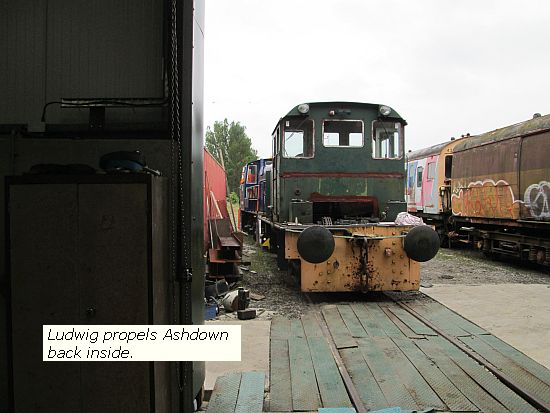
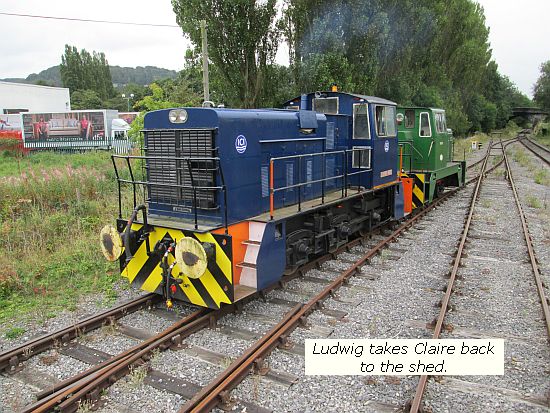
Towards the end of the day Ashdown was returned to the shed, and Ludwig went out to bring Claire back and so return James to its usual head of the line position.
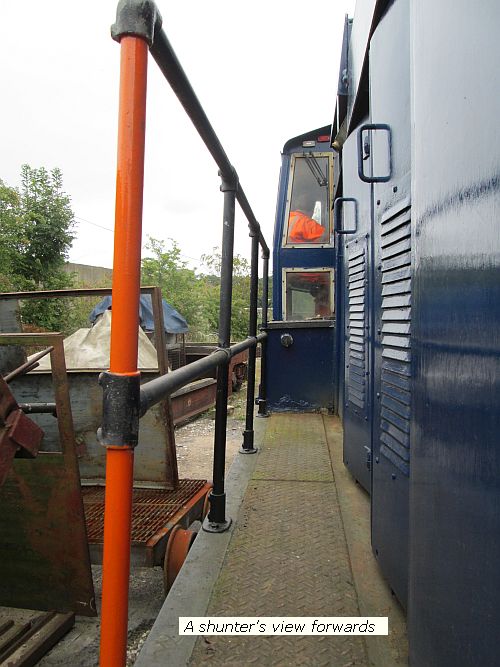
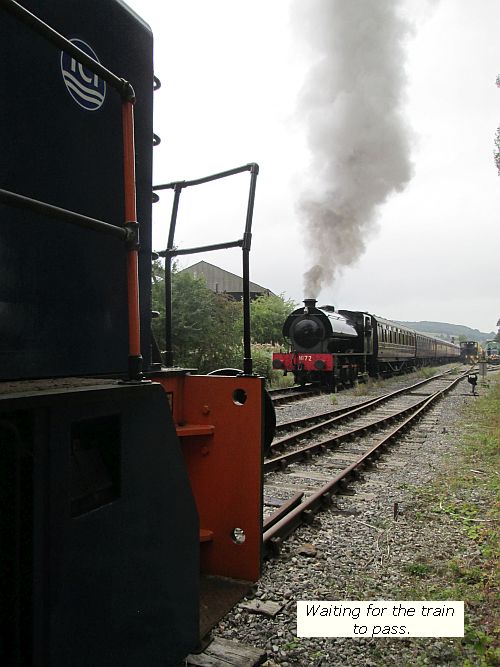
Our operating rules require that if the Peak Rail train is passing, we cease movement, and so we waited as the last southbound train of the day passed, before Andrew set off back and I transferred to James to follow.
Talking of transfers, I picked up a set for RS8 during the week that I will be taking up tomorrow, and more are due for the low load trailer.
Last week I reported on the sad demise of our dear friend Terry Day: during this week I was told that Rich Morris died about the 2nd of September and is to be quietly cremated in Bangor tomorrow. I hadn't seen Rich for many years: I had joined the merry band of him, Pete Nicholson and Andrew Wilson late in 1970 and ended up buying my first loco from him - an 11/13 class 2ft gauge Ruston which was standing at a closed brickworks in Dorset. We collected it in February 1971 and I remained in close touch for the next year or so. Then our paths separated and it must have been in the 80s one evening when Steph and I were at the Cyfnod cafe in Bala with George Barnes when Rich arrived in a VW Motor caravan, several young ladies in tow and sporting an open shirt with medallion on hs chest. Whatever else, he was a character. Pete Nicholson is thinking of writing up their exploits: I look forward to reading it.
And with that, I'll invite you to return next week for more of the same. Will I have another obituary to compile? Who knows. See ya then.