
Of lumberjacks and tie-wraps
18th August 2019
Hullo again. After last weeks plethora of different locos passing by the shed at Darley Dale, we were taking bets today whether it would be a green one or a blue one at one end, and a black or a green one at the other. Andy H insisted that he'd heard blue diesels sounding exactly the same in the 70s and 80s. but every time it trurned out to be a green one. It just goes to show.....
I was a bit confused when I arrived at Tunstead on Monday. To explain, this wasn't (only?) the onset of old age and fading brain cells: I approach from the Wormhill side and as I descend the hill to the railway bridge I glance across to the far side, to where the building containing RS8 is, and normally there'll be Andy H's van, and hopefully, I can see a parking space where I can put my van close to the doorway for taking tools, etc in. But Andy's van was parked much farther back, facing down the steep descending road at the other end of the building. Oh dear, can he have a problem with his starter motor? I wondered, as I continued over the bridge up the other side of the valley and turned into the main quarry entrance. I was able to park right outside the roller shutter, where Andy (on foot) made some peculiar gestures and disappeared off. He returned with his van after a few minutes, and explained that he had lost his gear selectors on the way over, but reckoned there was just enough slope on the car park to roll back into place (Tarmac like everyone to reverse into car park spaces, but they rather assume that your vehicle has a reverse gear in order to achieve it). I half expected he was about to make his apologies and head for home, but he is made of sterner stuff and was un-fazed by the prospect of driving back to Sheffield over the hills of Derbyshire with only 3rd and 4th gears to play with.
And so it began to be a 'normal' Monday at Tunstead, if there can be such a thing, for it is holiday season, and apart from the need to drain the pit again, it was a first job to play 'find the keys'. These turned out to be on Alan G's desk, in an office he shares with someone else who was also on leave so was locked up. Just to make life more entertaining, our day-to-day contact, Bryan P, was away too, but we managed to find someone whom we were told had keys to Alan G's office (but when we asked him, didn't think he had) and eventually gained access to said keys, and thus our workroom and tools cupboard.
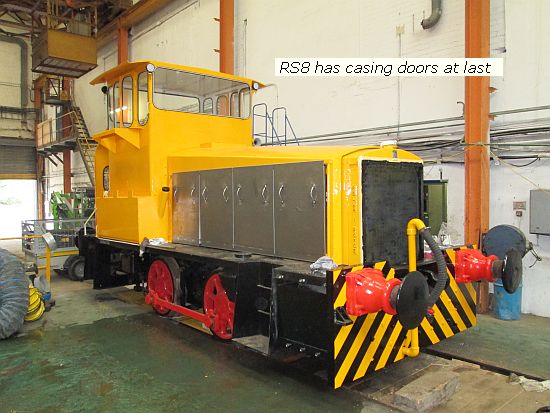
Before anything else I wanted to try the casing doors on and see that they fitted. The right-hand side was fairly straight-forward, but the left has the particular complication of the battery box and the attendant conduit that goes into it, and wangling it in turned out to be possible - just - though in the end I cut a little bit off the door stiffeners to get it to go in more easily. Andy had arrived with the cab step assembly that now had a coat of black on one side (and proceeded to paint the other side in the workroom) and I handed over the casing doors for him to start priming. We also refitted the now fully-painted front grille, and I set to work on installing some of the heater hose I had invested in to connect the one so-far-installed radiator to tees under the cab front and then on to the engine connections, one to the radiator bottom pipe and the other to the tee where I had brought the new air bleed from the heat exchanger.
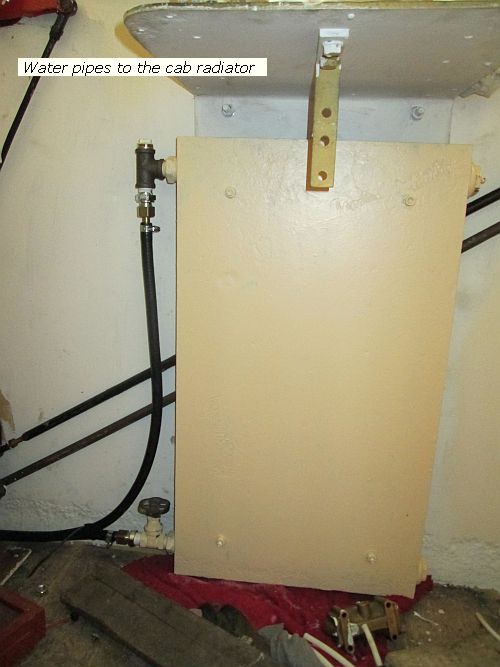
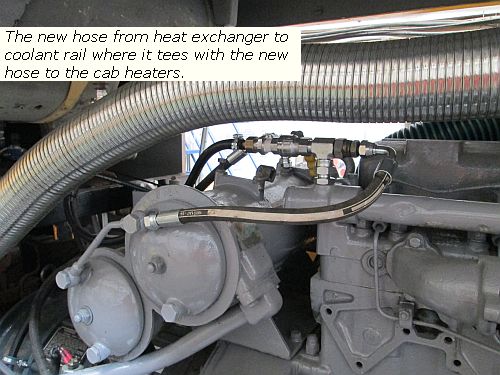
Until such time as Andrew finishes braizing up the cracked radiator that is as far as it goes, so I won't fill the system (there are isolating taps at each end) as the tees for the second rad would need to be blanked off and it isn't worth it, but hopefully that'll be done before any cold weather upsets our crews.
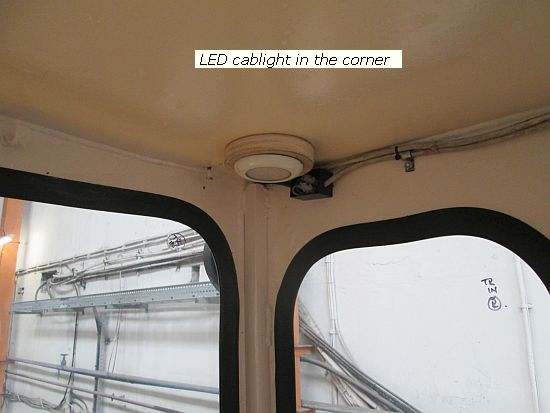
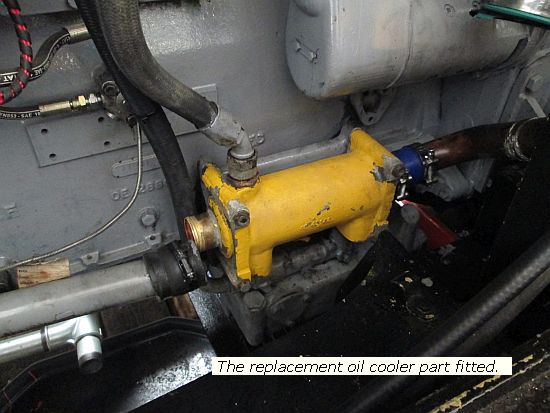
Some short screws finished the cab light at the far cab corner, and a start was made installing the replacement oil cooler and I concluded that as the pipe in left of picture includes the last two 2 inch rubber hoses that have not been replaced with silicon, and those hoses fought tooth and nail not to go back on, it was time I replaced those too.
In the end Andy primed the RHS casing doors on both sides, but took the LHS doors with him to do as a homework project, as events mean that we will not be at Tunstead tomorrow and as the following Monday is a Bank Holiday, our next trip there was 3 weeks off.
Anyway, Andy set off for home and according to his account, pulled up in a layby somewhere in the Hope Valley where, with skill, dexterity and tie-wraps, he restored full gearbox function.
Going back to the casing doors, my fabricators have made an excellent job of recreating the door handles like the originals, but the one thing I hadn't considered was the casing door catches. RS8 originally seems to have had some sort of fabricated latch, possibly made in the quarry workshops, though no drawing has survived and what bits have, apart from suggesting that no two doors were the same width, did not reveal how the catches were supposed to work. My plan had been to try and find some proprietory catch that looked vaguely like the original, but during the week it occurred to me that as the bottom edge of the doors rest against a piece of strip welded vertically up from the running plate, a simple budget lock would suffice. (Apart from the RHS side where hoses now obstruct that simple solution, but not insuperable.) So I broke the news to Andy H that once he had finished painting the doors in their beautiful Golden Yellow, I would be drilling holes to attached budget locks. He didn't seem impressed at my simple, elegant solution. I can't think why.
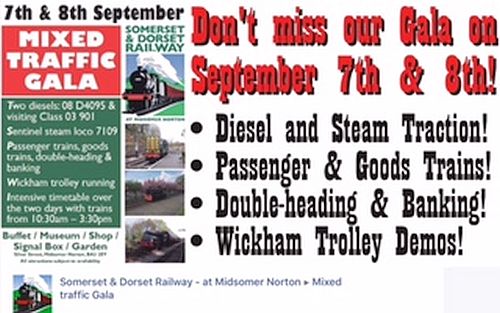
With tie-wrapped gearchange he arrived at Darley Dale on Friday and I set him to work on 03 901's cab, for time is getting short and the loco is already being advertised as a visitor for the S&D Mixed Traffic Gala on the 7th/8th September. With rain lashing down outside he rubbed down the cab interior that Jagger had not already done and primed all but a few bits where rain was dripping in. On Saturday I was joined by Alistair L and his son J, the latter dipping his toes in the railway preservation water by volunteering to help paint the cab interior. Really an undercoat would have been beneficial, but two coats of gloss will have to serve. With the weather far, far better than forecast, Alistair was able to finish priming the bits that were too wet yesterday, and between them much of the cab received a first coat and hopefully they'll be back next Saturday to continue, as the loco must leave soon.
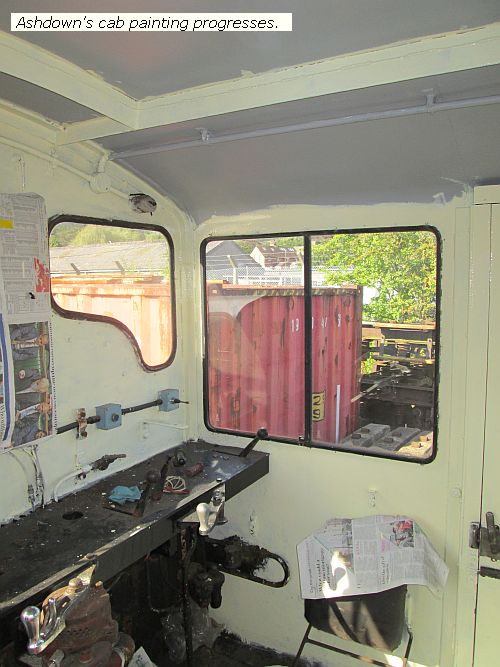
(ooops, that caption should say 03 901, not Ashdown!)
My Andrew was involved with his son, but came down for a couple of hours and cleaned out the stop valve on the engine fuel system, and re-flared the delivery pipe from the fuel pump up to the injector rail. The former might account for the engine failing to stop when last run, the latter was replaced by us and has always leaked a little when in operation: if re-flaring it doesn't work, he tells me I'm to change it to a flexible hose: I just hope the threads are compatible. Meanwhile he took stock of the hose that is supposed to act as the sight gauge for the engine coolant. It has become completely opaque, so draining down the coolant and replacing it with hose tails and another hose in a different (transparent) material has been added to the snag list.
Andy H and his tie-wrapped van were back again today (we can't keep him away it seems) with something completely different in prospect. By the entrance to the yard at Darley Dale is Station House, which is a listed building as - if I understand my history correctly - it was designed by Paxton and is the original Station building for the Darley Station. As is well known the present station, which was originally Darley but gradually became known as Darley Dale (even today people get confused with Darley Abbey, which is within the outskirts of Derby) was built north of the level crossing to replace the older station south of the l/c. Latterly the signal box was built exactly where our entrance way is today, suggesting that at some time the entrance to the goods yard must have been farther east, and the alignment of the Station House does not seem to me to be parallel with the present day tracks, but was the original passenger station farther over? Was it merely the Station Master's house and another building, since demolished, served the commercial function, or did it double as both - after all another couple of miles to Rowsley and the independent railway ran out of cash and had to stop. Anyway, as we try to be good neighbours we maintain cordial relations with the present day owners and had reached agreement for us to renew a section of our common fence and also fell a pine tree that was growing too large and near to the building.
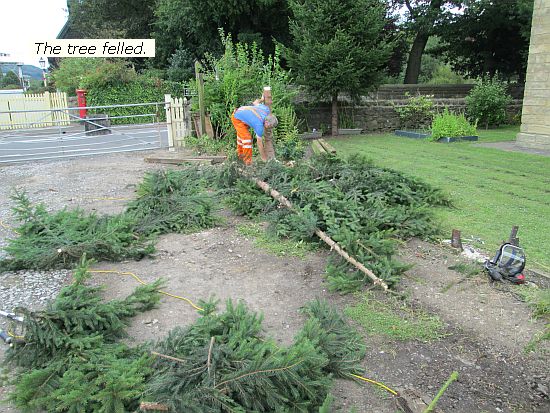
We had already had 'brushes' with this tree - when we were unloading the building cladding in 2016 or so our lorries could not back in through the gateway, so a loadall was hired to move the sheets in bundles from the lorries parked outside and up into the yard. Though with a gateway less than 5m wide and the lane not much bigger, yet bundles up to 9m long, this overhanging tree was a confounded nuisance and if only we'd known we could have probably felled it then. Today was the day and after encouraging the offending fence panels to fall over (there wasn't much stopping them) we felled the tree in record time, Andy performing the task with one of those reciprocating cuts-through-anything electric saws. (I had a go on it and can see why it is popular, Father Christmas please note.) The house owner retains the main loggish bits for his wood-burner, but the rest is left to dry for burning or otherwise disposing of later.
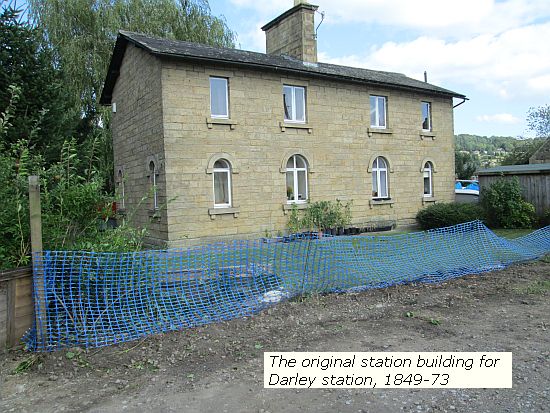
For now, there are some interesting vistas opened up of Paxton's architecture, which will soon disappear as we restore the 6ft high fence panels to their former solidity, so enjoy it while you can.
And that's it for this week. If you're bored of a diet of RS8 you will get to have two weeks with little or no refrence to it, while some other locos get a bit of a look in. Where are we off to tomorrow instead? You'll just have to pop back next week and find out. See ya then.