
Of fuel pumps and rubber humps
21st July 2019
Lots of variety this week. So get stuck in.
Y'know, when I said last week that 'a large part of the week appears to be fully booked', I didn't realise how right and wrong that would turn out to be. Just as an insight into how my weeks sometimes go, on Tuesday I was due to refit a fuel pump to a customer's loco. Since our old fuel pump man Graham died, I hadn't needed anything urgently so when a customer had a problem I had to find a new repairer in a hurry, and I thought that this firm fitted the bill, although the bill itself was substantially higher (like about 6 times what Graham used to charge) but I dutifully paid up and took it along to the loco. Assembled, I tried to start the loco but the batteries were well down and it wouldn't crank, which was probably a good thing as when I went back to the engine I saw the Run solenoid was still engaged, which was strange as the power was off. Detaching the solenoid linkage it was apparent that it was not the solenoid but the stop lever on the pump had stuck in the Run position: a trifle ironic when you know that the original fault was that the stop lever went round and round and did nothing.
Anyway, I phoned the repairer, who insisted it couldn't happen, then I took the pump off again and headed home. First thing Wednesday I returned to the repairer and left it with them for an hour to investigate and rectify. When I went back it was 'ready' but my suspicions were aroused when they informed me that the fault had cured itself as they started to investigate and they were confident it was all OK. I returned to the loco, whose batteries were now fully charged, and fitted the pump. The engine cranked, but didn't fire (probably still purging the injector lines) and before trying again I went around to check for any leaks - and found the stop lever was again jammed. Several phone calls ensued. They suggested I was pulling the stop lever too far - to which I pointed out that the actual amount of pull was dictated by the travel of the solenoid, and as that, the lever and the pump itself were all manufactured by CAV and had worked perfectly well for years prior to the repair, that did not tend to support their theory. Suitably chastened, they met me at a motorway services to take the pump back and investigate it properly.
Thursday morning at half ten they rang to say it was sorted - a lever internally was catching on a nut but not any more. They met me at the services and I took the pump back and fitted it to the loco, which then started and stopped properly. Thus a job which ought to have occupied one day and left me two to get on with other work ended up taking all three. And worse still, I can't charge the two unexpected days to the customer (not their fault) nor the repairer (warranties don't cover consequential loss) so I'm the one who is back behind schedule and out of pocket on hours and mileage. Just remember that when you think of the 'joys' of being self-employed, 'your own boss'.
Anyway, back to Monday. The grand plan with RS8 had been that we would be filling the front ballast boxes with worn out mills balls, and I was half expecting a 45 gallon oil-drum-full to be sat next to it, as Pete C had indicated before he left. But Bryan P had a different story: it seems the mills balls don't go for scrap, they are either recycled or used until they diminish in the mix altogether. We spent some time talking of this with Bryan and he has some other plan in his mind as a result, but what we shall see of this and when I know not.
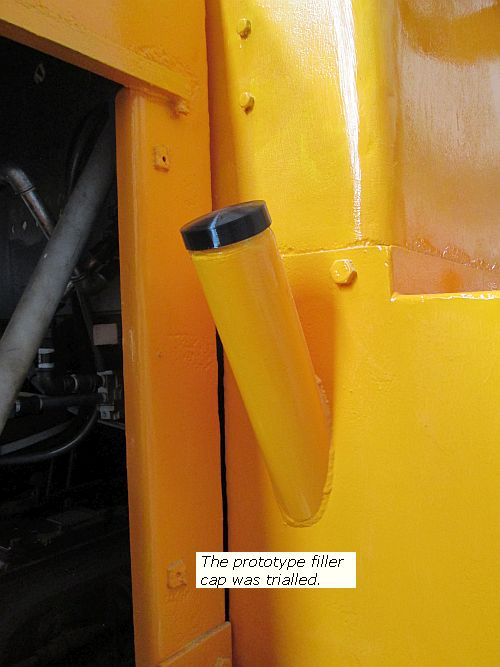
I had brought a prototype fuel filler pipe cap with me for trial - two of them will serve until we locate some of the originals at a reasonable price. I went out to collect the servicable cab radiator from the van. Tarmac insist on you reverse parking, which is fine with a car but seldom do the parking bays take account of a van and the need to access the back doors. This particular bay had big rubber humps designed to chock your back wheels and thus go no further into bollards behind, so to get out the radiator I went to the side sliding door of the van. With a heavy cast iron radiator needing both hands, I extracted it and assumed I could slide the door shut by putting my shoulder to it as I have done before, so took a step or two backwards - and fell over the rubber hump. Andy H kindly suggested I should report the humps to their H&S manager as a tripping hazard.
While the aforementioned Andy H found plenty to rub down and paint again, I had not many obvious tasks, particularly as he had painted the timing reservoir so it couldn't be handled until after lunch. But I had my radiator, and bolts and spacers, so at least I could get on with that, although trying to get it all together through the cab wall was a trying occupation. In fact, I really need slightly longer bolts and spacers, as the control linkages passing behind and are just scraping. Andy H immediately painted the radiator with undercoat.
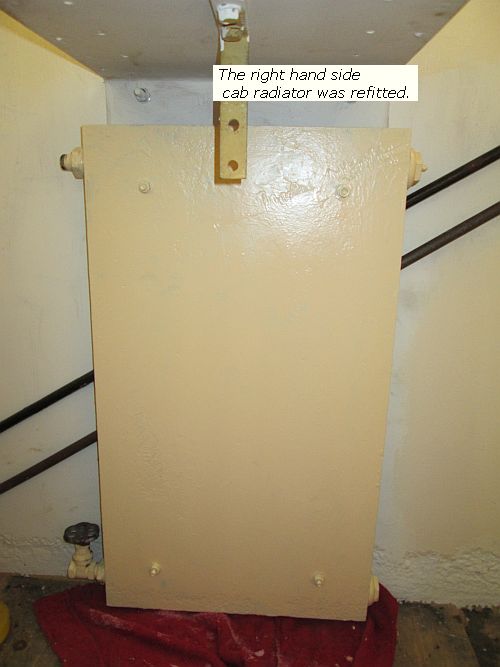
If I am going to get the radiators to well, radiate, they need hot water, but as an ex-genset engine our C6N had no provision for a hot water feed (the return at least, can go to a tee on the original radiator bottom pipe). Rolls' coolant rails have a number of suitable apertures, plugged off, and they are usually so tight that you wonder whether they will undo or crack the ally' casting. Besides, they have a square recessed head for which we had no suitable male mate, but with a redundant bolt, hacksaw and files I produced a tool and succesfully extracted one towards the rear of the engine. A tee here can serve two purposes, firstly the hot water connection for the rads but secondly as a bleed connection to the top of the heat exchanger. Again, Rolls-assembled engines with t-cs have such a connection right to the end of the coolant rail, but again our genset engine had no provision and RS8's original pipe was a victim of theft. It is not a major hardship - a tap on the heat exchanger output can act as a bleed nipple - but a piped connection does it better.
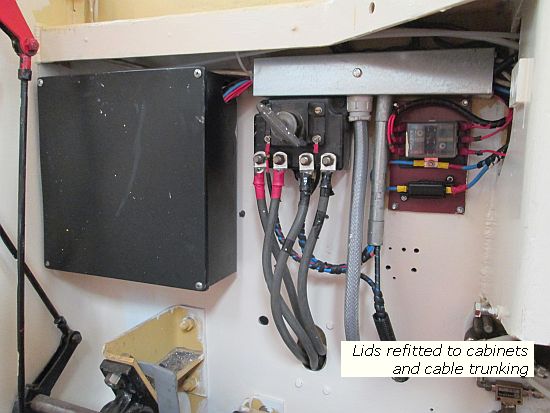
I did box up the electrical cabinet and the adjacent trunking in the cab - the trunking lid had no method of retention so I cut the lid to length, trimmed down the offcut, got sufficient thread through the thin plate to engage with an M6 bolt and voila, a tab that rotates and holds the lid in place.
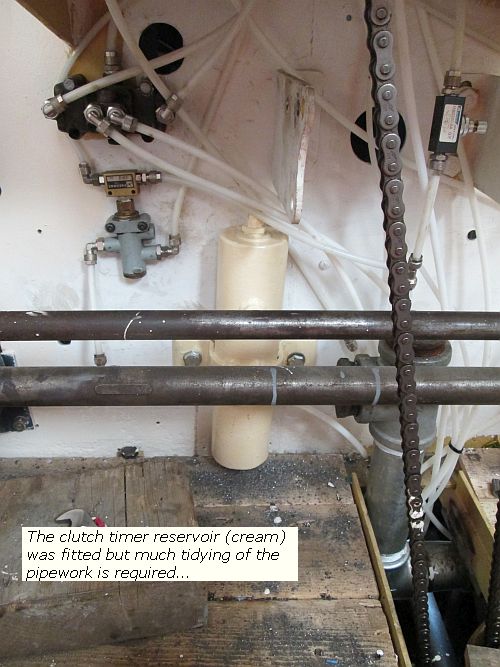
Finally after lunch I got the timing reservoir back and mounted it on the front bulkhead. The plastic pipework here is a bit spaghetti-like: it was hurriedly connected to get that first run on the loco. It wants tidying and p-clipping now that I've got it to work properly!
I had hoped that I would get to do other jobs, but as you already have read, my week didn't go to plan. Friday was in the workshop, mostly on commercial work, and though I did hope to build the access steps for RS8's cab, it never got into the frame. On Friday night, Steph and I made a foray out to the house of a PRA Director whom, we were informed, is the present Membership Secretary, and as he didn't appear to be in, posted our and Andrew's subscriptions in through his letterbox. Saturday morning had me and Andrew firstly down at the hauliers' yard, gaining practice at rear wheel steering the trailer and discussing up-coming jobs and strategies.
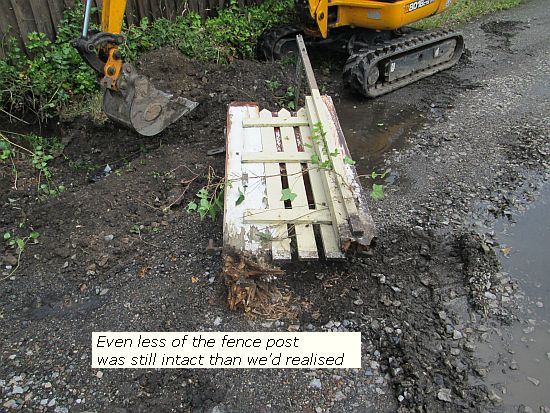
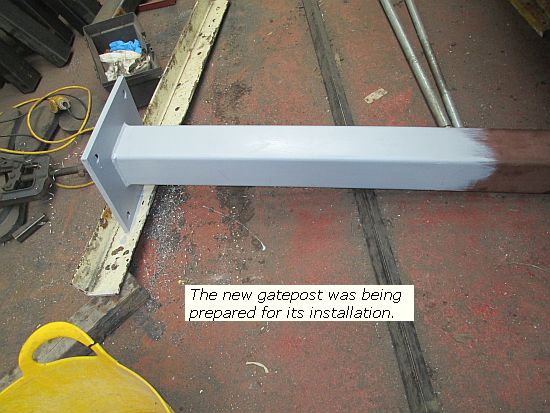
Then it was back to Darley Dale for a quick lunch and down to the shed where Jason had been booked to dig an 'ole ready for the new gatepost. The old gatepost was even more rotted than we'd realised: only a small section in the middle still could be classed as wood and a second post next to the boundary gave up without a fight. Jason scooped out a slot a couple of feet deep and departed.
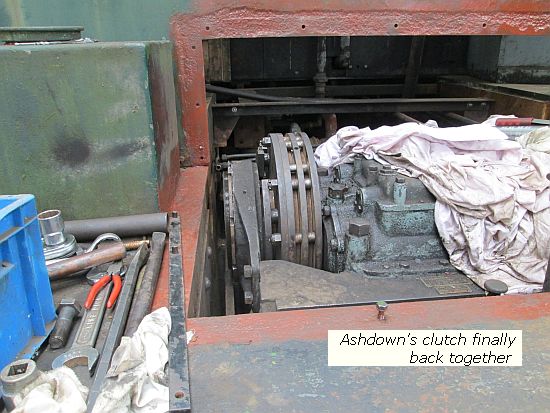
Andrew welded up a concoction of bits of re-inforcing steels left over from shed construction that looked like modern art but was intended to carry 4 cast-in sockets to which the new gatepost would bolt. Then it was back to Ashdown and the clutch part (which had been machined during the week) was slid on and the clutch fully assembled.
Today I was down by 09.00 to meet with Peak Rail's S&T supremo Dom B to facilitate his periodic maintenance of the crossover at the top of the yard. That done, he had a wander round the shed and we discussed tales of badger setts in close proximity to railway lines. We had both Andy H back and Jagger due over. Andy had brought with him a couple of 7.25 inch gauge wheelsets to assemble on our press.
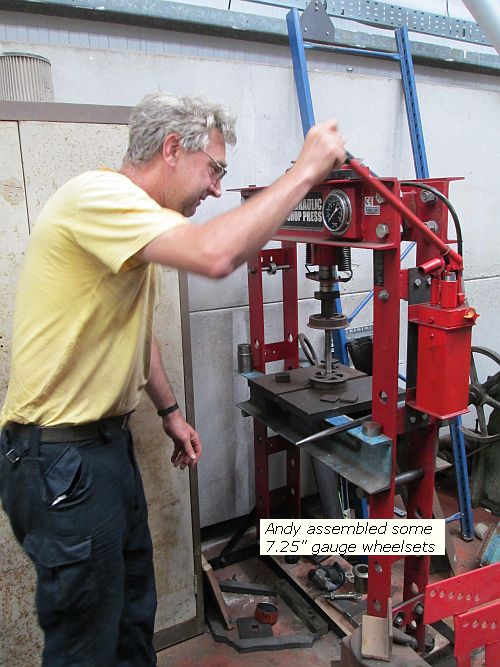
He's been doing a lot of miniature work lately: I got him the profiles to make a turntable which I hear is now complete. But his main job was to insert Andrew's sculpture into the hole and fill same with hard core and bags of Postcrete I had been sent to buy yesterday afternoon.
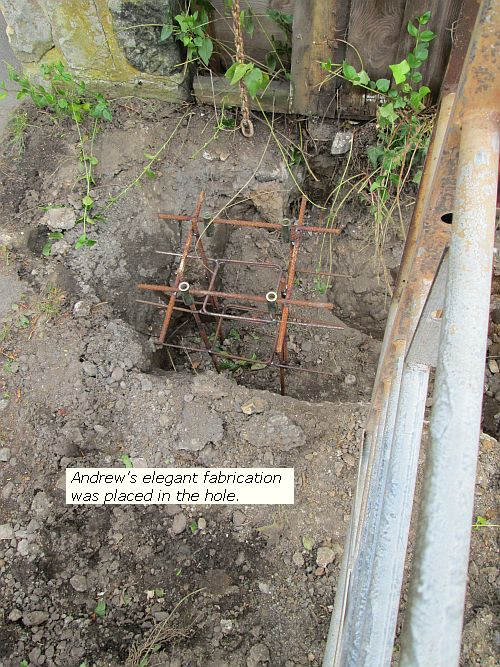
As per instruction I had bought 8, but despite using virtually every lump of redundant concrete, stone, etc, it was insufficient and I have instruction to buy 4 more to get it finished off. For the moment, the offcut base used to extend the gatepost we are to use is deputising to keep the sockets in position. Meanwhile Andrew and Jagger finished the remaining pipeworks surrounding the gearbox and clutch on Ashdown, then indulged in a long and complicated shunt with James to extract Ashdown from track 3B and position it outside 3A, having removed the loco from 3A and put it in on 3B. Simple? Yes, but not with 03901, Ludwig, Thelma and Louise and the bogie well wagon to shunt away, and the Brewery to move.
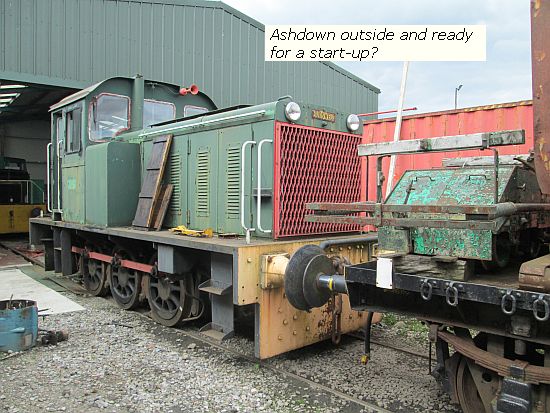
They then sorted out the start-charger and had a go at starting Ashdown up, but without success (or visible smoke). More effort next week, no doubt.
A few weeks ago I reported on a meeting at Buxton where a Peak Rail Director had presented plans to the audience and indicated that it was all going ahead and tracklaying might be only a couple of years off. Now it seems that some of his audience are cycling enthusiasts and saw this as a call to arms. They regard the railway as 'theirs' now and after trying to whip up a campaign through Facebook, took the matter up with the Peak Park Planning Board. The PPPB response is illuminating and very fully refrenced. It stresses that no formal approach about re-using the trackbed has been made for several years. That 'the National Park Authority places a high value on both the Monsal Trail and other multi-user trails within the National Park' and that any proposal would have to include creating an alternative cycle/walking/riding route prior to taking possession. Such an alternative route is subject to policies DTM4 and DTM5 of the Development Management Policy document published this year, and requires that the alternative shall be equal to or better than the original, with similar surfacing and as convenient and visually attractive. The railway itself must 'represent a sustainable transport solution for residents of and visitors to the National Park whilst delivering an overall net benefit, including an environmental benefit'. It must also be seen to reduce road traffic from parallel routes. Indeed, the Core Strategy document (2011) does not promise support for any re-opening scheme but would consider one on its merits. This latter document was published before the 'Peak Pedal' scheme re-opened the Tunnels with lighting.
Now, if we compare this with the reinstatement of the WHR through the Snowdonia National Park, this first thing to bear in mind was that SNP came out against re-instatement but that Prescott overruled it. The SNP insisted that Beddgelert was not to be used as a staging point in the drive south as it would exacerbate road traffic (PPPB was said to be against Bakewell as a PR staging terminus for the same reason), and that the occupation of the section through the Aberglaslyn pass was not taken until the so-called Fisherman's Path was brought up to standard as an alternative (and included the new footbridge at Bryn-y-felin). So a reinstatement of the Bakewell line because a group of railway enthusiasts want it is not a given nor can its stipulations be ignored. A reinstatement for stone haulage might reduce the lorry movements on parallel routes (although this has never been claimed so far as I have heard) but does nothing to provide a sustainable transport solution to visitors and residents. That is where PR comes in - or does it? Does a heritage railway service meet the criteria, or do residents travel requirements include times and days when PR is unwilling or unable to provide a service? Since almost the entire route is currently the Monsal Trail, a considerable sum must be anticipated to buy and build an alternative Trail (even if only to circumvent the tunnels) and would be subject to detailed planning approvals and construction time. And since the stone traffic cannot be routed through until the whole line exists, building it in stages (a la WHR) doesn't work. According to the original press announcements (some 16 months ago) PR and its quarry company partners were going forward with a feasibility study, now a PR Director seems to think construction will be under way in a couple of years. Presumably this is based on the positive results of the (unpublished) Feasibility Study, but perhaps, like PR's SMS, it is a confidential document. Publishing that, and public statements from the quarry companies, would go a long way to encouraging those, like myself, who are more than a little sceptical. On the other hand, one railway mag is reporting that Transport for the North is inviting a business case submisson to install the turnouts at the Blackwell Mill end of the line, to face both Peak Forest and Buxton, but the reporter wonders who is to foot the £100,000 bill. £100k for 2 main line standard turnouts with installation and signalling seems low, on the other hand £100k just for preparing a business case seems high - or maybe I'm just in the wrong business.
And with that, I'll call it a night. Back up to Tunstead tomorrow, and the rest of the week - if last is anything to go by - may be another shambles. Who knows. You will if you tune in next week. See ya then.