
Of Setbacks and plasma
24th March 2019
Well I promised you lots of variety this week. Let's hope you think it's worth it.
Monday, and we returned to the wintry wonders of Tunstead to progress RS8. First major task on the horizon was to re-assemble the brake cylinder and rigging to the loco, and re-connect the feed pipe, which had moved a little during the previous week's re-arrangements. With all this achieved, we moved back to air testing the loco, reaching the dizzy heights of 90 and 100 psi in the air system. I had stripped and re-sealed the timing reservoir, and after swapping the gearbox control valve not once, but twice, found one that didn't leak, but by then another valve in the system started to leak, tending to suggest that there is still some dirt finding its way around.
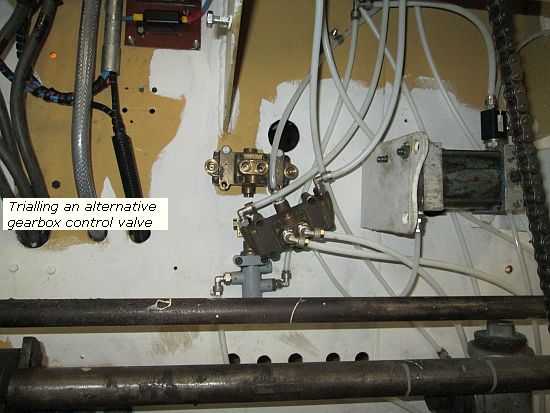
I set up the auto-emergency regulator to give a brake application, and its control valve to toggle at about 70psi, and all appeared to be going well. The normal straight air brake was now operable (the auto-emergency having switched to normal) and gave correct pressure responses. Attention turned to the clutch and its cylinder. Even with full air pressure showing on the gauge, the clutch wouldn't 'go over' as it should. At this point an awful possibility dawned on me. As I've said before, I've never seen a clutch cylinder this small, and moreover, driving through a short lever. It is, if you like a double-wammy, of not enough force and not-enough leverage, but I had innocently assumed that it had all worked once, so must be OK. But did it? The 'correct' clutch pneumatics pulls the clutch over-centre and after a few seconds, empties the cylinder. RS8's never did, it merely put air on and held it there. What if that was the way it was always working, and the clutch never went over-centre in its working life? Having designed a new mounting bracket and bought a replacement cylinder of the next-up metric size, I may have to do it all again, with a proper cylinder and lever. Still pondering all this we topped up the radiator with two watering cans full and attempted to start the engine. My nice new blue capacitor took out a 5amp fuse as soon as I powered up, but changed for a 15Amp one it was time to see if it worked. And it didn't: the capacitor was trying to smooth out the entire loco system, and I realised that a further bit of re-wiring is on the cards to introduce a diode to limit the capacitor to the timer relay that I was interested in. But by the customary way of over-riding the relays, the engine was started, air pressure maintained, the gearbox worked sweetly but no amount of clutch engagement would get RS8 to move: not that it could have gone far if it had. To Pete C's delight the horn worked though. He and Andy H dismounted the clutch arm to see if there was any lost motion: it needs a new piece of keysteel but not enough to cause what we are seeing. I was despondent enough when I pulled the engine dipstick out, being concerned that the amount of water we'd put in didn't reflect what had leaked onto the tray underneath. It didn't: the sump oil was emulsified and well up the dipstick. Given that we were running with the rad cap open so there was no coolant pressure, that points to either a porous liner or some of the liner seals have failed. So there's nothing for it but to drop the sump and see where it's dripping from.
I was across in Sheffield on Wednesday when I came to a T junction and found ahead of me a black Nissan pickup sat partially on top of the bonnet of a white SEAT taxi. I thought it would be on my dashcam so rushed home to download a still of it but found my card reader couldn't cope (it's getting old) so ordered another. Tonight I've gone through all the files on the memory card and it seems my dashcam records when it wants to. Further investigation required.
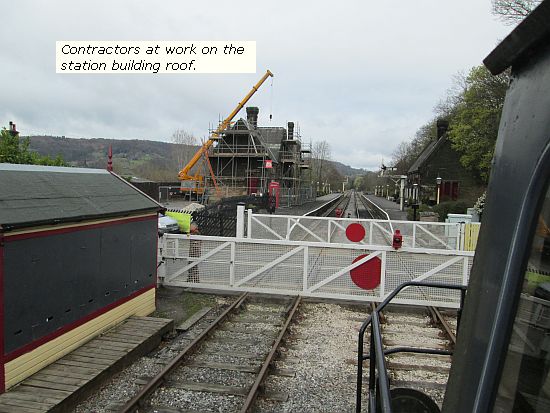
On Thursday Harvey C arrived at the shed at nine a.m. ready for a run up the line with Charlie. On the station contractors continue the repairs to the down station building, which I'm told is being made weather-tight at council expense in order to make it saleable after the railway bowed out of it.
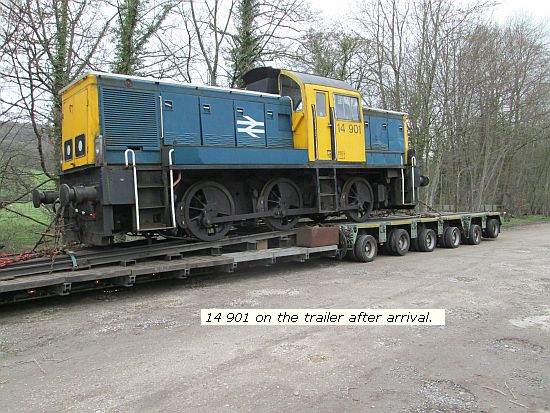
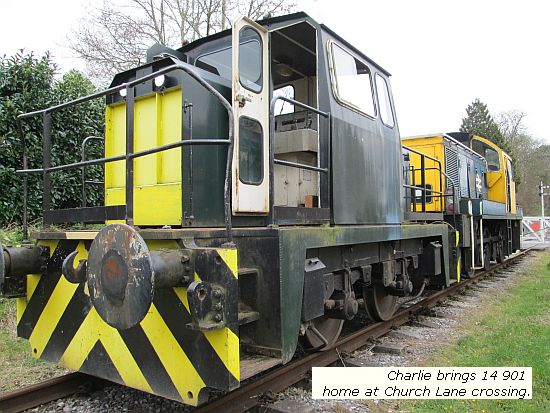
We arrived at Rowsley just as the haulier arrived with 14 901 back from the Colne Valley railway. We were not entirely happy: the haulier is relatively new to rail work and we would have liked to have seen more and heavier chains securing the loco, but as you'll see from the picture, it had travelled north right across the transition from ramp to level, with the result that the front springs were carrying virtually no weight and the middle springs were flat (overloaded) with the axleboxes right at the top of the hornguides.
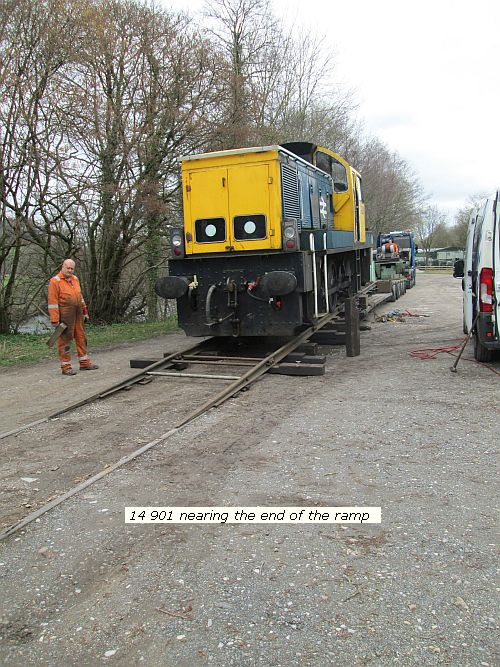
Unloading too, we ended up with the middle axle two inches in the air with leading axle on the ground and rear still on the ramp. Anyway, off the loco came and Charlie hauled it back to Darley Dale. It is 10 years since Andrew and Terry D painted it, it is looking well worn now with rust in places, two casing doors require attention and one of my speedos has apparently dismembered itself in the desk. Although we talked about suggesting to Peak Rail that we have a last 'hooorah' before it stands down for overhaul, it was unlikely to be taken up and instead the decision that it is time it had a more thorough repair was settled, though it will have to wait until Adolf has been completed.
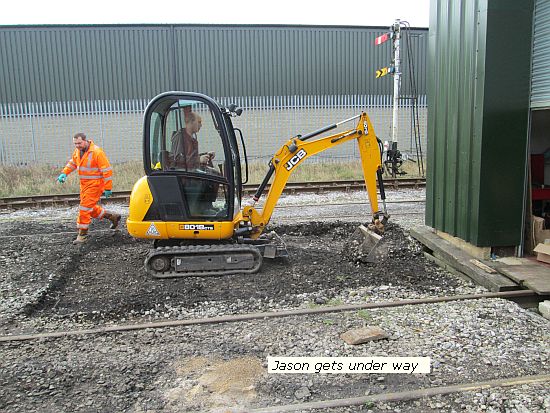
On Saturday I was down fairly early to let Jason onto site and get under way with his mini-digger as phase two of the external apron gets under way.
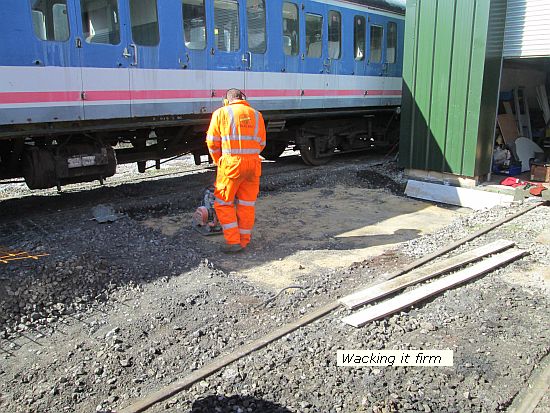
He'd finished by lunchtime, and Andrew laid some sand and started compacting it all with Jason's wacker when it ran out of petrol.
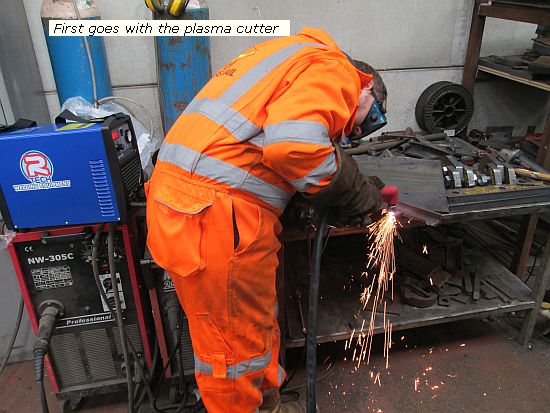
Never mind, he moved on to his latest toy, a plasma cutter. We've been talking about one of these for some time and have even bid (unsuccesfully) for a couple on ebay, but the technology is moving on and the price falling. Basically a plasma cutter appears to liquefy the metal by means of an arc, and then blow it out the way with a jet of compressed air, much as oxy-acetylene does, but with less heat amd cleaner cut. For Saturday he practised on some old bits before opening out a hole in a 10mm thick plate (the base for the winch) which he'd drilled slightly wrong.
For myself, I fuelled up the power pack, changed the flywheel housing adaptor for the other (which suits a bigger pump) connected up the battery and turned the key. Nothing. Now, I've done very little to this since we ran it a few weeks ago and it worked perfectly, and so far as I can recall, I've done nothing that would render it inoperable. But it seems that I must have, and as I don't have a wiring diagram for it, this may take a while to resolve: a while we don't have. On Sunday we were joined by Andy H., who set to work making up the shuttering. I got down with fresh supplies of petrol for the wacker and Andrew continued with that, before breaking out the plasma cutter again for some more steel cutting plus a trial with a piece of aluminium chequer plate which I marked out weeks ago to replace a heavy steel plate on the trailer.
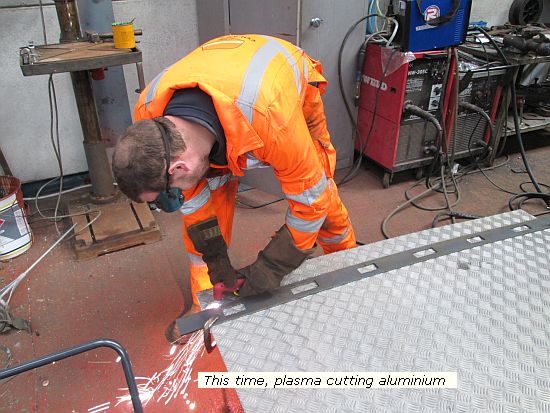
I cut the first bit with a jig-saw - it was slow, noisy and unpleasant. In contrast, plasma-cutting with a guide clamped to the plate gave a quick, quiet cut which will require only minimal cleaning up. Clearly this will prove a useful device in the future.
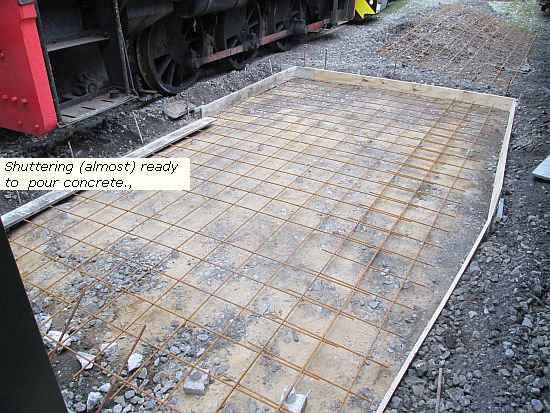
By the end of the day, the shuttering was largely completed and the mesh cut and wired in place. 14 901 had been partially de-fuelled and some transferred to James (which was low). I had mapped out part of the Hatz wiring, mounted up a 110v outlet by 'my' bench and cabled it back to the nearest other one to avoid a semi-permanent extension cable trailing across the floor.
So that's it. Not the happiest of weeks. Tomorrow we must make a start on dropping RS8's sump and see where coolant is coming from. More news next week, I suppose. See ya then.