
Of Hatz ov
3rd February 2019
OK hands up all those who've seen the newsreels of the 'polar vortex' that froze Chicago and found 'The Day After Tomorrow' theme music running round in their heads?
No? Maybe it was just me.
Welcome to this latest edition of Weekend Rails, and as you may guess from the title, I have finally forgotten how to spell. So, back to Monday and the usual trip up to Tunstead. I have explained to people before that there is a 'big lump theory' to perceived progress. Fitting big lumps takes little time, but are so obvious that passers by see that progress is being made. Fit small pieces which take several times as long and the casual observer cannot see the difference. It was rather like that last Monday, with just me, Pete C and Andy H (there are maintenance shutdowns on). I set Pete to work manufacturing the replacement linkages for the rear right corner of the cab. What somebody was thinking when they ripped out and removed the brake handle and links from that side I don't know. Andy H had manufactured a new handle for the brakes using profiles I'd passed over, and now Pete was to connect the whole thing up, (rather on a trial and error basis as there are no drawings) using bits of original plus ends and such I'd dug up from around our workshops.
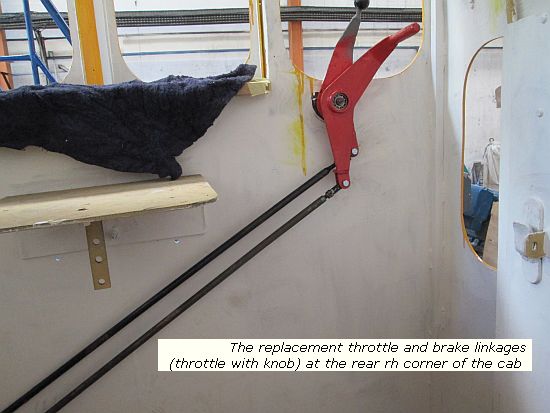
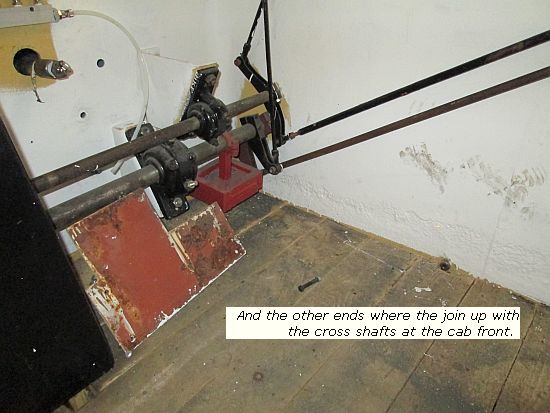
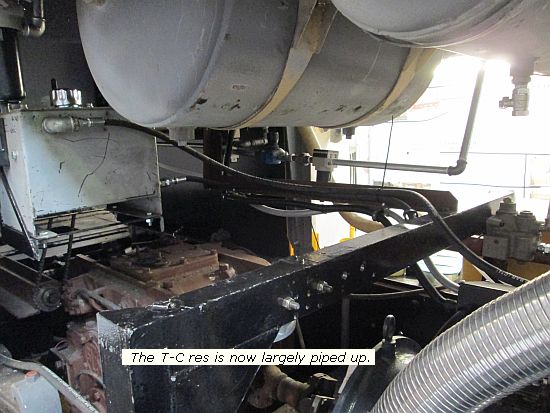
Meanwhile I set about assembling more of the flexible hoses required to route oil and fuel to the prime mover and torque converter. Needless to say I had not brought sufficient hose - I re-aligned the fuel feed hose from the primary filter to the lift pump so as to run along the edge of the chassis, and a shorter one from the fuel tank outlet to the primary, so apart from an elbow fitting fuel in to the engine is complete. Between Pete and myself the nipple that forms the return line at the tank was extracted (it was damaged) and a new nipple installed. On the converter side the feed hose from tank to suction filter was installed and the latter turned 180 degreees to make a more logical flow: the hose from there to the converter charge pump was repositioned (I'd accidentally lined it up to pump output) although really it could do with being about 6inches shorter. I added a couple of fittings and a tee on the pump suction side - although a full tank of oil should be equal to or above the pump header, I think provision for an easy priming of the pump might not be a bad idea after all these years of idleness. That leaves me with a new hose from suction filter to charge pump, and a return fuel line from fuel pump to tank, and that side of the piping is finished, though to the casual passer by, there is nothing much to see.
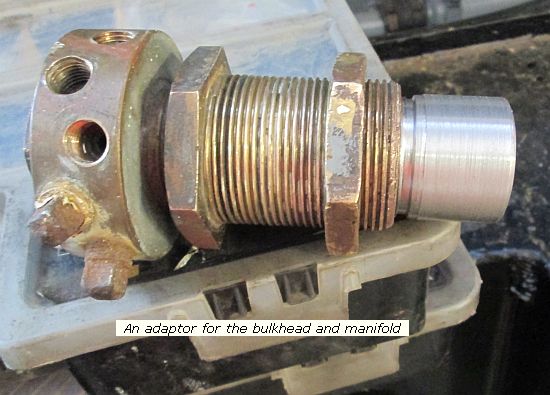
Andy H had brought with him the manifold/bulkhead fittings complete with a brand new adaptor machined to match the Enots thread and end up as 1 inch BSP.
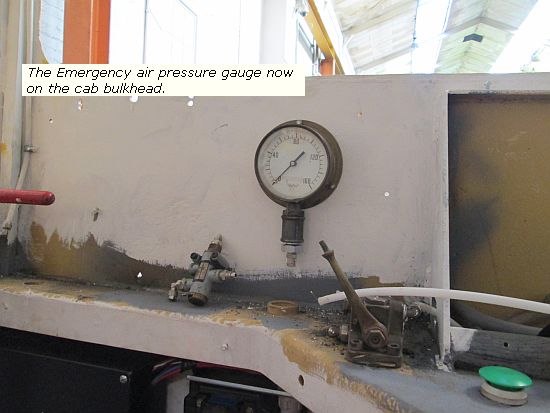
After all the effort last week of finishing the air feed pipe into the cab I decided not to break the news to Pete that I was ripping it out again, instead, I've brought it back to Darley Dale for a thorough clean-up. Andy spent much of his time using up the last of the small tin of Golden Yellow ensuring that all external window surrounds were painted, then went underneath and gave the axleboxes a fill of fresh oil. That is by way of a first installment - the new oiler pads will mop most of that up and will need re-filling again hopefully this week. Finally he mounted up the emergency air pressure gauge and removed the pneumatic valve that I'd previously placed in the way of all the cables.
All in all, it is now the remaining pneumatics that is holding everything up, and we are close to putting water in the engine and fuel in the tanks to see where it all leaks. I hope it doesn't, but you never can be 100%. Years ago I had two brand new fuel tanks made to my drawings by a professional fabrication company. They tested their welds with dye penetrant and all seemed OK. When when we came to put fuel in, out came the fuel, pushing dye in front of it through minute holes in the welds that the dye would not pass through unaided! The guys back at Sigma6 who welded up the holes we had to make in the tanks were equally confident..
A week or so ago I said that one option with the power pack was to find another matching Hatz engine or engineer-in the Lombardini. Neither option would be cheap and the latter would take longer as it required manufacturing mounts and either making or sourcing bell housings and torsional drives. Time is not on our side as there are two transport jobs in the offing requiring a winch. Of course, when I made a joke about 'Hatz off if we could find one', I had not taken into the account the abiity of ebay to have the very thing when you least expect it, and so on Wednesday I was heading down to Bilston to collect a rather woe-begone-looking Hatz 'Silent Power' engine the same as we had. Reputedly low hours but looking rough for having been exposed all its life to the elements and especially road salt, I had to cross my fingers as there was no way of hearing it run first, though the vendor has more if I have any trouble with it. That came back with me and Andrew and I unloaded it that evening, he finishing by photographing the Lombardini to go on ebay as it should no longer be required. But such is the way things go, Andrew also asked me to bid on his behalf for another Lister. Now, I don't suppose you've been keeping score, but ever since the Petter PH1 in the pseudo-Wickham was pronounced by agreement to be under-powered, it has been as though we have gone on acquiring Listers in the quest for the ideal. First was a TS3, which on arrival was obviously too big. Then there was an SL2 which I brought back triumphantly from somewhere over Southport way but try as we might, could not get to go, and also looked rather too big when put it in the same workshop as the Wickham. Now if this was a 3 bears story the next purchase would be just right - and considering we drove all the way to darkest North Wales it darned well should have been, but the description was vague, its Lister data plate missing, and it took an eagle-eyed reader of the blog to tell us that it was actually a smaller engine than we had thought (same overall dimensions, just smaller bore block so lower power). Maybe then this is a 4 bears story, since the ebay offering was most definitely a LV2. I duly bid as ordered and won, for actually a very good price. Various messages went to and from as the vendor stressed we must move and load the engine without assistance. We had hoped to postpone the collection until next Wednesday, but the vendor was anxious to get it out sooner, and Saturday was agreed subject to snow. Yes, but this was a weekend where grandson was coming up, so there would have been other calls on Andrew's time. Anyway, on Friday me and Steph drove across to Norfolk once again to collect him (he's now 6) and he was persuaded to come out with Andrew and grandad on an important mission to collect this engine. And as planned, just before noon on Saturday I was knocking on the door of a house in Bolton, while Andrew and grandson waited in the van. The old lady that came to the door clearly didn't know what I was on about. I rang the vendor who proceeded to give me a completely different address to that listed by them on ebay. Had Andrew not been able to get Google street-whatever on his phone this might have been a major problem - I don't like Satnav and prefer to read maps and plan such journies. However after 20 minutes we had found the correct address (they'd moved there 7 years ago!) and with the aid of a sack truck I'd brought, wheeled this latest Lister out to the van, where by way of apology we received an extra bit of muscle to get it in. (If we couldn't lift it I'd brought a plank to walk it up).
Grandson was due to return today, so although Andrew reckoned he'd be back in time to help get it out, I didn't and wandering down to the shed after lunch, built up a stand of pallets and timber and walked the engine out of the van.
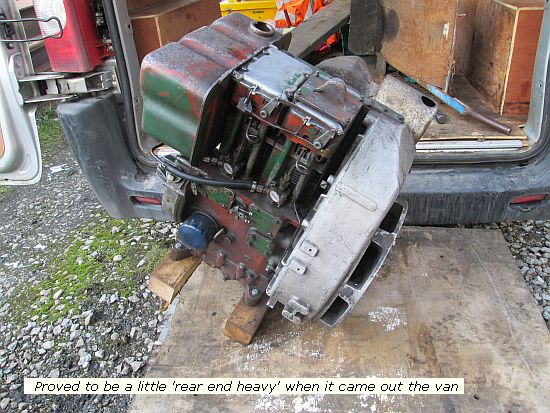
The top pallet was a trifle weaker than I'd thought and the engine heavier at the flywheel end - no matter, I put the plank into position and walked it down to ground level, before the sack truck took it into the shed. And for the afternoon I was working on both the Lister and the Hatz. Admittedly on the Lister I did little more than remove the blanking plate on the flywheel housing to confirm that the flywheel has no ring gear -(grrr). The Hatz however is required sooner, and I need to make sure it runs ASAP. But the accumulated road salt had corroded the heads of the self-tappers that held the acoustic housing together, and it took a selection of 10mm, 9mm and 3/8 AF sockets and spanners, allen keys and hammers to release them
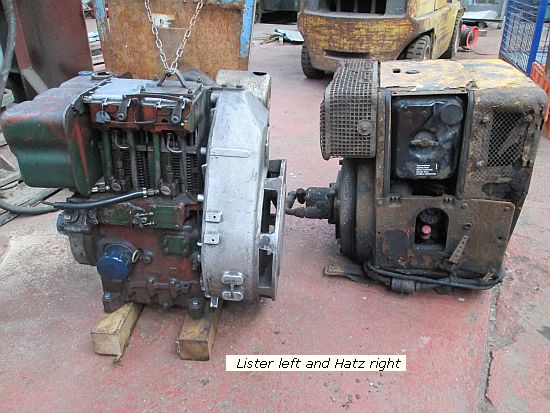
I was aware that the Hatz had come off a road trailer, where it powered hydraulic rams that lifted an intermediate floor, so there was a serious risk that the starter and alternator would be 24V powered from the tractor, whereas our power pack is 12V. When I finally got in to it, late this afternoon, the first thing I found was the starter motor markings - 12V 2.0kW - so sometime soon we'll get to see how well it goes.
That's about it for this week. Sat next to me as I write this is the air cleaner element for RS8 - it arrived on Friday but beyond measuring it and producing a CAD drawing, only a few vague doodles of how I might put it within an enclosure that doesn't change the outside look of RS8 and doesn't protrude too far under the casings have so far been scribbled down. I suspect there'll be a few (dozen) more before I settle on a workable arrangement that I can convert into a manufacturing drawing. I heard an interesting quote this week that rather sums up our attitude to 'preservation'. It went along the lines that one should 'nurture the flame, not worship the ashes'. Now we can all have opinions as to what 'railway preservation' is today. To me it has gone far beyond the altruistic early pioneers who were genuinely saving something of the past for future generations. That justifies one of anything, but we have 'saved' multiples for no better reason than the heritage railway movement as a whole has become a hobby activity with only scant regard for literal preservation. There are those who insist that they are true preservationists, and as such they choose to restore their loco/coach/wagon to original condition, reversing even improvements or corrections that may have been made over the years. That of course is their right, but equally ours is to 'nurture the flame' and if that means incorporating improvements in the light of later experience, we shall. In RS8's case, the pneumatic system had a serious flaw - there was continuous pressure feed to the clutch cylinder, with no 'unload system'. It cost Tarmac a couple of thousand pounds to replace virtually all the clutch parts as this continuous load had worn pins and links. Should we therefore 'worship the ashes' and stick to its original, flawed, system, or 'nurture the flame' and correct it? I'll leave you to turn to your keyboards and accuse me of heresy. Nonetheless, I'll be back next week. See ya then?