
Of fits and starts
3rd March 2019
I would like to tell you that RS8 was happily running up and down at Tunstead last Monday, but sadly I can't.
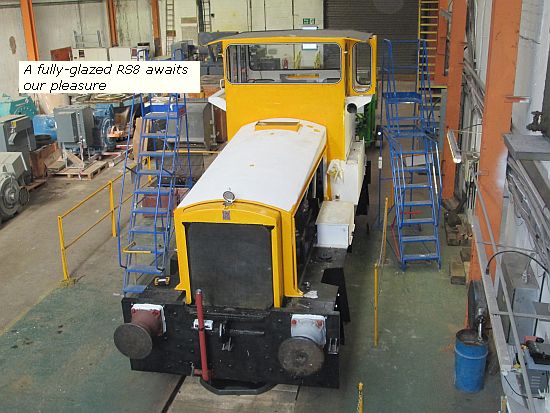
Jagger had arrived for a few days stay and so joined Andy H, Pete C and myself for what I hoped would be a momentous day. And in many ways it was, but not the one I had envisaged. For starters, first crisis arrived even before we could get our ovvies on and sign in. RS8's rhs fuel tank, the one from which the fuel supply to the engine is drawn, has started to leak. Not from the welds that I had worried so much about, but from a 1/2 inch malleable plug towards the rear of the tank intended for draining. We mopped up the damp patch, got fuel to the pump, and started bleeding it through.
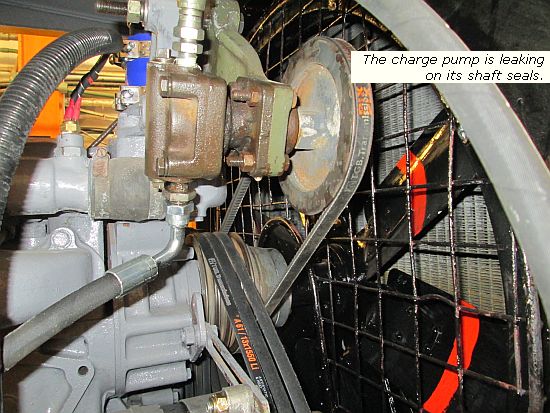
But the lift pump didn't feel right, and several sore thumbs later we found that it wasn't pumping at all. Andy and Jagger removed the front of the lift pump and identified a stuck non-return valve. Reassembled and connected, it bled through and we were ready to start. So I went up top and with due ceremony, turned the key. No, not too impressive. Instead of cranking and firing up, the starter went 'bang, bang, bang, bang' and everything flickered. What was happening was that as the starter engaged, the 'inrush' dropped the voltage so far that the timer relay effectively turned off, and as part of the Start circuit went through this relay, in doing so it turned off the starter, whereupon the volts restored, the timer came back on and went through the cycle again. At first I thought this was because those batteries were too small, or hadn't fully recharged, so we brought a spare set in which were larger (so much larger I couldn't shut the battery box) and swopped them over, but with the same result. This was denting my professional pride, so next time I merely turned the keyswitch 'on', over-rode the Run relay and operated the Start relay manually, whereupon the engine started up and ran. I waited anxiously for the oil pressure to indicate on the gauge and the LED to change from red to green, but they didn't, so before too long I stopped the engine and looked for leaks.
The t/c res had dropped its level so we took the opportunity to top it up, and then had another go. Still no apparent oil pressure. I had a look on the back of the instrument panel, and the cause of the gauge not functioning was obvious - I had omitted the +ve feed to the gauge! But why no LED? Andy and myself opened up the Visutector. It didn't take too long to spot another c**k up. I had wired the oil pressure switch connections to the coolant temp switch, and vice versa - it wouldn't have changed over on the LED unless the engine overheated! Fortunately there was enough slack in the wires to reverse them and soon indications were showing oil and converter pressures.
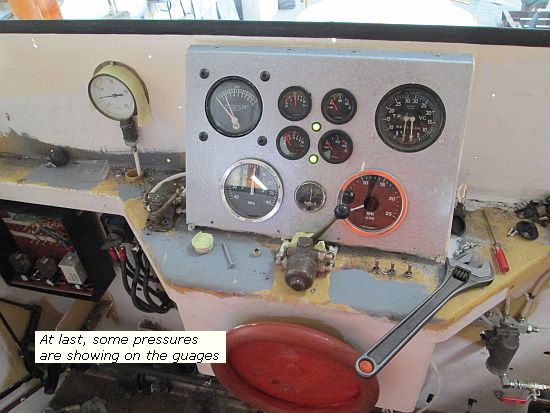
But not air pressure. In an ideal world, you connect the loco to a static air supply and charge it first from there - you can't hear air leaks above the engine noise. We did our best, but struggled to get much above 15 psi. Then there was a regular banging noise coming from underneath. I thought at first that the silencer was loose and causing this, but then out the corner of my eye I saw the propshaft going round and the banging were the reverse gears which are not in mesh, but might have a few pounds pressure on them. One thing to resolve on my pneumatics 'set up sequence' list had been 'which way is the Clutch control valve operating?' Now I knew, the valve was set for clutch 'in' and there had been enough pressure to lift the piston and bring the clutch plates to drag, but not enough to enable the unloader valves to function even if they had been set up. I knocked the valve handle across.
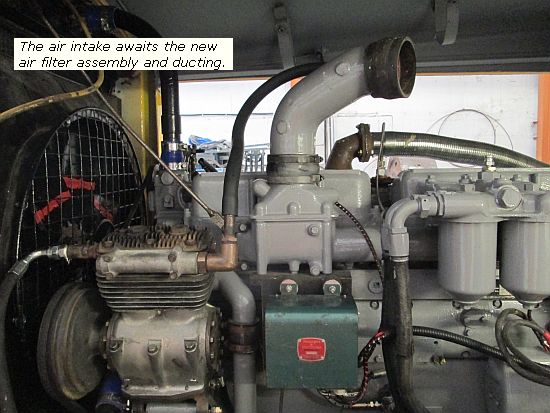
And I am sorry to say that most of the day was occupied with chasing air leaks. A large one turned out to be coming from a pipe union, and when we undid it, the two surfaces were several millimetres apart, but no amount of waggling would bring them together. Jagger proceeded to make up a gasket and seal it up, and appeared to be succesful, we eventually got air pressure up to about 25-30. Strangely, when I tried to adjust the regulator that sets the emergency brake level, Pete C reported that pressure was rapidly lost. I couldn't think my way through this at the time, but later realised one scenario is that the reg is in the wrong way round - that's on tomorrow's list for investigation. As we sat having lunch, a passing manager said he had an air compressor that we could use - if that materialises it'll make life much easier, but we have spotted a couple more leaks to sort, one of which appears to be between the overhauled driver's brake valve and its manifold. (You may be mystified as to why this is such a problem. Yes, we've got 230V portable compressors that would pump up the loco supply, but in many companies 230V is unacceptable. What's considered safe in your home is banned in the workplace. Hopefully the manager has a 110V one.)
To finish the not-so-good-as-I'd-hoped day off, I attempted to fit the throttle cable that I'd measured, plotted, checked and finally added 6 inches as a precaution, yet it turned out to be 12 inches too short. Yes, my original calculation was seemingly 18 inches adrift. History repeats itself - the two I'd brought up and tried before were ones I'd got wrong in the past.
So what about the electrical issues? I've had this happen in the past with PLC systems, like that on 14 901. Here I've always put in a couple of 12V alarm batteries and wired them so that they are kept charged from the main system but run the PLC as soon as the main system drops in voltage. Here the only issue is the Timer relay, a low current device, probably only the relay itself taking any appreciable current, so I'm trying out a large capacitor. These are used to smooth out the ripples in DC supplies - it's just that this is a rather big ripple. It may mean making a few other changes - when the power is turned off the cap may keep the LEDs on for several seconds, for example, but I'll cross that bridge when the starting problem isn't any longer.
Jagger has spent a couple of days at the shed, and another where he barely moved from a chair in our living room as I plied him with books from my book-case and regailed him periodically with reminiscences. When we have been down it has largely been on Ashdown, and eventually, after some judicious use of gas, the traction clutch was extracted from the loco.
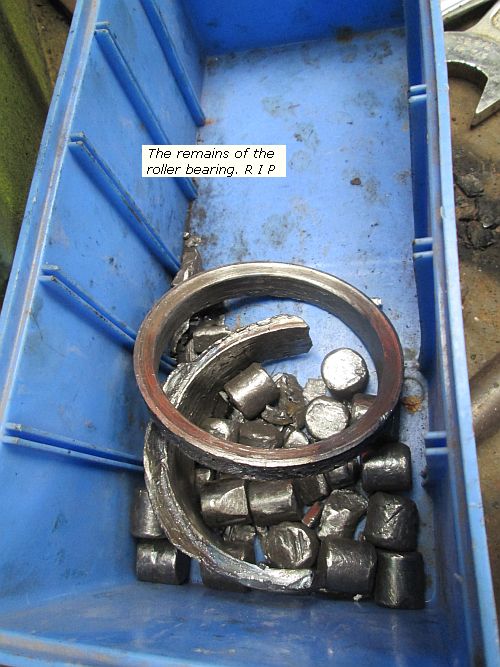
Andrew contnued the work on Saturday. What a mess. Once upon a time it had a parallel roller bearing, some 6 inches broad, and an oil seal. We managed to extract the outer race in enough of one piece to read the bearing number, but you can see the damage from the pictures, with broken races, chewed rollers and machined faces of castings looking like they'd been painted in Hammerite.
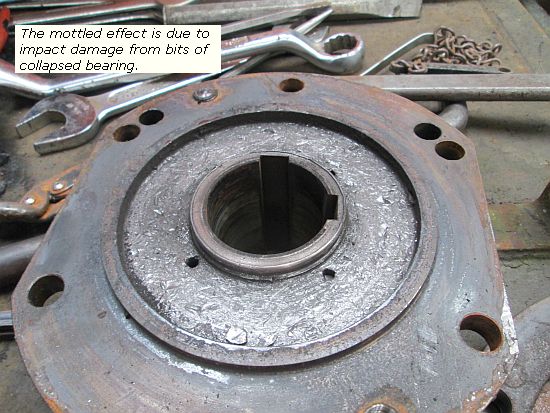
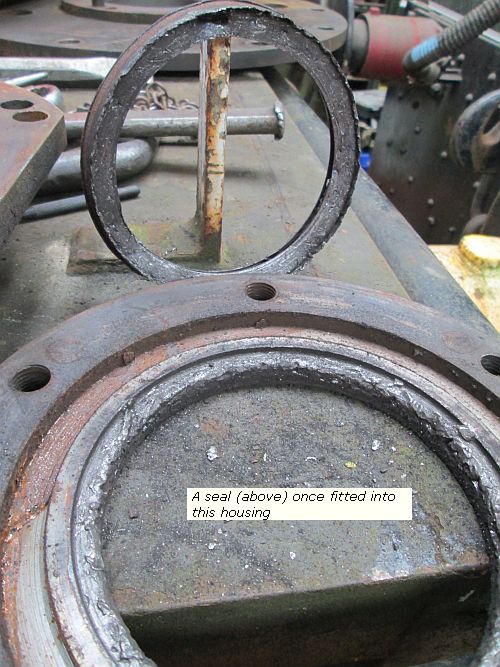
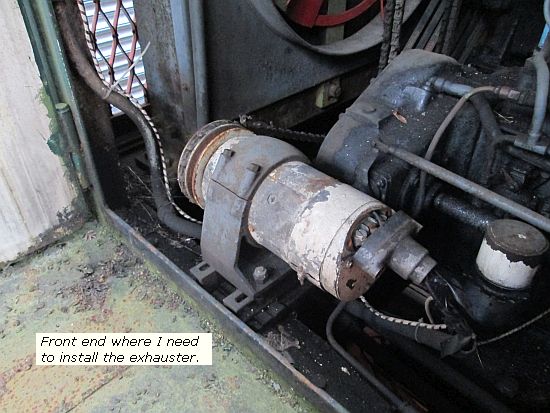
It's a very old imperial bearing, and I wouldn't be surprised if it has to come in from the States Up at the front end of the loco, I had been musing how to squeeze an exhauster and drive in without repeating the ghastly installation Ashown had when it arrived. Here's the front end as it stands now - so you can see what sort of contorted set-up I can dream up:-
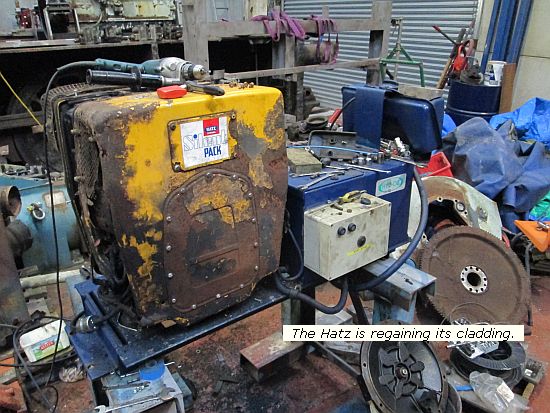
On Sunday morning I'd arranged to pop along to a customer to do a quick brake adjustment, so Andrew put some time in on further tidying. The second fire extinguisher station is now in its home, and a second assembly of pallet racking has gone up in the container. When I returned I got back on to the Hatz. It had been a surprise earlier in the week to discover that our two Hatz's are not quite the same: none of the body parts from the 'old' Hatz can be employed on the 'new' Hatz to replace those badly corroded, so I will have to make up some new pieces using the old as patterns. It won't look as good as new but it should be 'workmanlike' once I've finished. In the interim I ordered up a brand new, yes, unused, hydraulic motored winch. We still need to find a suitable pump and control valve and mount it all on the low loader, and as there are jobs that require it that it's becoming something of an increasing urgency, so we might farm it out to sub-contract.
That's about it for the week. Back to Tunstead tomorrow to sort out the bugs and maybe, just maybe, get a bit nearer to having RS8 move under its own power for the first time in over a quarter century. No promises - we won't have a throttle control for one thing! - but pop back next week to find out how we got on. See ya then.