
Of concrete, chequer plate and oils
31st March 2019
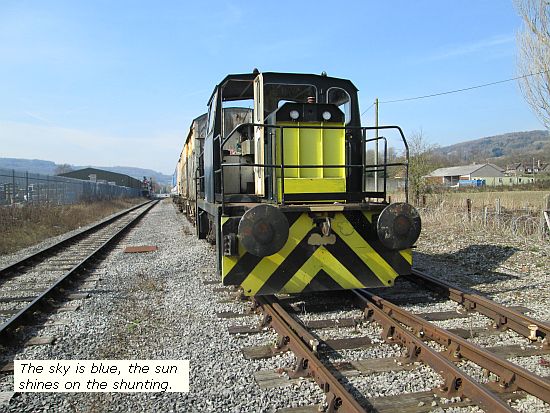
As I drove over the railway bridge by the top of Tunstead works on Monday morning, there were two of Network Rail's finest with their backs to me and I thought - idly - that one looked a bit like Dom B. By the time I had driven in to the works, and dropped down the hill to come alongside that long building wherein RS8 resides, these two had descended to the tracks and were talking to Andy H, and sure enough it was Dom B in the flesh. I invited him to come and have a look if he had time to spare: we had talked about it before as he had a soft spot for RS8 from youthful visits to Dinting. With essentials completed a while later he popped in and I showed him round what we had achieved. It is inevitable that for us, who have seen the project slowly progress, it is all routine and normal, whereas for Dom, who had not seen it since it arrived, derelict and festooned with branches, at Darley Dale nearly 3 years ago, the transformation was considerable. He took some photos which he duly posted on Natpres, which got picked up the the EVR's Neil F-L, and reposted on some Facebook page for Wirksworth town, inevitably bringing the usual range of comments from the 'great to see it being restored' and the 'I thought it had been scrapped' to the 'are they restoring it as a steam loco?'. Actually Andy H has come up with our official reply for this one - 'we are conserving the chassis towards the day when there are no similar industrial 0-4-0STs cluttering up the sidings of heritage railways'.
But to return to the actual work. As you will recall, at the end of last week we had found the sump oil emulsified and there seemed nothing for it but to drain the sump, drop it down and examine where the water was coming from. The only consolation was that the radiator still seemed to have the same amount of coolant as it had had after we'd topped it up the previous week. The aluminium sump pan is held with a considerable number of bolts of differing lengths, each with a 9/16 AF head but also differing in accessibility. Back at Hills, we used to pride ourselves that we did not let a loco out of the works if the sump could not be removed from an engine in situ. There was a simple reason for this - we had roving fitters, up to 12 in fact, doing work on customer locos throughout the UK. If Kilnhurst sent out a loco where bits were stupidly sited, and made our fitters lives a misery, said fitters tended to stomp up the stairs to the Drawing Office and give Bill Burgess a piece of their minds. So maintenance accessibility became a keynote of Vanguard locos, and I tend to assume that anyone who builds or repowers a loco has the same mentality. But 2 or 3 bolts at the front were right above the front end fabricated mount, and no spanner would release them. In fact, we found a 'spare' spanner and cranked it several times in an attempt to get in through a slot, but without achieving a reliable grip. Almost all the contaminated oil had meanwhile been drained out, and Pete C decided to pressure test the cooling system. By turning the output regulator on the compressor set right down to 1 bar or less, and connecting it to the 1/2 BSP tap intended for the cab radiator connection, we could impose pressure on the cooling system. So we refitted the sump plug and left it pressurised for nearly an hour, before taking it out and - well a little more oil dripped down, but no more than a tablespoon full.
We did though, get the Mk2 throttle cable installed. Here's the cab end.
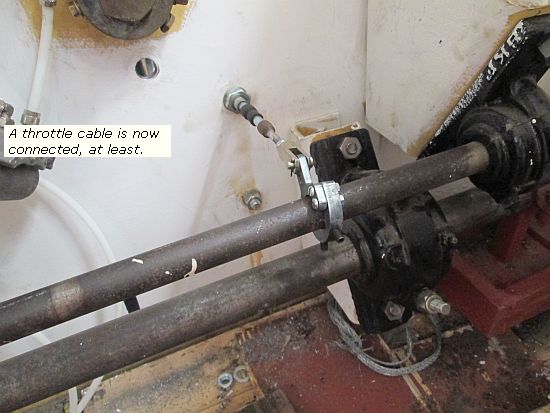
At the engine end Pete C came up with a couple of pieces with which to hold the cable outer- we need to clean out the threads in the block and find some suitable setscrews. At the moment, if you move the throttle lever in the cab, the arm on the fuel pump stays still and the cable outer moves away. We had not resolved how to get the remaining bolts out the sump by the time we left, but had dreamed up a special tool comprising a ground down impact socket (impact sockets are single-hex, so grip better, and are not case-hardened like ordinary ones are) together with a special lever to turn it. But that evening Andrew and I had a brain storming session. The fact was that I had not checked the oil prior to last weeks run, only after, so had the contamination been there aleady? Had it in fact not been passing somewhere, probably a dried out liner seal, as soon as we had started to fill the cooling system but the heat build-up running the engine had sealed it back up? We had had an hours pressure test with no significant flow - sure, it might be a porous liner where the engine had stopped with a piston straddling the hole, but a cold piston shrinks and water would find a way past. It might be a cracked head, but again why still remain tight after an hour of pressure? All in all, it was time to about face, and unless anything further untoward is found this Monday, change the filters, fill with fresh oil and run it again to flush out the remaining contamination.
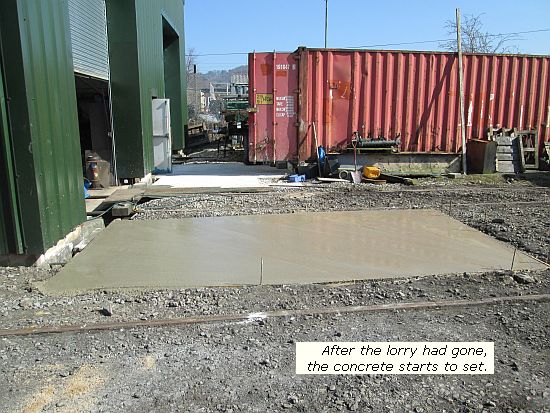
Andrew had booked the concrete delivery for Friday at 10.00 and Andy H had agreed to be there for 08.30 as we needed to drag the train back to allow the lorry round the back to pour. Andrew reckoned to be with us by 09.30, but on Friday morning first thing came the news that Andrew would be late and the lorry would be early, like 09.30. So Andy H and I had less time to prepare than we thought, and I had a nagging feeling that the 'the lorry will be a little early' message was the supplier softening us up for the lorry arriving at 09.00. As it was James had just brought the train clear at 09.05 when the driver rang ('Are you Andrew's mate?') because he was outside at tbe gate! We got him in but had to shift the pallet full of chequer plate to one side as it was just too narrow to clear him by. So no pictures of concrete pouring as it fell to Andy H and me to get it spread and tamped, with help from the driver, of course. In the end we had it poured, levelled and the lorry on its way by 09.50 (His next job was booked for 11.00 and was barely 300 yards away!). Here's the result.
Andrew finally arived at lunchtime. Andy H and I continued through the rest of the day, mostly tidying up, as the shed is a mess and we've two groups booked to visit shortly.
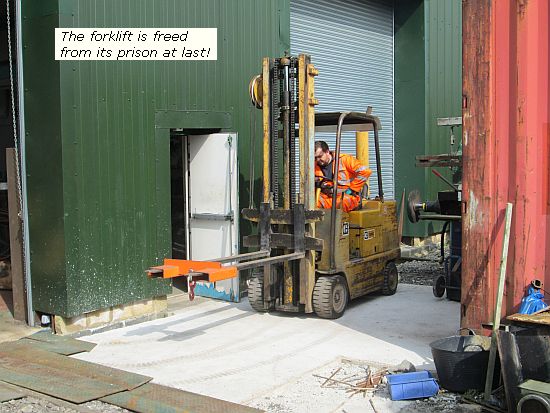
Saturday and bright skies and sunshine decided Andrew that we should carry out a big shunt. But first, Charlie was low on fuel, and it was time to see whether our first stage work outside meant that the forklift could at last roam free in the great outdoors, confined to the interior of the shed no longer. So with chequer plate duly in position, the forklift tentatively nosed out of its enclosure. And yes, here it is, sat on the first piece of concrete we laid, and ready to lift a 45 gallon drum of gas oil up to gravity feed Charlie's tank.
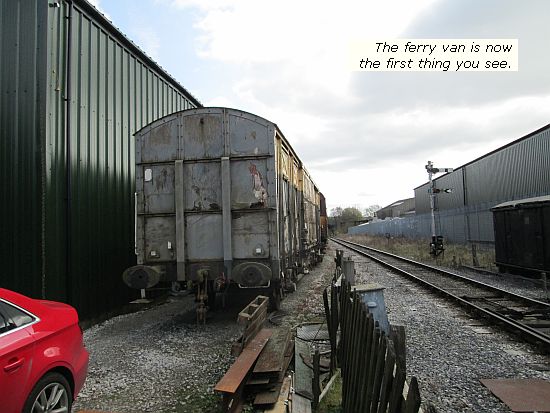
Now, the idea of the second part of the concreting (which at this point, we had not dared to walk on) was that we could access either a road vehicle or rail vehicle with the forklift without having to bring said vehicle into the shed. And the greatest benefit would be if our stores vehicles, to whit the Ferry van and the PCV, were nearby. So after lunch Charlie started a long and involved shunt. It would have been simple, on a day when trains are not running, to have performed this shunt by using the adjacent running line as temporay overflow, but let's be honest, goodwill is not really present at the moment so we had to work within the confines of a headshunt some 55m long, or roughly 2 carriages and a loco. And the end game was to have the Ferry van and the PCV at the end of the siding where the 2HAP resided. To achieve this meant some ticklish shunting with the 2 halves of the HAP separated - which you think is easy until you discover that the SR did not join coaches into sets with side buffers and hooks, but a single central buffer and a chain underneath, each end in a forged eyebolt. So had you been around late in the afternoon you would have the slightly novel combination of a HAP carriage apparently paired up with a PCV. Perhaps we should have promoted this as an April Fools' gag - a new Post Office sorting train with the neccessary 'personal needs' provision for the sorting workers. At one point the 2 halves of the HAP were even cab-to-cab.
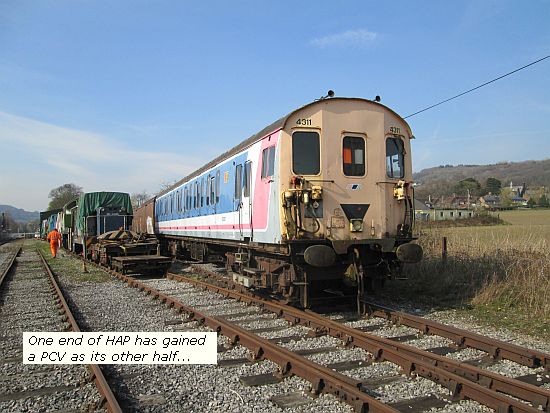
But we finished it just in time, and this is now the first view of rolling stock alongside the shed.
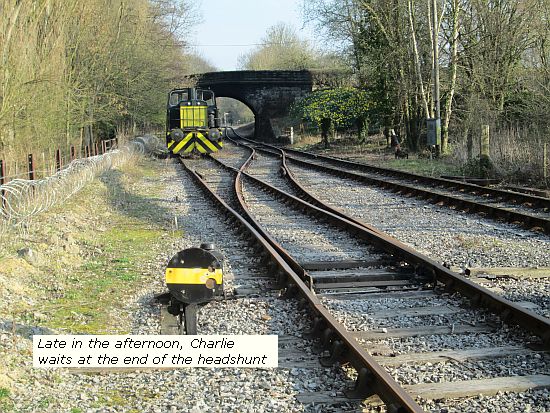
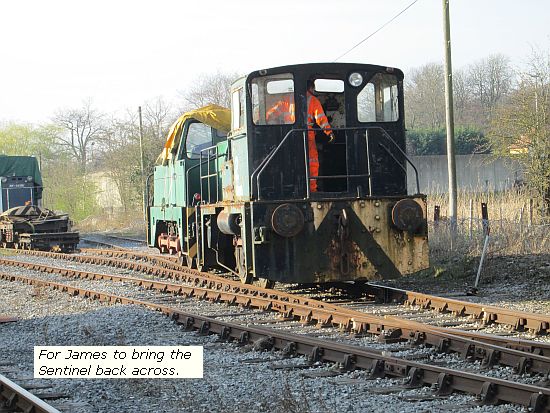
James had taken part in some of this, our final moves being with Charlie at the end of the headshunt while James brought the Sentinel back onto the siding.
First thing Sunday was to knock out the shuttering from around the new concete and back-fill the gaps with earlier arisings. We had dared to walk on it late Saturday (30 hours of setting) and at 48 hours figuered it was time to de-shutter, although we won't try the forklift on it for a few days yet. Pondering RS8's clutch, it had occurred to me that I had sourced a new clutch cylinder and my design of bracket in anticipation of replacing Charlie's some years ago, and as these were kicking round they might as well be put to RS8. But I had not had reason to provision a clutch shaft, so Plan A had been to get Andrew to plasma cut a new one. However he pointed out that we had an old one from Libby that was otherwise unusable, so as the damaged bit was the clamp block, he took the plasma cutter to it and cut the offending part away.
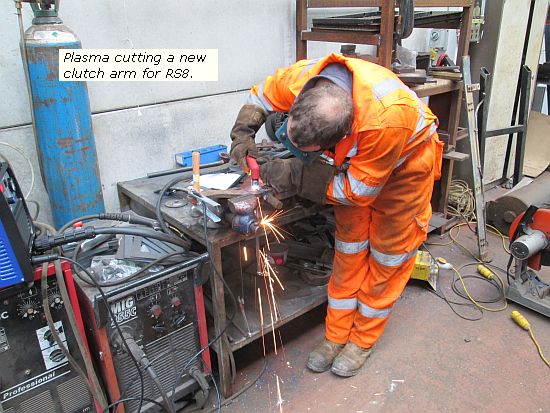
The idea is to use the clamp block from RS8's old clutch arm and adapt bracket, etc as required to fit. After that much of the work was a continued tidy-up, adding to Andy H's efforts on Friday and Steph's who had spent a couple of hours on Saturday while we had been shunting. Late in the day Andrew repaired a couple of the racking beams for the last of the pallet racking that is in the container - not very exciting but it has to be done.
The 'apology' on the Peak Rail website disappeared exactly on the 14 days they had undertaken to display and not a moment longer. At a Peak Railway Association meeting somebody asked why it had been put up - he was unaware of the circumstances behind but it was apparent that, like a lot of PRA members, he pays little attention to the hot air emanating from the Matlock office. A few weeks ago the local paper carried refrence to the Campaign for Better Transport who published a report itemising a large number of closed rail routes that it felt should be considered for re-opening. It got into the Matlock Mercury and its sibling locals because it argued for a re-instatement of the Matlock to Buxton route for passengers. Now it seems that Peak Rail has dashed into the fray against the C for BT because it conflicts with PR's plan for route re-instatement which unfortunately it cannot reveal because it is 'shrouded in commercial secrecy'. This from the same Board that last year told shareholders that the opportunity for Peak Rail to rebuild the line itself had long passed by, but that its new President was 'even then' in the corridors of power convincing civil servants that it would be a good thing under the auspices of Transport for the North, whose plans, issued a couple of months ago, don't even include Buxton on the map, let alone Matlock. I don't think that C for BT has a cat in hell's chance of success in any its re-instatement plans given the present 'Brexit - bright future or the end of British civilisation as we know it?' crisis, but then maybe Peak Rail should include 'making friends' in its mission statement..
Right, that's it for tonight. Another hectic week beckons. I should be here, same time, same internet, if you will too. See ya then?