
Of air cleaners and cylinders
13th January 2019
If you cannot abide RS8 and don't like reading about it, best not bother with this week's instalment...

... because for various reasons, we haven't done much else.
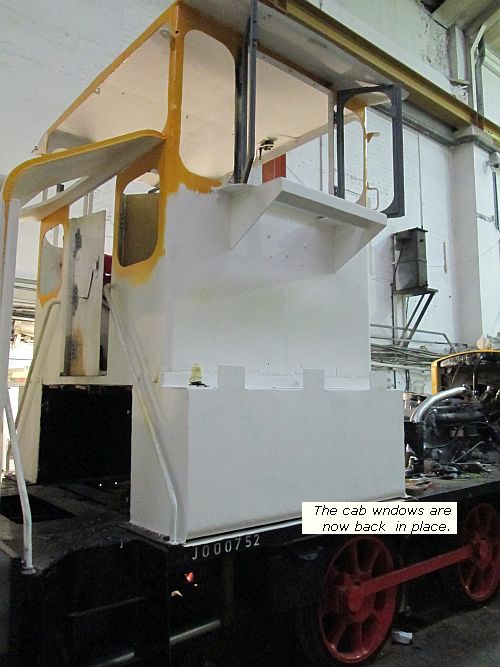
Returning to Tunstead on Monday was rather like the first day of term, asking each how our christmasses were and not really getting under way as promptly as before. George unfortunately is no longer available to us, he has transferred to Hindlow, which is spoken in hushed tones at Tunstead as if it was like being despatched to a gulag. But we did get Andrew Hn, on his last secondment to us to complete the outstanding 'on the loco' welding jobs. So to some extent it was a case of aiming to be in whatever place he wasn't. He started by welding up a bracket to go under the cab floor where we've brought up what will become the vacuum brake pipe to the drivers valve. Originally on RS8 this came up the front of the cab and back through a large hole, then having a peculiar fabricated tee inside the cab under the desk one branch of which has seemingly always been blanked off. I opted to bring the incoming pipe up through the space in the cab floor through which the handbrake chain passes, but the resultant unsupported length was becoming a trifle excessive and a clamp just under the cab front has made it nice and solid.
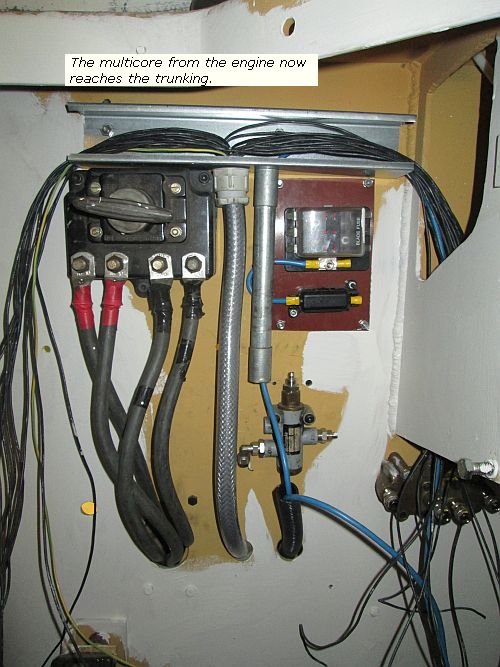
So while Andrew Hn was out the cab, I leapt in and extracted the trunking, chopped a half-inch or so off, redrilled its mounting holes half an inch further over and cut an aperture next to the 20mm conduit for a suitable gland. Later in the day I was able to get back in, cut off the insulation, and thread the multicore up and into the trunking, directing its cables left or right as appropriate.
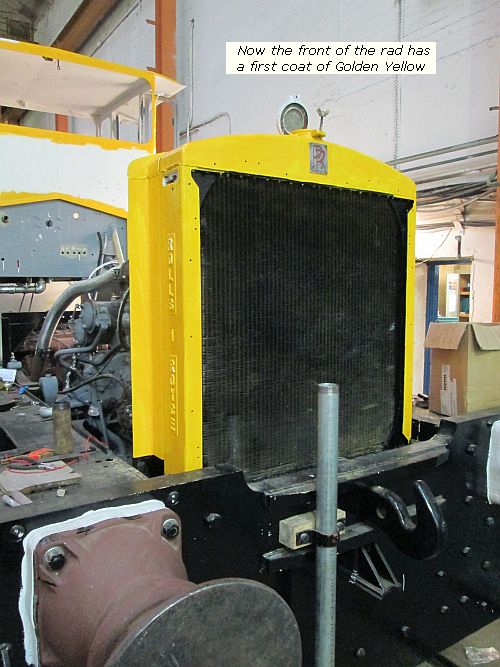
But that is to get ahead of things, and at this early stage of the day Pete C was tapping out the holes in the radiator header tank and installing the radiator stay bar, and Andy H was going over more things in Golden Yellow paint, especially where he'd painted last time only for finger marks to appear.
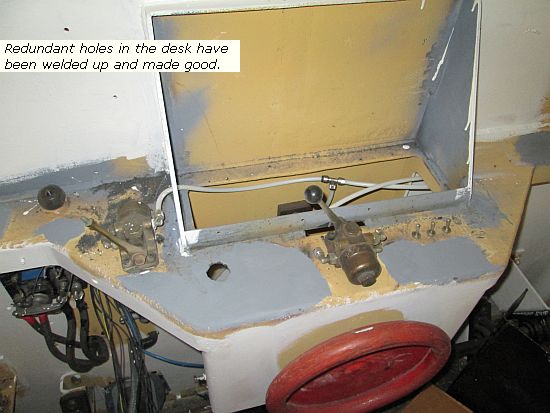
Andrew Hn had meanwhile returned to the cab, sorted the rear cab doors and then started filling up numerous holes in the desk top which related to old parts of wiring and pneumatics which no longer applied. (The original RS8 electrics had heavy duty CAV STOP and START buttons, long since obsolete. The new system has a discrete keyswitch instead, you'll see more of that in due course.) The resultant clean top was handed over to the other Andrew, who primer'd it forthwith.
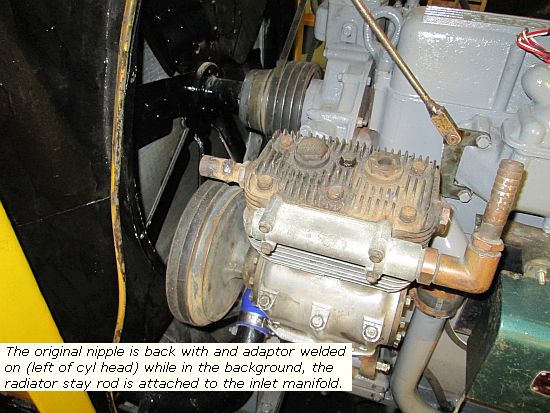
Andrew Hn also took the compressor cylinder head nipple (which I had struck out on identifying) and welded on a 1/2 inch BSP sleeve so that I can put in a nipple and a delivery hose to the unloader valve.
Back out on the engine, I dragged through the wires for the tacho genny and the clutch detection switch and by early afternoon had finished the engine end of the wiring apart from working out which low current wire goes on which alternator terminal, as ours does not have the A and F markings it ought to have. That meant though I could fit the top of the wiring box on after a final trip round checking that all the terminal nuts were tight. Pete C was looking for his next job so I hastily sketched out the brake valve and associated piping. The brake valve is a D&M FD1, which sits in a manifold and normally has its ports identified on the casting. Ours doesn't, but I had brought along one from the workshops that did as I had realised that the porting was not symmetrical so could be extrapolated. The brake cylinder itself has a 1/2 inch BSP port, but screwed on to it was a couple of adaptors we hadn't disturbed, which turned out to be a 1/2 inch nipple, 1/2 to 3/4 female adaptor and a coupling to get into a copper pipe - more of the obsolete Enots fittings but the pipe itself had been thieved by cutting off at the union nut. We'll do it in steel back to a changeover valve at the front of the cab, but after discusson later in the afternoon, it was agreed I'd source some new pipe ready for next week, and bring along a (hand operated) pipe threader.
Although Andrew Hn's work was done, we sent him back with one of the cab radiators which has a frost crack. It is a cast iron rad so not replaceable, but we're hoping he can braize over the crack or otherwise make the rad usable once again. A conference late in the afternoon concluded that next week (i.e.tomorrow as I write this) we'll refit the casings which will mean we can continue with the brake cylinder piping plus the feed from the air receivers to the driver's brake valve and the feed to the receivers from the compressor unloader. One of the reasons Pete C has held back fitting the casings is that he feels that passers by will interpret that as 'nearly finished' and he'll be inundated with questions as to when it will be running. But time is about there, as until the loco is re-united with its air receivers the air system cannot progress.
Years ago, I had a first rate contact at Fleetguard on the technical side but he retired and re-organisatioms since has meant that I had lost track of whom to talk to in what nowadays likes to think of itself as Cummins Filtration. But my son-in-law works for another part of Cummins, so I enlisted his help over Christmas to start the ball rolling to resolve an air cleaner. RS8 originally had the common Rolls' method of having 3 teeny-weeny oil bath air cleaners joined together on a manifold. Apart from being quite compact in two out of three axes, I have never quite figured what Rolls saw in this arrangement. Oil baths are nowadays regarded as inadequate - at least for turbocharged engines - and having 3 ganged together must have been an additional maintenance chore for no good purpose. On RS8, they were engine mounted, and committed the cardinal sin of being inside the casings, where they suck air which is both warmed from radiator/engine as well as carrying dirt and fumes. Anyway, we didn't have one complete one between the three, so my plan has always been to have a new single paper element cleaner. Now, I could take the 'easy way' and fit a modern round bodied cleaner and cut a big aperture in the casing top so as to sit a pre-cleaner 'mushroom' outside keeping the rain off. I could, but it would spoil the appearance of the loco, and some would say that it looks bad enough already. We had a similar issue with 14901: when it came to us it had a conventional genset air cleaner, intended only for use 'indoors' i.e. in clean air and not subject to variations in humidity. This one drew its air right by the turbo and, we found later, had a big crack in the bottom where unfiltered air could pass freely. Before it went to the Gwili in 2011 we needed to sort this, and my contact at Fleetguard put us on to a suitably sized element in regular manufacture, I drew up a housing, and we mounted it behind the casing grille where the Paxman's had been and ducted it along to the turbo. Since those pictures are no longer displayed on the blog, I'm reproducing one here to show you what I mean.
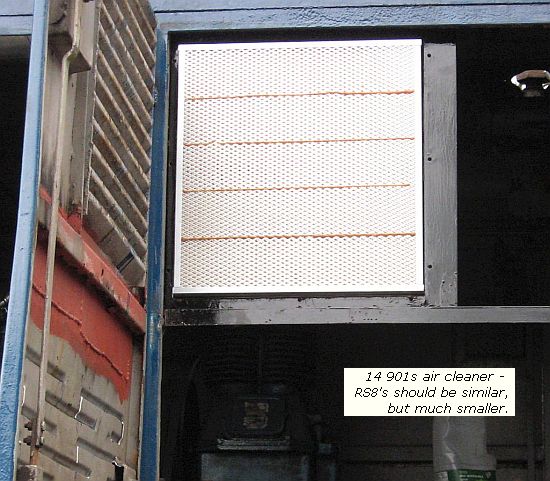
Now, the DV8 in 14901 is a 32 litre engine whereas the C6 in RS8 is only 12, and there is no turbo to up the flow. So we could use the same element as on '901, but it would be a trifle OTT, and a touch large for where I am hoping to site it, hence needing to talk to someone.
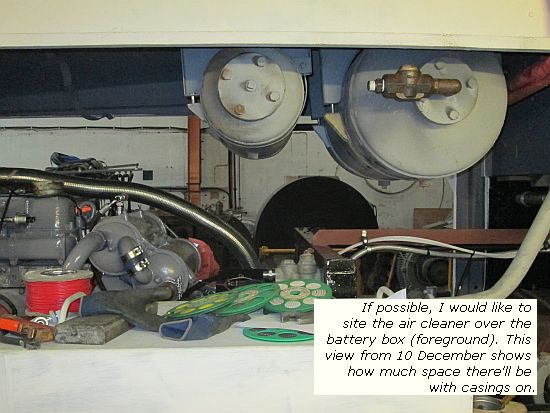
During the week this bore fruit, but took a number of phone calls and e-mails before it was clearly understood all I really wanted. Hopefully it will get sorted this week and I can start drawing up a housing, which will need to incorporate some grille or other external piece that doesn't alter the appearance of the loco. My prefered home would be over the top of the battery box, 'dead space' from an access point of view and reasonably close both to the engine air intake manifold and perhaps a branch so that the compressor can draw its air from there too. The crunch will be when we can see the element size and whether its depth will fit clear of pipeworks, but the picture below, taken when the casing was trialled on, gives some idea.
So after all that on RS8, what else has been going on? In a sense it has been a quiet week: I got into one of my suppliers in Shefield and came away with galvanised pipe ready for Monday, and ordered a rectangular air manifold so we can proceed with the control air plumbing and not be held up by the obsolete pipe fitting that my supplier has had no luck at all locating. On Friday though it was off to Norfolk to collect grandson for the weekend, and in the end I didn't go near the shed on Saturday and only got down there after an early lunch on Sunday. Even then most of my time had been occupied on sorting out the gear required for Tunstead, apart from a trip around the yard tightening up the many tarps that were flapping in the wind which made the shed grown and grunt from time to time. Peak Rail's p/way crew were out again, and like last week two of their number came and took up hospitality out of the wind.
And that I suppose is about it. Next weekend should have both me and Andrew back in harness, plus a collection of profiles, ordered at the beginning of the year but ready too late for me to collect last week, should be in hand. What will we get up to? Come back and see.