
Of stopping and starting
28th April 2019
There's a tendency for visitors to ask how many of the locos 'go' and seem disconcerted when we admit not many, but what do they expect? Well there's another coming up on the operational list - read on.
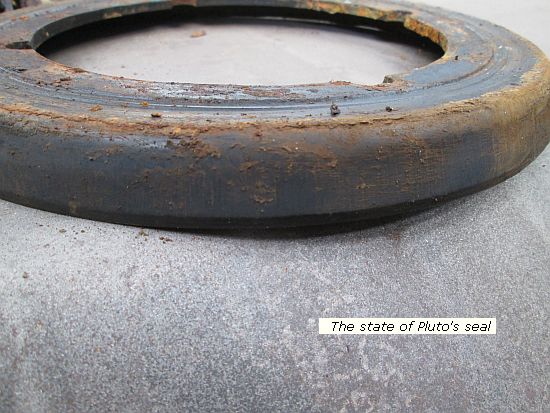
We were back at it again on Monday, with Pluto the first on our list. As you can see from the state of the brake cylinder seal (below) (and the edge of the seal has multiple scratchlines which don't show up too well on the photo) it was not in a healthy state.
Having dried out the cylinder itself required a lot of attention with wire wheels to clean the rust and dirt from the bore while minimising further damage to the surface. This was not a pleasant job within the confines of the bowels of Pluto but eventually Andrew was satisfied and came to assemble the piston. I had already fitted a new seal to the piston itself and when it slid in, a satisfying whoosh of air could be heard from the exhaust port of the brake valve up in the cab, indicating that that was the air's only direction of escape, as it should be. On top of the piston is a long coil spring that was going to give problems getting it in (because within the confines underneath, part of Pluto's brake rigging gets in the way) so Andrew had the bright idea of compressing it partly with a tie-wrap on either side. He didn't have much success with this, so I invited him to put it on the ground. A suitable tin was to hand so I put that on top and proceeded to sit on it, compressing the spring further while he followed it up with tightening the ties. Thus aided, and with two long M10 studs, the spring was inserted and the outer cover placed over with enough space for him to get in and snap the tie wraps, after which it was all gradually tightened down and the Westinghouse retaining bolts added. Finish off reassembling the push rod and pivot pins and Pluto was lowered back down on to the rails. It was duly started up, the other locos moved out the way and Pluto was tested with everything working satisfactorily.
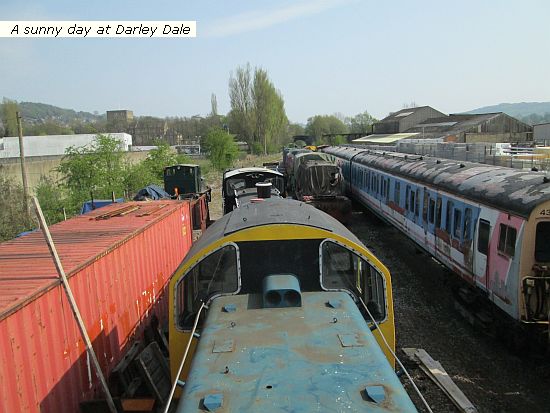
While the end of the shed had been clear, Andrew had brought the forklift out and with a 45gallon drum of fuel recovered from 14 901, we set about part filling the fuel tank on Ludwig Mond, which had effectively emptied itself when the pipework failed. This technique is simply to lower the drum on to the forks, raise it over the loco and using a half inch tap on a pipe off the drum, control the flow into the tank. I carried out this task, and while waiting for the fuel to flow, grabbed this unusual view of the yard from my vantage point.
With the fuel added, we had spent some time giving the batteries a charge and as there is no immediately forseeable need for vacuum, I had disconnected the exhauster belts and tied them up out of the way. So we took the opportunity to start Ludwig up and see if we could now get traction. The Dorman 8QT burst into life surprisingly easily, but air pressure was slow to rise and it was obvious there must be more leaks that couldn't be readily discerned above the engine noise. The loco refused to take power and as the day was drawing to a close, we formulated a plan for the next weekend.
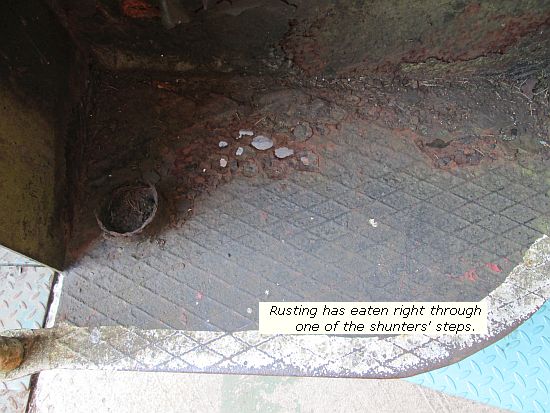
Talking of 14 901, you might be interested to see some of the work in store. I have mentioned previously that the cab columns are known to be badly rotted, and the original floor plate of the battery box was replaced by a wooden one before it went out a couple of years back, but here (below) is a picture of one of the shunters recesses, where treadplating is now completely holed through, and the socket for the shunters pole is but half the height it once was. The overhaul that the loco will receive is going to have to be extensive.
During the week I put some time in on the Hatz. I had already changed the keyswitch for a stock one as the original seemed intermittent in meter testing. Hatz provided clarity on the connections to the alternator, and whereas previously I had been checking everything on the +ve side of the system, for once I tried the -ve side and struck lucky, being unable to meter through from the battery -ve post to the negative terminal bolt by the engine. As I investigated further I found I could get continuity to the cable lug, just not the bolt, so took it apart, cleaned and vaselined and hey presto, off went the Hatz, vibrating the stand until nuts, bolts, tools and other bits were taking suicide leaps onto the floor. The alternator is definitely charging, but not by much, and the warning light doesn't light up (and neither does the oil pressure light actually) so there is still some work to do. At least we can look at sourcing a pump and control valve for the winch.
I used to moan about a phenomenon that we had noticed that on the last weekend of any month, we didn't make much progress. For me Saturday began to take on that mantle again. Pluto's shutdown system is to flick the bottom idle stop out of the way in the cab and push the throttle lever back farther, effectively shutting off the fuel to the engine. On the other side of the pump is a stop lever, which traditionally we had tied in the run position and left alone. We had talked from time to time about rigging an energise-to-stop solenoid on to it, and indeed I had dug one out of the container, but never got around to fitting it. In the last couple of weeks we had agreed that instead a cable-operated stop might be good, using the wrong-length throttle cable I had bought for RS8. So on Saturday I decided to concentrate on this. And as far as progress goes, it wasn't good. If the stop lever shaft came to the outside, it would have been eminently practical, but on the engine side, I could barely see the stop lever for fuel injection pipes. The stop lever was short, and having no suitable clevis end for the cable control, I had to improvise. In the end I thought that maybe a longer lever would be beneficial, so wasted half an hour or more hunting out an alternative with the right spline. But such were the clearances that I couldn't get the original off without detaching an adjacent injector pipe, and when I had got the longer one on, I couldn't get the injector pipe to line up and allow the nut to pick up on the thread! Add to this that even to get one 6th of a turn meant using a spanner first one way, then the other, and that pipes prevented me getting any decent grip with fingers, and you'll understand why my temper was getting shorter to the point that Andrew suggested we ought to do something else for a while! He had started reassembling the clutch on Ashdown, but in the end moved over to Ludwig and he started detaching another pipe under the floor that he knew from last week was holed. This is not one that passes through the running plate, but whether it was the atmosphere at ICI (which did produce salt) or Barrington (where wet cement can be corrosive) it had rotted to the point where the pipe wall thickness was compromised. It was only half an inch bore, and as I had dutifully bought a stock of taper/parallel nipples during the week, it was a simple matter of pulling out the old steel pipe and malleable fittings at each end, substituting new nipples, and me making up a new flexible to re-join the two places. In between times though I had returned to Pluto, removed the stop lever altogether, refitted the injector line and declared that it didn't really need a second engine stop, but it did need an oil pressure warning light as although it had a gauge (an electric one from when I rewired it a dozen years ago) it didn't have a physical warning. Having found where I had put the pressure sender, I located a Y-shaped tee piece in quarter BSP (one I'd originally bought for gauge lines on 14901 but replaced as they weren't ideal) and left it out for Sunday.
And on Sunday we were joined by Jagger, fresh from a day drivng loco 58 around Scunthorpe on a railtour there. Andrew got him on removing a piece of jack-rusted bodywork on Ashdown by drilling out the remaining rivets. Overnight I had found a 1/4 BSP pressure switch from my stock at home, so detached the wires from the old sender, unscrewed it and soon substituted the tee and refitted the sender and pressure switch alongside. Then the fun began. I had cabled this loco with split conduit. In theory it's simple stuff, it is moulded into a circular section which overlaps, keeping dirt out and making it easy to force fresh wires in by opening up a slot. Nowadays I prefer an SY multicore to a break-out box on the engine as you've seen on RS8, but back then I was in a poorly paid job at RMS Locotec and we had a load of this picked up at an auction. It's sufficiently corrugated internally to fight any wire you attempt to push along it, let alone any 'pull-through', and forcing an opening to insert a wire leaves finger tips sore for days. And my favourite hard-wearing rubber gloves don't last long at that either. But I persevered and eventually got two new wires back to the electrical box above the batteries. Now, I am sure somewhere I had a wiring diagram for Pluto, but I cannot find it, though bits of the story are coming back to me. Up in the desk is an ammeter, but it doesn't do much - in fact I was sure in my mind that it was supposedly showing discharge but not charge, and I thought while I was at it I'd run a couple of thick cables up and re-cable it in the right place in the system. As I peered up I realised it isn't wired at all, in fact, it was jammed half in/half out of the desk top and abandoned. So that's another task to do before Pluto goes on holiday. A Telelemec lamp assembly was dug out the container, a 24V AC/DC LED inserted and a hole in the desk opened up slightly to accept it, cabling completed and gratifyingly, the the warning light came on as soon as the battery switch was made. So it will serve as a reminder to turn of the battery master, as Pluto was the first conversion I did using a solid state regulator to control the dynamo and is prone to flattening the battery of you don't isolate it when you leave it!
Andrew had interspersed work on Ashdown with charging Ludwig's air system through the res line from the workshop compressor. Several more air leaks were thus revealed, including at least two Martonair valves which are showing signs of corrosion. Another was adjacent to the main air pressure switch, which needs to close before the loco will take power.
All this was interrupted by the arrival of a Director from Midland Railway (Butterley) and his fiancee, come to collect a pair of buffers that Andrew had sold them. And what's more they brought bickies, though we shared our crackolates over teas and coffees. After they'd departed, Andrew finally remembered that the main air pressure switch had been a trouble back at Cottesmore, and bridged it out, whereupon Ludwig took power, much to Jagger's obvious delight.

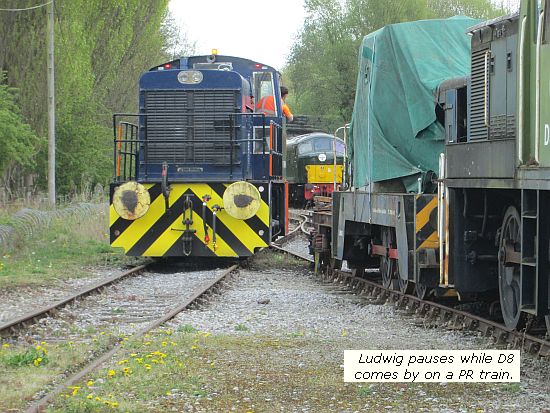
Ludwig ran up and down, clearly able to maintain air pressure despite the remaining leaks, though a noise from a blower motor tensioning pulley brought testing to an end.
Jagger and I had failed to get Pluto started when he spent a few days with us months ago, so it was now Pluto's turn to expand Jagger's locomotive experience, and I think he understood why I have a soft spot for this loco, as it was small and responsive - even if b****y noisy!
Anyway, tomorrow, for one week only, it is back up to Tunstead and see how RS8 has been without us. We need to make that clutch cylinder bracket a more permanent addition (which includes getting paint on it!) and I have a freshly lasered bit to add to the bracket to fix the cylinder more firmly. Andrew's finished welding up the clutch arm, I have new keysteel for it, and we must sort out a new detection arrangement. And maybe there'll be the pleaure of entertaining Netta Christie from Discover Buxton. Who knows? Andrew won't be around next weekend, and I may be otherwise occupied on Saturday, but I'm sure there'll be lots to report. See ya then?