
Of brakes and vapes
21st April 2019
I think we're in danger of becoming a Lister heaven - or haven.
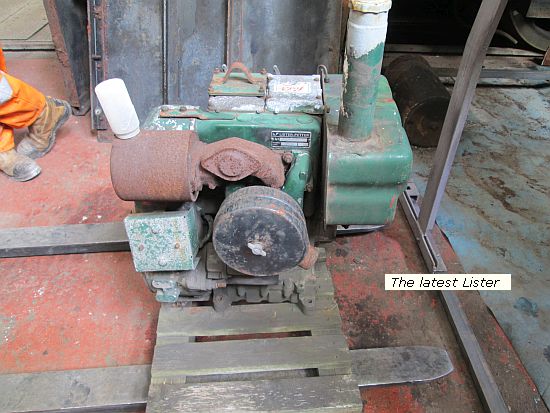
The SR2 may have gone but another LT2 was won on e-bay and on Tuesday I headed over to Doncaster to pick it up. What do we want another for? Well this one is the same as the one we got out of Manchester but has electric start and generator. We've seen a spare flywheel with ring gear for the earlier one on e-bay but whether it has the generator windings too (which appear to be built in) wasn't clear and we haven't gone for it. So this engine might become the prime mover for the Wickham, (but Andrew is putting that project on a bit of a back burner until Adolf is up and running, he says). So as I say I dutifully trundled over to Doncaster and collected this engine from a backyard. Nice guy, runs a groundworks business, and living in a wooden shed (as he called it) while he clears the site at the back and builds a new house there. If there was anything else I saw that interested me, he said, we could talk a price. I looked around at half-dismantled industrial gearboxes, stillages, anvils (I saw at least 4) I was temnpted but not too much. The newly acquired Lister remained in the van until Friday - fortunately I didn't need the van for anything important in between - and as Andrew wasn't around I carefully moved things to get the van around the back and unloaded the Lister with the forklift.
I can't say I was looking forward to dealing with Pluto's brake cylinder. As I said last week, it is mounted immediately behind the front buffer beam, and as there are chassis members above and below, the air inlet pipe is at the 3 o'clock position. On the opposite side of the cylinder - the 9 o'clock if you will - is another threaded port, and a pipe comes from this around to the front left hand side and an innocuous drain tap sits at the end. This is both a good thing and a bad thing. You see, an air brake cylinder is a cul de sac. Air that goes in can normally only escape the way it entered, but at lower pressure and slower. Sure the rigging and cylinder return springs do their very best to get a rapid release, but as the driver's brake valve opens to atmosphere, the pressure drops, and somewhere along the way, a certain amount of condensate gets left behind. Hence the drain pipe on the opposite side. Now, there are several industrial locos I know where, for whatever reason, water builds up in the brake cylinders, and Pluto is one of them. If the cylinder was rotated 90 degrees, with air in at the top and the drain pipe at the bottom, it would be perfect - the condensate would collect in the drain pipe and a quick blow through would eject it all. But those pesky frame members mean it can't, so the condensate builds up in the bottom of the cylinder, mixed with maybe a bit of carried over oil, and does its best to gum up the brake cylinder seal and corrode the bore. We changed it last about 2005-6 while the engine was out. In fact, we had the cylinder off and lightly skimmed to get rid of some rusting, and Pluto hasn't done much since it returned to us in 2015. (Oh, and I said that the drain tap was a good thing and a bad thing? Well think what happens if it leaks or some berk leaves it open. There's no low air protection system on a loco of that age so you know nothing until your first brake application...) We had hoped that the time spent idle had merely deformed the cylinder seal, but we had to go in to find out.
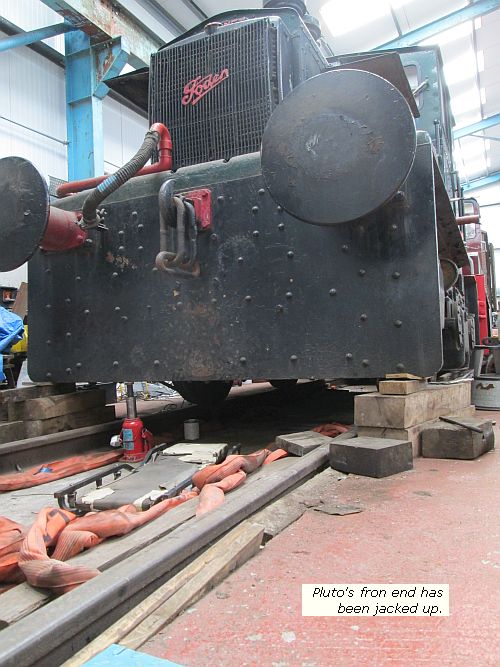
When we first drew up plans for the Geoffrey Briddon building, we considered a pit. It would have meant additional drainage, oil separation and a lot of cost in digging, steel and concrete. And for the number of times we need to work under a loco, it was decided to be a luxury we would do without. If there's a lot of work, we can set the loco up on the Mattersons, but for jobs like this, we can jack it up where it is, or with some locos, simply slide underneath anyway. Pluto is quite low to the ground (I'd even installed a sump drain to make life easier) so I started jacking it up. Shuffling underneath I found it was too dark to work, and here my afternoon came to a productive end as the floodlight was u/s (although the bulb looked OK, leading me to waste time doing continuity checks on the cabling) as was the next worklamp I found. I also realised that when I'd surveyed underneath and sat up, I'd rested my weary back not on the axle, but the chain and sprocket leaving large black greasy marks on my ovvies. I came across a working lamp, set it up in Pluto's bowels and called it a day.
For once, mine and Andrew's priority lists coincided on Saturday. Basically there were 4 things to progress. Charlie's sandbox needed refitting, Pluto's brake cylinder needed sorting, Ludwig's duff piping needed renewing, and Ashdown's gearbox awaited a progressive reassembly. As far as the last-mentioned goes, on Friday morning I had picked up the plate that carries the oil seal after a local engineering firm had cleaned it up and turned the bore oversize by 1/8 inch on diameter (Andrew had sourced a replacement seal for that already). Anyway, Andrew went down to the shed ahead of me, decided I hadn't jacked Pluto high enough, and proceeded to raise it on additional blocks.
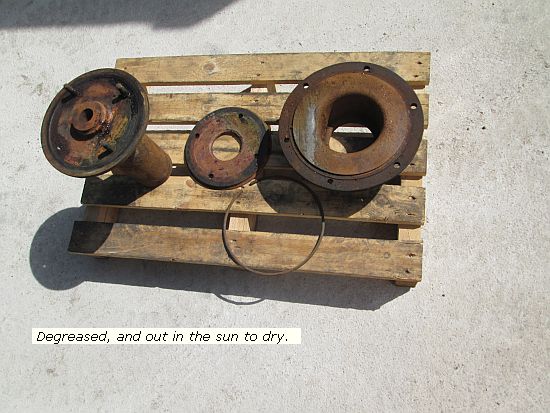
By the time I arrived he had released the piston rod and was about to dismantle the cylinder. As the first bolts were released, water started dripping out and we dreaded how bad it might be inside. In the end about a pint emerged, initially clean, athough there was some oil skinning on top. As Andrew released the parts and passed them out, I degreased them and left them out in the sun to dry.
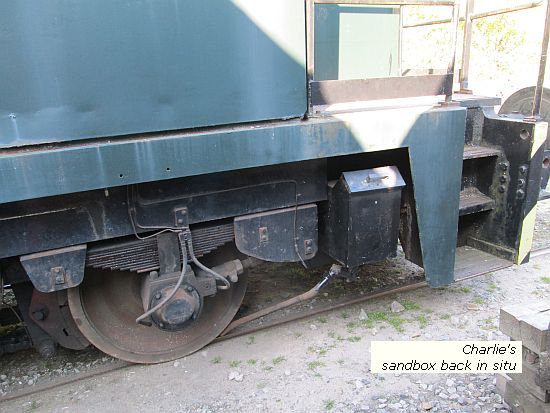
Leaving the subterrainian cavern that is Pluto's underside, we moved on to Charlie. When Charlie came back from filming at Longcross, the riggers managed to damage the rear left sandbox as it was craned on to Allelys wagon, breaking and bending the box's brackets and damaging the delivery pipe. It has been on the 'must get around to' list since then but has found its way to the top at last.
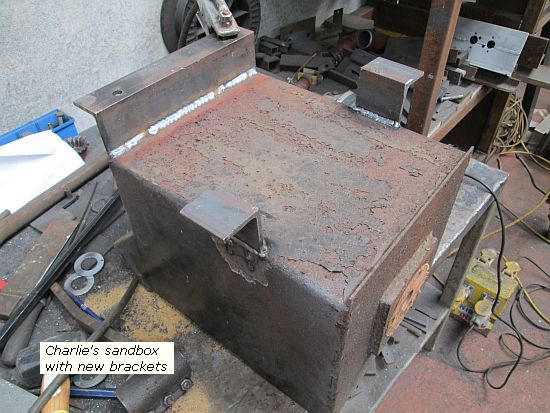
Andrew had already added a top bracket, now he added two smaller side brackets after removing the remains of the old ones, we offered it up to the loco, marked where the other brackets were and drilled holes for the fixing bolts, for which we used capscrews as clearances for ordinary hex bolts and spanners were limited. The sandpipe required straightening and a new end welding on, but by late afternoon, Charlie was whole again.
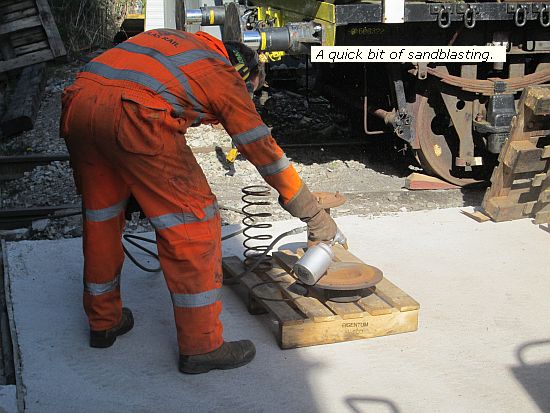
Before departing, Andrew decided Pluto's brake cylinder bits could do with a blasting. Now, yes, in one corner of the shed is a shotblast cabinet about which one of my readers has provided much useful advice yet still awaits us to put that into practice: but Andrew has a sand gun (like a paint spraygun but for awfully thick paint) and proceeded to blast everything.
Sunday, and Andrew declared that it was Ludwig's turn and we shunted it nearer to the shed. GEC had a quaint practice of welding pipes where they pass through the running plates under the cab. This gives the pipes additional support, but erodes some of their wall thickness. When Andrew had first acquired Ludwig, still then at Rocks by Rail, we knew it had an air leak on one pipe, which turned out to be a pinhole just above the running plate, i.e. the weld area. Unfortunately, Ludwig also has low down fast-fill fuel pipes, as on BR locos, and unknown to us, the next thinnest pipe was one of these. It proceded to dump a lot of fuel all over their museum floor! If two had gone, others would not be far behind, so Andrew had decided to replace them all. The loco had arrived with much of the pipework above the left rear axle removed (from an earlier visit of ours), as you needed to extract some to get at others behind. So first task was to start burning the fixed pipes out altogether, an awkward process as some fuel still remained in pipes or dirt, causing volumes of white smoke like a giant vaping out his car window. My task was to stand around with the hose pipe, cooling things adjacent (especially an electrical cable that was in danger of getting singed) and being ready to extinguish any fires. In between times we had found the black Rustoleum paint and Pluto's brake cylinder bits received a protective coat.
Having now got appropriately sized holes through the running plate, Andrew started reassembling the original vac and air pipes, although seeing no likely use for the fast-fill, that is coming off and blanks added at the tees under the fuel tank. That was largely completed by the end of the day, including an inch-and-a-quarter pipe which proceeded across under the cab floor before reducing to half-inch under the control cubicle. Rather than mess around finding a suitable fitting to run the original pipe, Andrew found enough fittings to step it down at the running plate, and I assembled a flex hose to fill the gap.
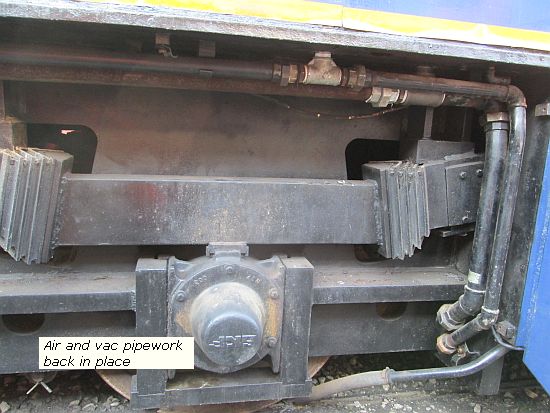
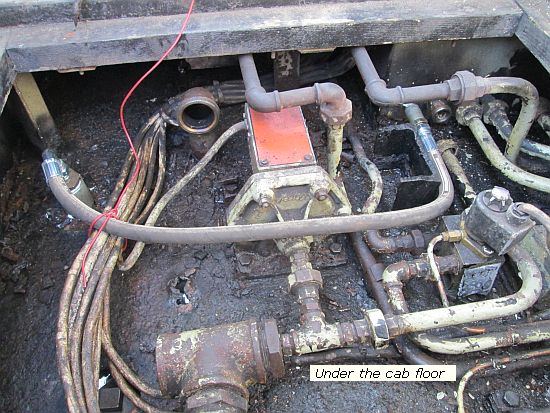
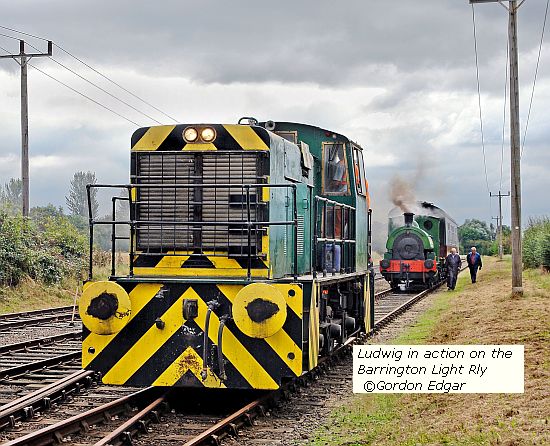
As the vac system is not likely to be required at present, the vac pipework has been capped and left for now. I took the belts off the exhauster and tied them out the way for later re-use. Next task is to refuel it, check the batteries and get it running again. Before I move on though, I can't resist using one of the pictures that Gordon Edgar sent me after his visit, of Ludwig in action back on the Barrington Light Railway during one of their Open Days.
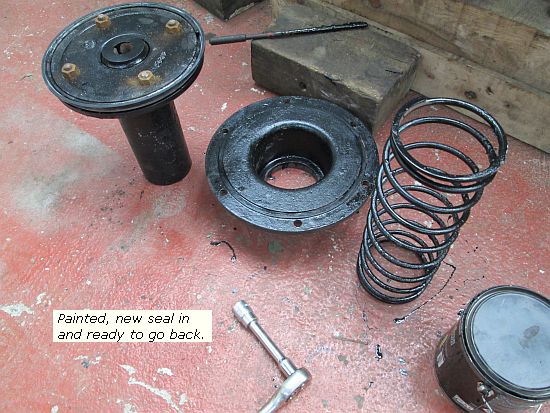
Before shutting up shop this evening I started reassembling Pluto's brake cylinder parts with a new seal, ready to go back in.
The Hatz received attention again today. After a third phone call to Hatz UK a helpful lady actually managed to send me a wiring diagram, although a few items on the drawing (the original is in german) leave me a little confused. The voltage regulator, for example, has 4 terminals, that marked B+ even I understand but another is marked W - could that be warning light? we'd use WL over here - and two others I've no idea over. But despite a couple of hours all I got from it was a momentary squawk, which tends to suggest a high res joint somewhere as everything else seems to bell through to drawing. Maybe I'll crack it tomorrow.
Peak Rail watchers this week were alerted to the resignation of Roger Hallatt from the Peak Rail plc Board. This seemingly took place at a Board meeting on Friday 12th, and was filed very promptly at Companies House on Saturday 13th. All we've heard officially so far is that he resigned for personal reasons: though he did say to us last year that he would only step down if he felt company's finances were unacceptable. It could be something else entirely. Meanwhile the 14 day deadline for a response from the Directors of the Peak Railway Association has been extended by agreement after a firm of solicitors engaged by them, wrote and requested time to consider and reply. This firm brings yet another name into the arena: located in Sheffield it has a US-domiciled Director and was incorporated under a different name some 9 months ago, (though its facebook page says 2019).
And that's about it for this week. We'll be back in the shed tomorrow, with more work on Ashdown, Pluto and Ludwig to see through. And next weekend, well, I'm not sure what's happening, but hopefully it'll be as productive as this one. Care to find out? See ya then.