
Of concrete, coughs and compressors
3rd November 2013
First thing Monday morning Andrew and I zipped down to Darley, arriving on the dot of 07.30 and finding a tractor, trailer and a small 360 degree Kubota excavator sat outside, and Paul on the phone wondering where we were. We got him in on Darley yard and set up, then left him to it.
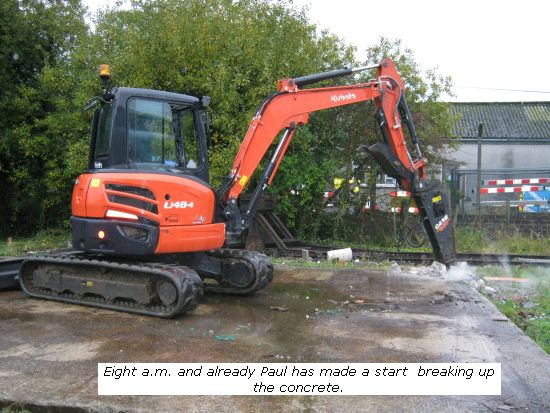
I popped back at various times during the day – by lunchtime all the concrete pad had been broken up and once Neville arrived with a second tractor and trailer, the arisings migrated down the yard and Paul began digging out the first feet of the middle siding. It was surprising, given how long the track has been down and how it looked from above, that once past the first panel (which had a rather reduced number of concrete sleepers), the wooden ones thereafter seemed in quite good state and the ballast astonishingly clean.
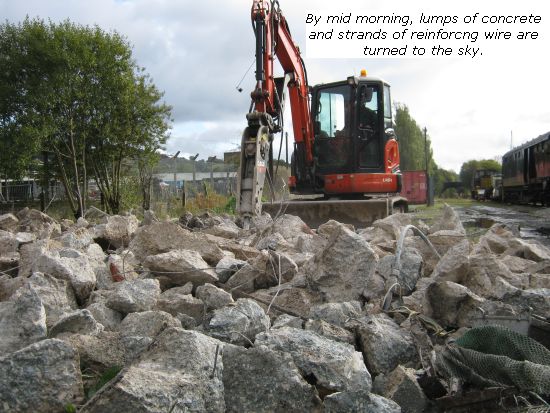
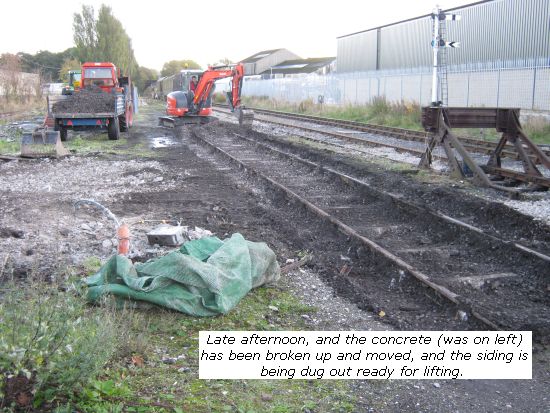
By 5pm and darkness fell, they had completed all I had asked for and set off northwards up the A6 in convoy, much to the annoyance, no doubt, of the evening traffic out of Matlock.
During the week the news came through that Pluto's new windows are ready – I'll probably pick them up later this week – and advice from Peak Rail that they would have the rail crane in to Darley on Tuesday to lift the panels we'd exposed and would I bring Paul and Neville back in to dismantle the back siding and drag a bit more of that lovely ballast out? We need another meeting with the Structural Engineer to discuss how to accommodate the track so as to minimise loss of headroom inside the building – it may mean lowering one of the drains outside and possibly raising the base of the foundations slightly above nominal ground level. Of course, in part this depends on what rail height we use, and how we bed it to the concrete floor inside. To keep the height to a minimum, and spread the weight over the greatest area, crane rail – known in n.g. circles as bridge rail – is ideal, but jointing it to conventional f.b or bullhead is to say the least, difficult. (on the n.g. such transitions were usually made by mounting the bridge and f.b sections on a common sleeper, no fishplates, just spiking it thoroughly!). A nice compromise would be 75lb FB, but that is none too common nowadays.
Our plan had been to do Rowsley Saturday and Scunthorpe Sunday, and the weekend began OK with an early start at Rowsley where Simon, Colin and Terry from the D&EG were up to purchase a few bits off the carcase that is currently D9500. There are not many parts left on the loco now which either we don't want for its resuscitation, or never came with it in the first place, so they headed back with less than they had hoped. Later I gave Simon a guided tour of '901, from our fan control valves in the front through to pneumatic manifolds in the back. Visitors familiar with “normal” 14s are amazed how spacious the cab becomes when you remove the massive electrical cabinet that occupies the front bulkhead, though Andrew insists that we will retain this on D9500 (and of course, had it been present on 901 when it came into our possession, we might well have used it in the same manner).
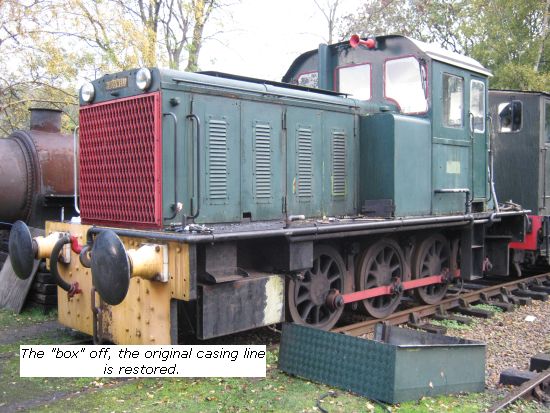
While Andrew had concentrated on the visitors, I made a start on “Ashdown” where the decision had been taken that we would dispense with the 'orrible exhauster drive and 3 belts that would just drive the compressor had been received. It was important that the compressor move in its base if the belts were to be fitted and tensioned. It was apparent though, from the pronounced lip on the base, that someone had been encouraging the base to move with a large hammer, so in the end Andrew and I lifted the compressor off, separated the sliding part from the fixed part, cleaned them both and greased them before reassembling. The old belts were cut through (either that or have to dismantle the fan drive and it brammer belts) and the new belts fitted and set up. I continued disconnecting the box from the original hinge pin points and eventually we toppled it off the loco.
At this point we fired up Cheedale, and brought it and Ashdown across to the works road so that Tom could assist us by lifting off the exhauster and burn off the 'modern art' column it resided on. He did a good job, removing all but a little without nicking the running plate.
Next we got together and lifted the casing top from Cheedale, proving what my old boss at Hills had always told prospective customers, that 4 people can lift off the casing top without mechanical aid and so expose the top of the power units. Mind you, he didn't mention how easy it would have been to trap fingers.
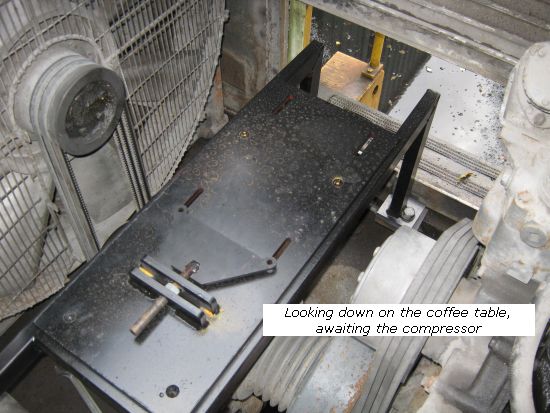
With that to one side, we used the loader to lift the compressor in and drop it on to the coffee table, then replaced the casing top and bolted the compressor down. It requires drive belts delivery hose and some oil but that should not take long to complete.
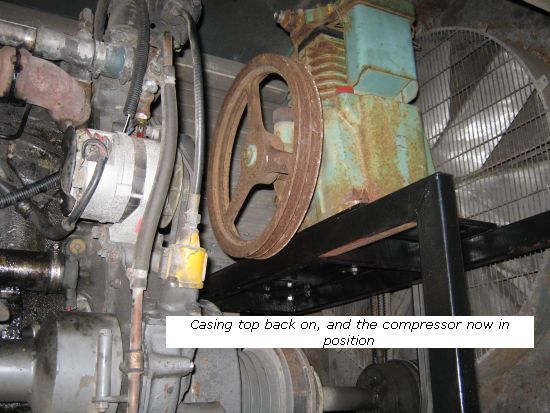
Everything was put back before the Austerity came back on shed and needed the loader for coaling, and we moved over to James and ran it up for a few minutes to give the batteries a bit of exercise.
Finally we returned to Ashdown now with its casing doors back in their original positions, and had a conference about the exhauster. Our revised plan is to drive it hydrostatically, having located the exhauster in the place presently occupied by the batteries, which leaves us the job of mounting and driving a pump at the front of the engine, much smaller and easier than squeezing in the exhauster. But all this is for next year, as we have enough to do at the moment.
All through the day (in fact, for much of the latter half of the week) I had been suffering from a cold or cough or somesuch bug, and by Sunday morning I was feeling much worse and so Scunthorpe got postponed. Andrew instead went back to Rowsley, and spent some time inserting a duplex check valve into the brake cylinder line on the Drewry, preparatory to installing a distributor as the final stage of its vacuum brake installation.